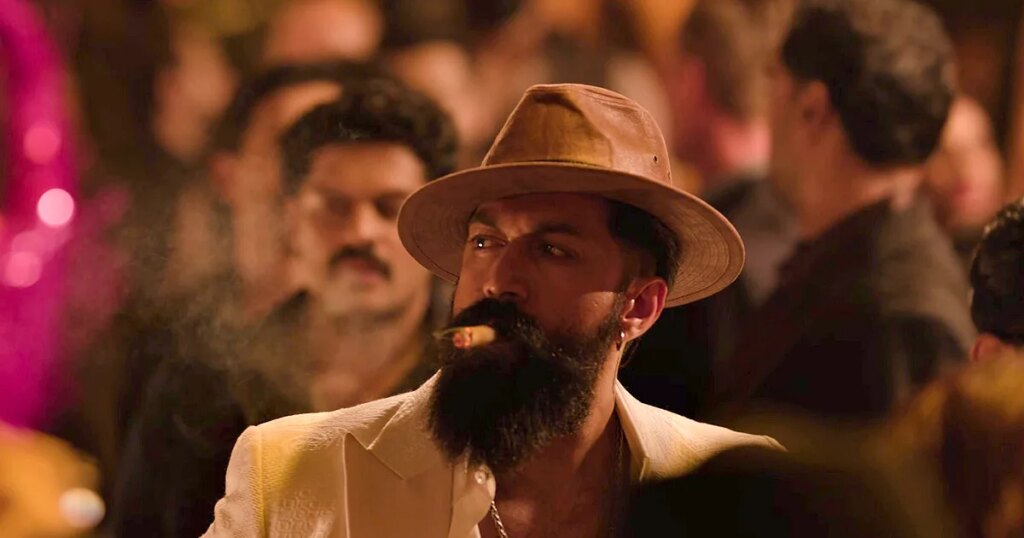

Dismissing Toxic as merely a style-over-substance gangster drama would be missing what makes it unusual, notes Mayur Sanap.

Key Points
- Beneath its guns, swagger and gangster theatrics, Toxic is a portrait of a damaged man.
- Director Geetu Mohandas uses the gangster genre as a smokescreen to explore the troubled mind.
- The film may be too long and occasionally go haywire, but its bold ambition and Yash’s willingness to take a risk make it admirable.
There is something almost mischievous about Toxic. It looks like a gangster film, behaves like a gangster film and, for long stretches, sounds like one too. There are guns, gang wars, blood, casinos, betrayals, and Yash striding through it all with the swagger of a man who knows the camera belongs to him.
But Yash, who has co-written the film with Director Geetu Mohandas, is playing a different game underneath all that noise.
Toxic is not really interested in telling us that Raya is a heroic protagonist. It is far more interested in asking what happens when a damaged man builds an entire personality around being one.
It brought to my mind the title card of Christopher Nolan’s The Odyssey, which opens with the words, ‘Tell me about a complicated man’. The eponymous hero of that film is not presented as a celebrated warrior, but as a man shaped by the choices he cannot escape.
Meet The Complicated Man
Raya is also a complicated man. Except that where Odysseus is defined by his journey home, Raya seems to have spent his entire life running away from one.
That is the real surprise of Toxic.
On the surface, it is a gangster spectacle built for Yash’s post-KGF superstardom. But underneath that familiar mass-cinema sheen is a portrait of a damaged man shaped by a rocky childhood.
Raya is the protagonist. He is not necessarily the hero. And Toxic becomes most interesting when it stops asking us to admire him and starts asking us to understand him.
That is where the film’s title begins to make sense.
Raya is toxic. His relationships are toxic. His idea of masculinity is toxic. Even his ways of dealing with pain are toxic. And the power he acquires does not cure any of it.
At one point, the film makes the word literal when Raya asks a woman if he is a bad person, and she responds by pointing out the obvious.
The real story is the troubled mind underneath.
The Gangster Is A Smokescreen
This is where Toxic reminded me less of a traditional Indian gangster film and more of the troubled protagonists that Hollywood has repeatedly used to examine masculinity.
Think of Travis Buckle in Taxi Driver, whose violence grows from alienation and loneliness, Michael Corleone in The Godfather, whose transformation into a ruthless crime boss gradually consumes the man he once was, or even the fractured masculinity of films such as Fight Club, where violence becomes an excuse for emotional vacuousness.
Toxic does not have the precision of those films. It is, in fact, far louder and flamboyant.
But the ambition is comparable.
Mohandas is trying to turn the gangster genre inside out.
The guns are the smokescreen.
The gangster is the disguise.
The visual language here is loud. The violence is excessive. The characters often feel like over-the-top versions of people rather than actual human beings. There is a fairy-tale quality to the proceedings, which makes sense given the film’s subtitle, ‘A Fairy Tale for Grown-Ups’.
But the fairy tale is not sweet. Because Toxic wants to make a gangster film feel like a nightmare. And nightmares do not always follow neat narrative logic.
That is a difficult experiment to pull off inside a film this commercial.
Sometimes it works. Sometimes it goes completely haywire.
The Experiment Goes Too Far
At three hours and 14 minutes, Toxic is too long. There are stretches where the film seems so determined to explore every corner of Raya’s damaged psyche that it forgets the audience has been sitting there for quite some time. The editing can be deliberately disorienting, but there are moments when experimentation feels less like design and more like a film that has lost its way.
Yet, dismissing Toxic as merely a style-over-substance gangster drama would be missing what makes it unusual.
I liked how Raya is not presented as a conventional mass hero. He has the entrance, the attitude, the violence and the larger-than-life aura that audiences expect from Yash, the star.
Yet the film keeps reminding us that there is very little heroism in this man. His swagger is armour. His aggression is a defence mechanism. His relationships are messy because he himself is messy.
The film unearths this troubled psyche and then covers it with neon lights, guns, drugs, sex, violence and old-school gangster theatrics. And that is where Toxic becomes far more interesting than its gangster surface suggests.
The most fascinating thing about Raya is that Yash does not play him as a man who wants redemption. He plays him as a man who does not quite know how to live without his damage.
That makes him part of a growing tradition of troubled Indian protagonists. Shahid Kapoor in Kabir Singh was an angry man who turned self-destruction into an identity. Allu Arjun in Pushpa was an outsider whose wounded pride became ambition. Ranbir Kapoor’s Ranvijay in Animal was built almost entirely around inherited trauma and an unhealthy obsession with proving himself.
These characters are not necessarily ideal screen heroes. In fact, their appeal often comes from the uncomfortable contradiction between their vulnerability and their violence.
Raya belongs to the same family, but Toxic takes a slightly different route.
Kabir wants possession. Pushpa wants recognition. Vijay wants his father’s approval. Raya seems to want something even more basic: Control over a life that once made him feel powerless.
That is why the gangster world matters.
The guns and casinos are not merely there to create spectacle. They become the language through which Raya expresses himself. He understands violence more easily than intimacy.
The Women of Toxic Shine
The women are another interesting part of the film. This is an unusually strong female ensemble for a film so aggressively centred on a male protagonist.
Kiara Advani’s Nadia carries a sense of dignity and emotional intelligence.
Huma Qureshi’s Elizabeth understands power and knows how to move through a world dominated by men.
Tara Sutaria’s Rebecca has the impulsiveness of someone who has grown up believing she can have whatever she wants, until she discovers the toxicity of that entitlement.
Rukmini Vasanth’s Melissa is strong-headed and alert, someone who enters Raya’s space with her own agenda.
And then there’s Nayanthara, whose Ganga is driven by a fierce instinct to protect her brother Raya.
It’s great that these women are not simply decorative additions to a gangster film. But unfortunately, the film does not always give them enough room to become fully independent characters and their stories still orbit Raya.
Yet, there are moments when the film gets even this aspect right.
The women often seem to understand Raya better than he understands himself. They see the charm, the danger and the childishness underneath the gangster act. They are not fooled by the mythology he has created around himself.
This is also why Kiara Advani’s Nadia becomes important. Her relationship with Raya does not simply function as a romantic subplot. She becomes one of the people capable of looking at him without being completely enamoured or threatened by his presence.
She sees the man who he actually is.
Raya hates that kind of intimacy because intimacy means vulnerability. The film’s most interesting theme, then, is not violence. It is emotional illiteracy.
Raya knows how to survive. He knows how to win. He knows how to unleash violence onto people.
What he does not know is how to love without damaging the person he loves.
That is what makes him toxic. And that is where the film becomes unexpectedly sad.
For all the violence, Toxic is ultimately about a man who cannot escape himself.
Yash Takes A Big Swing
The film’s boldness deserves to be acknowledged even when its execution does not always justify it. But there is a genuine creative risk here, and Yash looks like someone enjoying that risk.
Toxic also benefits from Mohandas refusing to make Raya comfortable for us. She does not package him as a misunderstood sweetheart. She does not offer easy redemption. She lets him be ugly. Sometimes disturbingly so.
Yash’s confidence is evident not just in the action or the dialogue delivery, but in his willingness to look ridiculous, cruel, seductive, vulnerable and frightening within the same character.
The KGF superstar is still there. But Toxic keeps asking what happens when that superstar is willing to take a risk. This is a brave place for a superstar to be.
The film may be too long. It may be too loud. Some of its symbolism is aggressively placed without any subtlety. The film sometimes mistakes excess for depth. But there is something admirable about a film that is this committed to its own strange vision.
That is the experiment.
It does not always work. But I would rather watch a star take this kind of swing and occasionally miss than watch him spend the next 10 years polishing the same hit.