
In 1999, the Pittsburgh Penguins owed Mario Lemieux $32.5 million. Under normal circumstances, that would have been a fairly straightforward obligation. After all, Lemieux wasn’t just any player. He was one of the greatest hockey players of all time, a three-time NHL MVP who had already led Pittsburgh to two Stanley Cup championships and almost single-handedly transformed the fortunes of the franchise.
There was just one very big problem: The Pittsburgh Penguins were bankrupt.
Years of financial mismanagement had left the franchise drowning in debt, and Lemieux, who had spent his entire NHL career in Pittsburgh, was its largest individual creditor. A significant chunk of the money he had earned as a player had been deferred into the future. Now the future had arrived, and the team didn’t have the money.
Mario had every right to fight for every penny he was owed. Instead, he came up with a much more interesting idea. He agreed to trade $20 million of his unpaid compensation for an ownership stake in the bankrupt franchise.
It was an enormous gamble. Twenty-seven years later, we finally know how the gamble ends. The team just sold at a valuation of $1.7 billion.
Ezra Shaw/Getty Images
A $32.5 Million IOU
Mario Lemieux was already a Pittsburgh legend long before he became a businessman. The Penguins selected him with the first overall pick in the 1984 NHL Draft, and he went on to become one of the greatest players in hockey history, winning two Stanley Cups, three Hart Trophies as league MVP and six scoring titles while battling a staggering assortment of health problems, including Hodgkin lymphoma and severe back injuries.
Unfortunately, being a superstar didn’t mean all of his paychecks actually arrived. During his playing career, Lemieux agreed to defer millions of dollars in compensation. By the late 1990s, the Penguins owed him $32.5 million.
Normally, deferred compensation can be a nice financial arrangement. It becomes considerably less nice when the organization that’s supposed to pay you goes bankrupt.
The Penguins filed for Chapter 11 bankruptcy protection in 1998 with enormous debts and an uncertain future. Lemieux was their largest unsecured creditor. He could have simply joined the line of creditors fighting over whatever money was left, but there was no guarantee he would recover anywhere close to $32.5 million. Even worse from Mario’s perspective, bankruptcy could result in the Penguins being sold to an outside buyer and potentially moved out of Pittsburgh.
So he came up with another solution.
Instead Of Taking Cash, Mario Took Equity
Lemieux proposed converting $20 million of the money he was owed into an ownership stake in a reorganized Pittsburgh Penguins. He then assembled a group of investors to acquire the franchise.
Among those investors was billionaire Ron Burkle, who put up $20 million and would become Lemieux’s longtime business partner. The investment group ultimately acquired the Penguins for roughly $107 million.
In exchange for converting his unpaid compensation and putting the rescue plan together, Lemieux emerged with roughly a…
25% Ownership Stake
But that’s not all…
25% Becomes 40%
Over time, Lemieux’s ownership stake increased from 25% to around 40%. Burkle’s stake increased as well.
Meanwhile, the business they owned became dramatically more valuable. The Penguins had lost roughly $16 million in the year before Lemieux’s takeover. In the first year under the new ownership group, they eked out a small profit. Over the following two decades, the franchise was transformed.
The team got a new arena. Its revenue exploded. Pittsburgh became one of the NHL’s marquee franchises. And it didn’t hurt that the hockey team was pretty good.
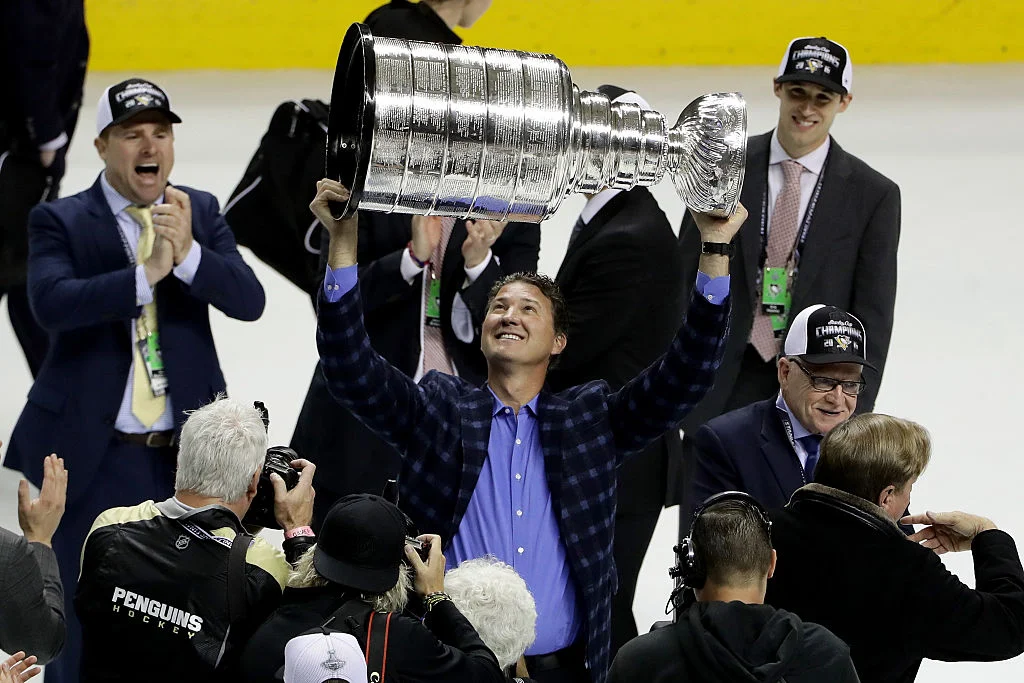
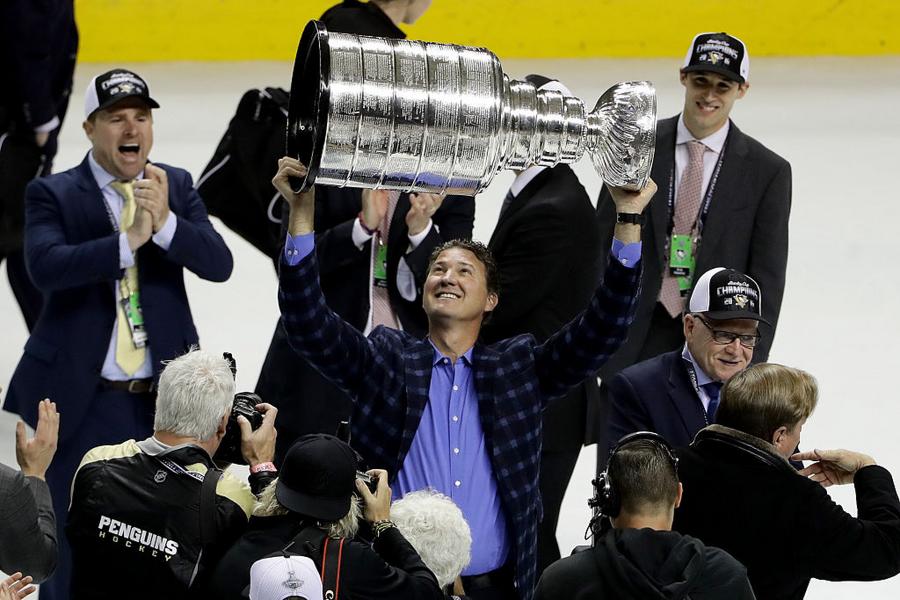
With Sidney Crosby leading a new generation of Penguins stars, Pittsburgh won Stanley Cups in 2009, 2016, and 2017. That gave Lemieux five Stanley Cup championships with the Penguins: two as a player and three as an owner.
Financially, though, the biggest moment was still to come.
The $900 Million Sale
In late 2021, Fenway Sports Group, the ownership conglomerate behind the Boston Red Sox and Liverpool F.C., agreed to acquire controlling interest in the Penguins. The transaction valued the franchise at…
$900 Million
Remember, Lemieux’s ownership group had taken control of the team for roughly $107 million in 1999, and Mario’s stake had reportedly grown to around 40%. At a $900 million valuation, a 40% interest was theoretically worth…
$360 Million
But that’s not all…
The Penguins Nearly Double Again
Fenway Sports Group owned the Penguins for less than five years. During that short period, NHL franchise values continued to explode.
In December 2025, the Hoffmann Family of Companies agreed to acquire controlling interest in Pittsburgh. The NHL approved the transaction in June 2026 at a price of…
$1.75 Billion
That’s nearly double the $900 million valuation FSG paid in 2021 and more than 16 times the roughly $107 million price paid by Lemieux’s investment group in 1999.
At first, it appeared Mario would continue as a minority investor under the new owners. Now we know he didn’t.
According to reporting from the Pittsburgh Post-Gazette, Lemieux and Burkle sold their remaining shares in connection with the Hoffmann transaction. The sale apparently occurred when the transaction closed, but Lemieux’s complete exit only became public yesterday.
His final stake appears to have been small enough that this probably wasn’t another $100 million payday. Even a 1% interest in a $1.75 billion franchise would be worth $17.5 million, and the reporting suggests Lemieux owned only a very small fraction of the team by this point.
The much bigger payday almost certainly happened back in 2021. But the 2026 sale provides the perfect final number for understanding just how spectacular Mario’s original gamble became.
$20 Million To A $1.75 Billion Franchise
In 1999, Mario was owed $32.5 million by a bankrupt hockey team. He converted $20 million of that debt into equity, helping him acquire roughly 25% of a franchise purchased for around $107 million. His stake eventually grew to around 40%.
Twenty-two years later, the Penguins were valued at $900 million, allowing Lemieux to cash out the overwhelming majority of his ownership for what was almost certainly hundreds of millions of dollars. Less than five years after that, the same franchise was sold again for $1.75 billion.
And with that transaction, Mario sold his final shares.
Mario Lemieux could have spent 1999 fighting a bankrupt company for $32.5 million. Instead, he became the owner. That decision saved the Pittsburgh Penguins and ultimately made Mario Lemieux an absolute fortune.