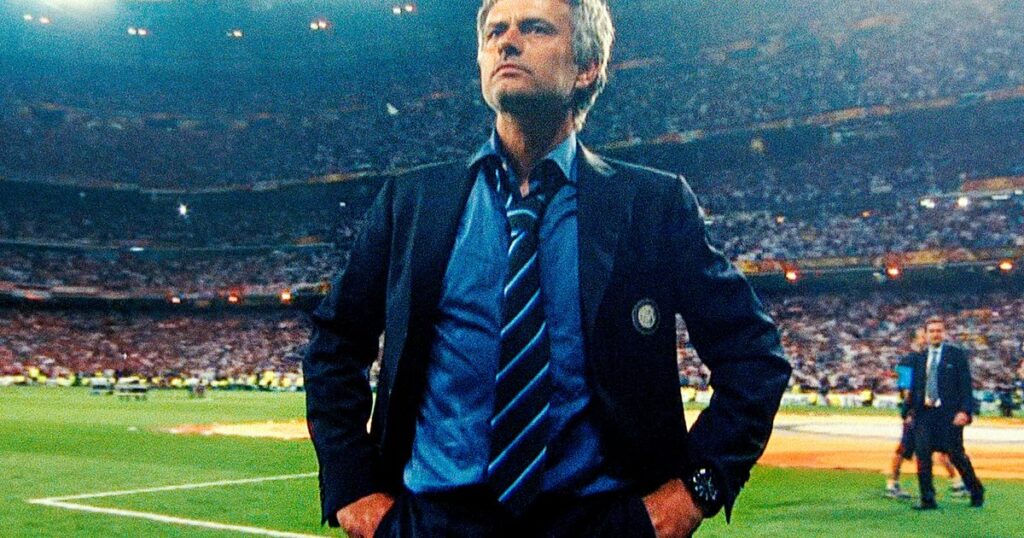

Add Mourinho to your watchlist
For the past two years, I have been making Mourinho, a three-part Netflix series about a man many believe they already know. The provocateur. The serial winner. The master manipulator. The manager who creates extraordinary loyalty, then so often leaves behind conflict. The more time I spent with José Mourinho, who is now in his second stint as manager of Real Madrid, the less interested I became in deciding whether he was a hero or a villain. He is both, often in the same moment. That contradiction is the point.
This was never intended to be a conventional career retrospective. We wanted to explore what happens when winning becomes more than an ambition and turns into an identity. What does it cost to build the Mourinho mythology, and what happens to the man living inside it?
José grasps the power of image better than anyone I have filmed. When he arrived at Chelsea in 2004 and declared himself “a special one” before going on to win two Premier League titles, an FA Cup and two League cups, it was not an accidental soundbite. He knew exactly what he was doing. He recognised that English football was theatre as well as competition, and that the manager could become its central character.
He changed the job. Suddenly the press conference mattered almost as much as the match. He could protect his players, destabilise an opponent and shift the conversation with a sentence. He created a world in which his team felt that everyone else was against them, then made that hostility feel like fuel.

You can still see that influence across the Premier League. Every manager is expected to control the story around his team, absorb pressure and create a public identity. Mourinho saw that before almost anyone else, and did it with a charisma, danger and sense of theatre that have never quite been replicated. That power is exhilarating, but it also comes at a price.
Across the series, we explore the cycle that has followed him throughout his career: arrival, belief, triumph, conflict and departure. The same qualities that allow him to transform a club, can make the relationship impossible to sustain. His intensity never switches off. Neither does his need for loyalty or control. The people who played for him describe something far deeper than admiration.
Frank Lampard, Samuel Eto’o, Zlatan Ibrahimovic and others speak about a manager who made them feel protected, seen and capable of more than they believed possible. Some talk about him with something close to love. That emotional connection is as important to his success as any tactical idea.
There are moments when the armour slips – that tension became the heart of the series
What surprised me most was the human being he works so hard not to show. There are moments when the armour slips and you see the vulnerability beneath the certainty. That tension became the heart of
the series.
José told me, with complete conviction, that nobody makes documentaries about losers. It is a brilliant Mourinho line: funny, provocative and entirely sincere. But our series is not really about whether he won enough trophies. That argument has already been settled. It’s about why winning matters to him so much, what he has sacrificed to keep doing it, and whether someone who has spent his life creating enemies can ever allow himself to be fully known.
The Premier League has returned and football is performing its annual reset. Although Mourinho is not on one of its touchlines (he left Spurs in 2021), his influence on the Premier League is everywhere: in the managers controlling the narrative, in the players being asked to believe the world is against them and in the drama. He may be back in Madrid, but English football is still living in the league José Mourinho helped create.