
It’s changed immensely from its humble origins, now attracting 500,000 visitors

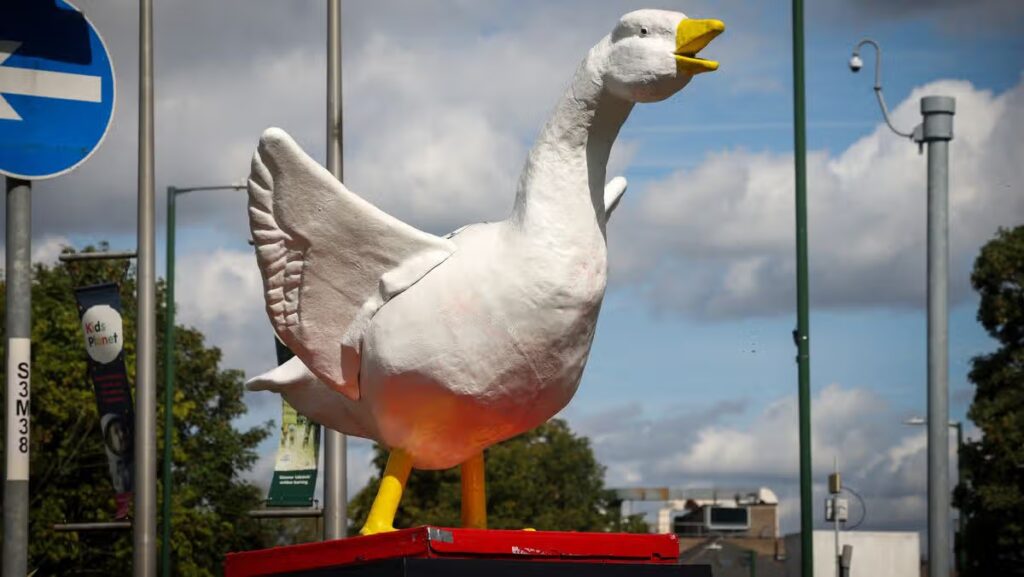
Goosey is brought out once a year to signal it’s time for Goose Fair (Image: Joseph Raynor/ Reach PLC)
Newcomers to Nottingham must wonder why the heck there’s a great white goose positioned on a busy roundabout.
But for locals it’s a sign that one of the city’s biggest annual events, Goose Fair, is just around the corner. Regarded as one of the biggest and best in the UK, the fair will be taking place from September 25 to October 4.
Most travelling fairs are named after the city or town they visit — Hull, Ilkeston, Hereford and St Ives are some of them.
But not Nottingham. The city’s historic fair has a unique name, if you discount Goosey Fair, a much smaller one-day affair in the Devon town Tavistock and Ovingham village’s quaint affair with Morris dancing and music in Northumberland.
Nottingham’s legendary event, famous for its brilliant illuminations, thrilling attractions, and the unmistakable aroma of mushy peas and doughnuts at the Forest Recreation Ground, has transformed considerably from its humble origins.
Originally a simple gathering that might have featured goose trading — a detail clouded in uncertainty owing to limited historical records — the fair’s beginnings remain enigmatic.
It’s commonly stated to be more than 700 years old, starting in 1284 when a royal charter was granted by King Edward I but mentions of ‘Goose Fair’ in historical texts appear less than 500 years ago.
Scott Lomax, the City Archaeologist, said: “It has often been written in the past that Goose Fair was the same fair as that of St Matthew’s Fair, first mentioned in 1284. This is probably the case, but we cannot be certain.”
Despite mediaeval documentation showing the fair’s length, originally eight days, there continues to be a shortage of information about the character of the fair itself.
“It is not certain where the fair was held during the medieval period, though it has been suggested that it was held on Carlton Street. During the medieval period, Carlton Street had a large open space and was known as Swine Green.
“It appears by 1577 part of the fair may have been held in the Old Market Square because in that year some stalls or booths were built on Timber Row for a fair,” Mr Lomax revealed.
Adding to the historical intrigue, the first recorded mention of the name Goose Fair was in 1541, when payments were made for stalls on ‘Gose feyre dey’. Also that year, the fair was mentioned in the accounts of John Truswell, steward of Wollaton Hall, where he purchased a pair of breeches for 1s10d.
The next reference dates to 1583 when John Verie was paid 6d for keeping the meadows on ‘Goose Fayre daye’ implying it was just a single day.
The fair’s original purpose was commercial, primarily centred on trading goods and livestock. Folklore speaks of 20,000 geese, their feet protected with tar for the journey, travelling from the Lincolnshire fens to be sold in time for the Michaelmas feast, though the truth of this tale remains uncertain.
Mr Lomax said: “Goose Fair may derive its name from the sale of geese, though medieval court records show that geese were sold throughout much of the year in Nottingham and could be bought for as little as 2d.
“Whether 20,000 geese were brought all the way from Lincolnshire, as has frequently been suggested in the past, is debatable and there is no documentary evidence to support this.”
As decades passed, the fair increasingly became synonymous with fun and festivities. In the late 19th and early 20th centuries, Bostock and Wombwell’s Menagerie, famously known as the Beast Show, would arrive with exotic animals including elephants, lions, tigers, and even Billy the pelican — creatures scarcely seen in Britain at the time.
The advent of steam-powered rides in the 1900s led to the introduction of attractions such as the big wheel, helter-skelters, and merry-go-rounds at Old Market Square, though it must have posed a challenge for women in long skirts to mount these amusements.
The construction of the Council House necessitated moving the fair from Slab Square, causing public uproar. In spite of protests, in 1928, the council relocated the fair to Forest Recreation Ground, and has remained there ever since.
The Lord Mayor of Nottingham continues to uphold a tradition dating back to 1634, where they read out the proclamation and ring a bell to officially open the Goose Fair.
Even when the fair was cancelled in 2021 due to the Covid-19 pandemic, this symbolic gesture was still performed on the steps of the Council House, while Goosey took centre stage in Old Market Square.
Goose Fair has had its share of cancellations throughout its long history. The fair was ‘wholly cried down’ in 1646 due to the bubonic plague and was cancelled during both of the 20th century’s World Wars.
“We cannot be sure if it was also cancelled in other years, particularly during frequent outbreaks of disease which occurred throughout the late medieval period and into the 17th century. It may have been cancelled on many occasions but the documentary records simply do not survive,” said Mr Lomax.