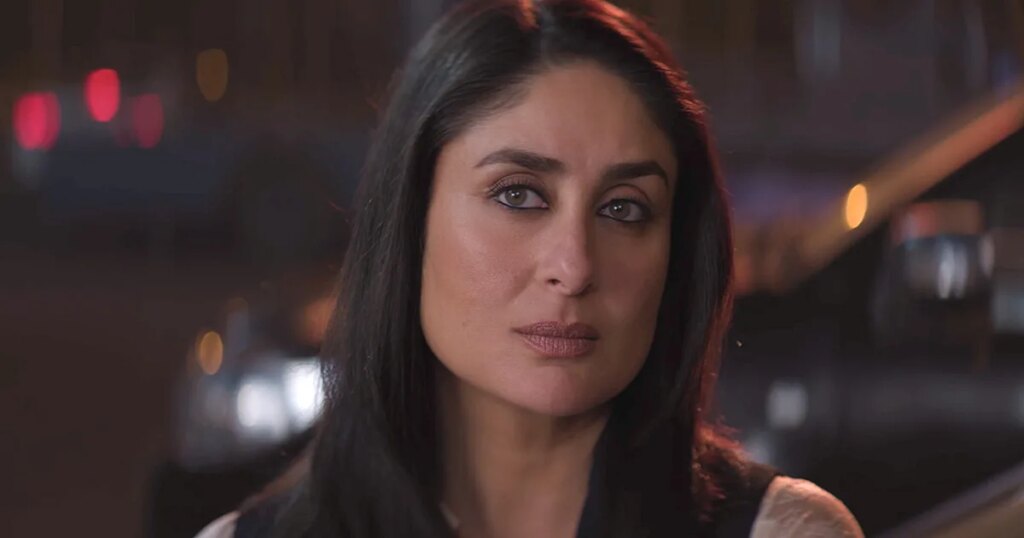

‘What Daayra tries to do is explore the greys because everything is not black and white.’

IMAGE: Kareena Kapoor in Daayra.
Key Points
- Meghna Gulzar’s Daayra explores the complex reactions of police, law and the public to crimes against women.
- The film, starring Kareena Kapoor Khan and Prithviraj Sukumaran, delves into the grey areas of justice, where perceptions of right and wrong can differ.
- Daayra is an amalgamation of multiple real-life cases across India, not based on a single incident, ensuring region-neutral storytelling.
Director Meghna Gulzar says she was first approached to make Daayra in 2020 and while she had already decided to move ahead with Sam Bahadur, she knew the story will always be relevant.
Known for films such as Raazi and Chhapaak, the filmmaker said she wanted to explore the differing reactions within police, law and public when it comes to crime against women.
“Daayra was actually sent my way by Junglee Pictures back in 2020, during the lockdown. It was a story whose intention grabbed me, like, what was it trying to say and why was it so important to say it?
“At that time, I knew that I’m going to be making Sam Bahadur next, which I did. But we also knew, all of us, that even four years later, when I start making Daayra, it’s still going to be relevant, unfortunately,” Meghna told PTI in an interview.
‘Everything Is Not Black And White’

IMAGE: Kareena Kapoor in Daayra.
Written by Meghna, Yash Keswani and Sima Agarwal, the story unfolds in the aftermath of a crime that grips the nation sparking widespread outrage while setting a series of events and two investigations in motion.
As the search for answers deepens, two senior police officers, played by Kareena Kapoor Khan and Prithviraj Sukumaran, navigate the same system through different approaches to duty and justice, on opposing sides of a case that challenges the very idea of right and wrong, reads the official synopsis of the movie.
“What Daayra tries to do is explore the greys because everything is not black and white. What may be justice for you may be injustice for me, it depends on which side of the line we are standing on,” she added.
The film, in that sense, leans closer to the procedural tone of her 2015 investigative drama Talvar, which was loosely based on the 2008 Noida double murder case of a teenage girl and the domestic help.
‘We’ve never ever ‘tadkaoed‘ it’

IMAGE: Prithviraj Sukumaran in Daayra.
Asked what is it about institutions that keeps drawing her as a filmmaker, be it military in Sam Bahadur, criminal justice in Talvar and the intelligence agency in Raazi, the director said it is always the story rather than a particular world or people that draw her in.
“If the emotion in that story hooks me, it’s an instant and completely instinctive choice to tell that story. It just so happens that it involves people in uniform, or it involves being true life, or period. That was never intended. It’s more coincidence than conscious planning,” Meghna said.
It was initially reported that Daayra is inspired from the 2019 Hyderabad rape case, but Meghna said the film is an amalgamation of several real cases from across the country.
“Daayra is not based in a particular city, which is from South India or North India. It’s completely region neutral. The characters are region neutral because this is not the success or the failure of a particular police force of a particular state,” Meghna said.
She, however, admitted that adapting real incidents into fiction isn’t easy and requires a careful balance between cinematic storytelling and a sense of responsibility.
“The cinematic liberty that we have taken is maybe a bit from here, a bit from there. But we’ve never ever ‘tadkaoed‘ (spiced it up) it or fictionalised it to creative liberty extent.
“For example, my criminal’s motivation could be the motivation of criminals from three different cases, and not just one. My public reaction or the reaction of law enforcement could be from two different cases and not just one. But is it fictional? Did I create that reaction? No. That’s the difference.”
Which is why the research and writing for Daayra took around two years, she said.
“A lot of cases that we’ve come across and are still coming across as we keep collecting and we keep reading are gut-wrenching, not just shocking,” the director said.
‘Kareena and Prithviraj are both instinctive’

IMAGE: Prithviraj Sukumaran in Daayra.
The region-neutral nature of the story made it essential to bring together talent from different film industries, and hence Kareena, a top Hindi movie star, and Malayalam star Prithviraj were roped in for Daayra.
The two actors brought their own interpretations to the characters and elevated them beyond what was written in the script.
“They are both spontaneous and instinctive. With Prithviraj, he also looks at… like, he will tell the other actor, you were standing here in the previous shot and your right hand was up because he’s also a director. So, he will remember somebody else’s continuity as well,” Meghna said.
“Kareena will also do that, but it will be more on an emotional level rather than a technical level. But otherwise, they’re both instinctive and definitely not method driven.”
‘Nepotism became a flavour of the month for a while’

IMAGE: Meghna Gulzar with Kareena Kapoor and Prithviraj Sukumaran. Photograph: Kind courtesy Meghna Gulzar/Instagram
Asked whether she has ever dealt with the film’s central concern about boundaries imposed on women, the filmmaker, who is the daughter of veteran writer-poet-lyricist and filmmaker Gulzar and actor Raakhee, said she personally has not experienced “prejudice or differential treatment” because of her gender.
She said she has encountered both advantages and disadvantages tied to her surname.
“Did I face anything different because of what my surname was? The word nepotism became a flavour of the month for a while, (but) it swung both ways.
“People would give you an opportunity to hear you out because of what your surname is. Also drag you down, saying ‘who do you think you are because of what your surname is?’
“So, it’s a double-edged sword. Similarly, I feel that this gender psychology is how much you are aware of it or attuned to it. I tune it out. My world, my film world, my film sets are not coloured by gender, we are all equal,” she said.
Produced by Junglee Pictures and Pen Studios, Daayra will release in cinemas on September 18.
Photographs curated by Satish Bodas/Rediff