
‘I want to make it absolutely clear that I did not say that Rani Padmavati was a coward, or that the other women, the queens of the palace, and the women who did Jauhar were cowards.’

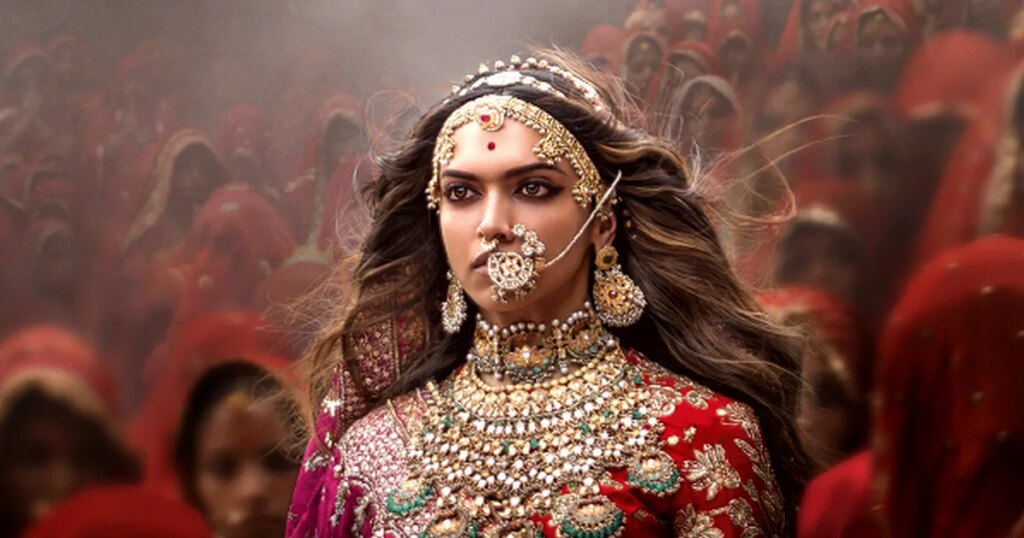
IMAGE: Deepika Padukone in the Jauhar scene in Padmaavat.
Key Points
- Swara Bhasker released a video statement to address social media backlash over her 2018 open letter on the film Padmaavat.
- Bhasker clarified that she never called Rani Padmavati or other women who performed Jauhar ‘cowards’.
- Her actual statement questioned whether films should promote the idea that a woman’s purity is more valuable than her life, especially for rape survivors.
Swara Bhasker recently found herself in the eye of controversy, and had to release a video statement to clarify herself and discuss her 2018 open letter on Sanjay Leela Bhansali’s film Padmaavat.
Denying allegations that she insulted the Jauhar (self-immolation) of Rani Padmavati and other women, Bhasker stated her remarks were mistranslated from English to deliberately spread falsehoods.
The controversy began after a clip from a recent public talk surfaced online, drawing sharp criticism from netizens who accused her of labeling the act of Jauhar by Rani Padmavati and other women as ‘cowardly’.
Clarifying the ‘Coward’ Remark
Swara stated in the video, ‘I want to make it absolutely clear that I did not say that Rani Padmavati was a coward, or that the other women, the queens of the palace, and the women who did Jauhar were cowards.
‘What I had said was that while watching the climax, I thought, God forbid, if I were a rape survivor, I would feel like a coward for not having taken my own life — that if I had survived after being raped, I would feel like a coward.’
On tackling online critics and trolls. she said: ‘Those who want to abuse me, go ahead, but at least abuse me for the right thing.
‘Should we be making films that send the message that a woman’s purity is more valuable than her life? Should we be telling a rape survivor that it would have been better if she had died, and that surviving the assault was a bad thing?’
Context on Rape Culture and Survivor Resilience
‘We live today in a thriving rape culture. Yesterday there was a horrifying gang rape case in Delhi where a small girl child was raped. She was being raped in a car which drove 46 km of distance. This is the reality of India,’ Swara added.
‘So, should we make such films in India where a woman’s chastity is more important than her life? Should we send a message to rape survivor that why are you alive? You should have been dead.
‘Should a woman’s life be over after she is raped? This was my question. One should never forget this that the brave girl Nirbhaya, she fought with her rapists till her last breath. She wanted to live and till the time she lived she fought against those 6 rapists. So don’t expect that the will power of a woman to live and survive is of less importance.’
The Jauhar scene in Padmaavat
Sanjay Leela Bhansali’s Padmaavat told the story of Queen Padmavati (played by Deepika Padukone), who performed Jauhar when Alauddin Khilji (Ranveer Singh) attacked the kingdom of Chittor to capture the beautiful queen.
When the film released in 2018, the Jauhar scene faced sharp criticism, with some viewers feeling it was a part of Indian history while others, like Swara, felt that it conveyed a wrong message.
Many also felt that the film glorified Jauhar.
Photographs curated by Manisha Kotian/Rediff