
Most of the time, when someone brings up “method acting,” it’s uttered with an eye roll and associated with not-so-nice male actors. “The Debut” challenges this assumption: what happens when a woman goes tunnel vision on her midlife mission to discover her new purpose?
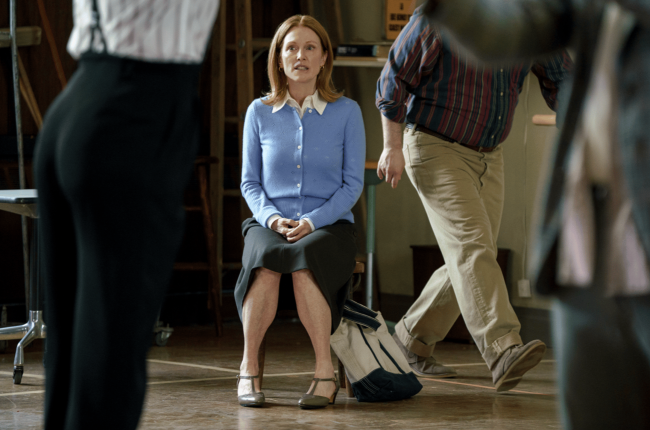
Opening on the ever-so-anxiety-inducing audition day at the local community theater, the camera journeys from the stage to the theater lobby where we first meet Mona Friedman (Julianne Moore) smiling nervously, waiting for her name to be called. She’s surrounded by women half her age, encouraging her with their projected feelings about what she needs to hear before putting herself out there. Immediately, the film forces us to consider the age-old issue of a woman being limited by her years on Earth, as opposed to being well-experienced. Set in the ambiguous past of New Jersey suburbia, there is an undertone of simplicity to the story, yet this small-theater, small-town story molds itself into a semblance of genuine community and belonging that we, particularly Mona, all long for.


The moment Mona meets the production’s director, Jerry (Paul Giamatti), his disdain is palpable. But after their local star Serena Cherry (Bernadette Peters) dropped out last minute, Mona receives the call back to play Miss Danielle, the role she desperately wanted. Arriving promptly to her first day of rehearsal, Mona is nearly love-bombed by the Gen Z cast and crew. The cutthroat nature, imposed mostly by Jerry, at the audition dissipates; everyone, except Jerry, is being genuinely welcoming and encouraging of Mona stepping in. The film’s depiction of the optimistic essence of community theater shines through in a way that feels good to be true.
Steph (Halle Bailey) is the star of Brook Theater’s “Nosy Neighbors,” and never once does she assert her power as the show’s lead. Bailey’s sweet voice lends her character an innocent demeanor. Despite never developing into more than a side character stepping-stone for Mona’s self-esteem, Bailey succeeds in all of her scenes in a way that deems her underutilized.
On a sunny afternoon, Jerry kindly releases the cast from rehearsal for their hard work; everybody except for Mona, he then adds with a groan. This intimidating 1:1 session on the dark, lonesome stage unlocks Mona’s unexplored talents. Soon enough, Mona throws her familial, homekeeping obligations out the window; it’s refreshing to see a woman invoking the mindset of “fuck them kids.” In doing this, director and writer Jesse Eisenberg exercises his understanding of being both the actor and the director. Inserting this duality almost limits his ability to take any one side. Furthermore, there is such an emphasis on fleshing out Jerry and Mona, as individuals and collaborators, that the rest of the characters’ opportunity for development wades in the kiddie pool. While this decision could reflect the potentially selfish nature of method acting, it leaves a lot of relationships unresolved.
“The Debut” presents us with a woman who wants something so badly, but it rarely takes her seriously. Repetitively, each act explicitly tells us that no one cares about Mona, that no one would notice her absence. As she goes further down the rabbit hole to fully embody her character, we witness increasingly dangerous decisions. Moore breathes life into Mona, but manages to intertwine a sense of entitlement that nods to her former life as traditional housewife. Moore’s unflinching and unhinged performance gives glimpses of Cassevetes’ “Opening Night,” a messy woman making the lives or jobs of others tumultuous yet rich.
At times, the writing seems to be trying as hard as Mona. Rather than develop a “prove you wrong” attitude, Mona depends on external validation through the very end. The script relies on the excellence of Moore and Giamatti to give everything the extra umph it needs to assert the affect the film seeks to have. In thinking back to Eisenberg’s well-balanced comedy-drama, “A Real Pain,” “The Debut” stumbles a bit in bouncing back and forth between laughs and something deeper. There is a flatness to some of the comedic moments that are tonally harsh because of the quick connection we feel for Mona; the film is funniest when it’s satirical and subtle. Jokes aside, Eisenberg flexes a new skill in writing several quality and quirky original songs.
Eisenberg’s heavy-handed call for compassion is crucial to our contemporary cultural landscape. He explores the beauty of overthinking; because of this intimate nature Eisenberg has with his stories, his ability to pace the rise, fall, and resolution resembles reality. When it matters most, Jerry’s walls finally breakdown and he admits to Mona that all along, he wishes to be the star too. It comes across as something that is said to boost Mona’s morale, but it’s ultimately freeing for Jerry, too.
On a technical level, Eisenberg’s eye for “The Debut” impresses me most. It can be easy for the frame to remain static when a story is centered around a play, but the camera is consistently in motion. There is ever-changing blocking and choreography that demonstrates an understanding of both medium’s strengths. The film’s score, composed by Emile Mosseri, floats in and out, naturally building a dreamlike state. At times it’s as melodic as a classic Disney movie, adding an element of magic to Mona’s journey.
The locality of “The Debut” reinforces one of its most key themes: creative expression demands community support. Eisenberg bolsters the platform and power of community theaters, and in doing so, he successfully showcases appreciation for the small spaces that birth future stars.
Grade: B
“The Debut” premiered at the 2026 Telluride Film Festival. A24 will release it on Friday, December 11.