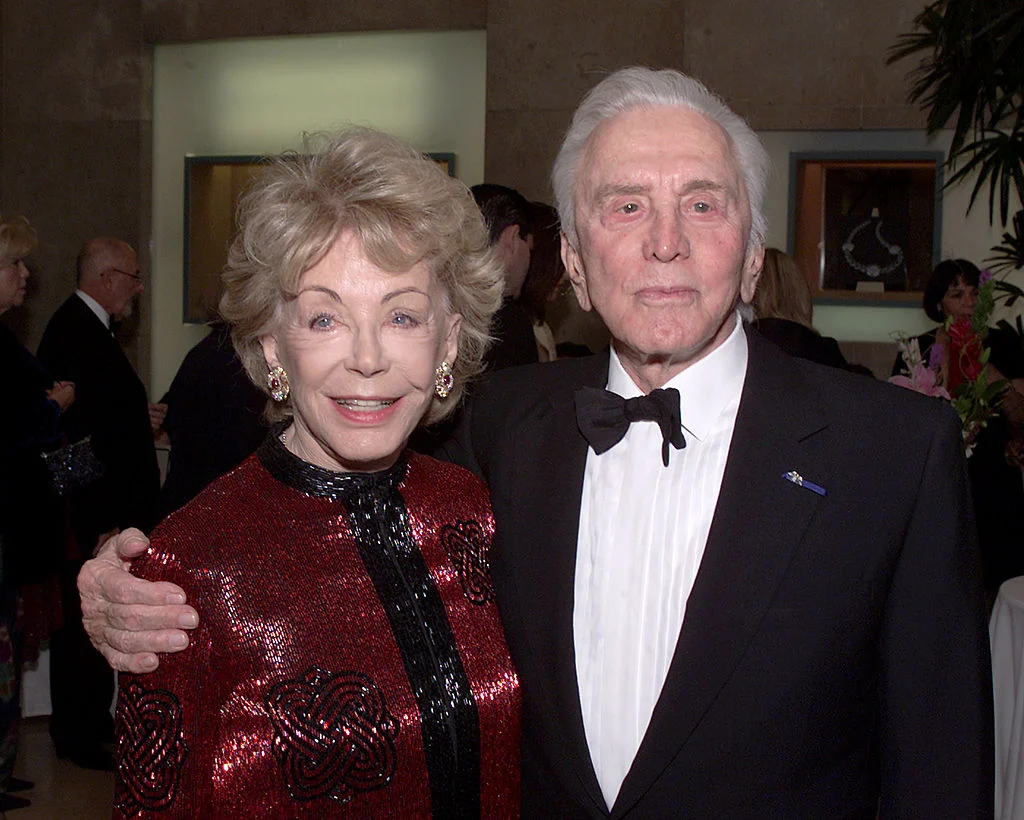

In December 1916, a boy named Issur Danielovitch was born in Amsterdam, New York. His parents were impoverished Russian Jewish immigrants who came from present-day Belarus. The family was extremely poor. The poorest of the poor, as he would later describe in his autobiography:
“My father, who had been a horse trader in Russia, got himself a horse and a small wagon, and became a ragman, buying old rags, pieces of metal, and junk for pennies, nickels, and dimes … Even on Eagle Street, in the poorest section of town, where all the families were struggling, the ragman was on the lowest rung on the ladder. And I was the ragman’s son.”
There were seven children in the family — Issur and six sisters — and money was perpetually tight. At times, there wasn’t enough food.
Issur started working almost as soon as he was old enough to be useful. He delivered newspapers. He sold snacks to mill workers. He worked as a gardener and a janitor. He would later estimate that he held more than 40 different jobs before finally settling into a career.
And yet, despite how little the family had, Issur remembered his mother, Bryna, doing something that never quite made sense to him as a child. If a stranger knocked on the door asking for food, she would give him something. Even when her own family barely had enough. Her philosophy was simple:
“You must take care of other people.”
As he grew older, Issur fell in love with acting. Unfortunately, he had absolutely no chance of affording college.
Undeterred, he walked into the dean’s office at St. Lawrence University, presented a list of his academic accomplishments and extracurricular achievements, and essentially talked his way into an education. The school gave him financial assistance. Issur worked his way through college as a gardener and janitor, competed on the wrestling team, and even wrestled professionally at a carnival one summer to make extra money.
After graduating in 1939, he earned a scholarship to the American Academy of Dramatic Arts in New York. Among his classmates was another aspiring performer named Betty Joan Perske. Betty would later change her name before becoming world famous actress Lauren Bacall.
Issur also eventually decided “Issur Danielovitch” may not have sounded like a Hollywood leading man. He needed an easy-to-remember, strong, short name. He landed on…
Kirk Douglas
Over the next several decades, that name would appear above the titles of “Champion,” “The Bad and the Beautiful,” “Lust for Life,” “Paths of Glory,” “The Vikings,” and “Spartacus.” It would earn three Academy Award nominations for Best Actor and become attached to one of the most recognizable faces in Hollywood history.
It would also earn a fortune.
Unlike most actors of his day, Kirk Douglas didn’t merely collect acting salaries. In 1955, he formed his own production company, Bryna Productions, named after the mother who had taught him that even when you didn’t have much, you still helped people who had less.
The decision gave Kirk something most actors of his era did not have: ownership and participation in the economics of his movies. “The Vikings” and “Spartacus” became particularly lucrative, and over the following decades Kirk accumulated substantial wealth.
Along the way, Kirk’s wife Anne stepped in to handle the family’s bookkeeping and financial management, establishing a trust that she carefully managed and invested over the years.
Kirk kept making movies. Anne kept managing the money.
And amazingly, Kirk didn’t spend much time asking exactly how much money they had accumulated. It’s crazier than that. Later in life, Kirk had no idea how much he and Anne were worth. Kirk’s self-imposed financial ignorance ended in 2012.
One day in 2012, the then-95-year-old asked his wife a simple question:
“How much money do we have in that [trust]?”
Anne gave him the answer:
“$80 million.”
Kirk was stunned.
“What?!”
Then came his response:
“I want to give it away.”
That’s exactly what Kirk and Anne Douglas proceeded to do. But $80 million was just an appetizer…
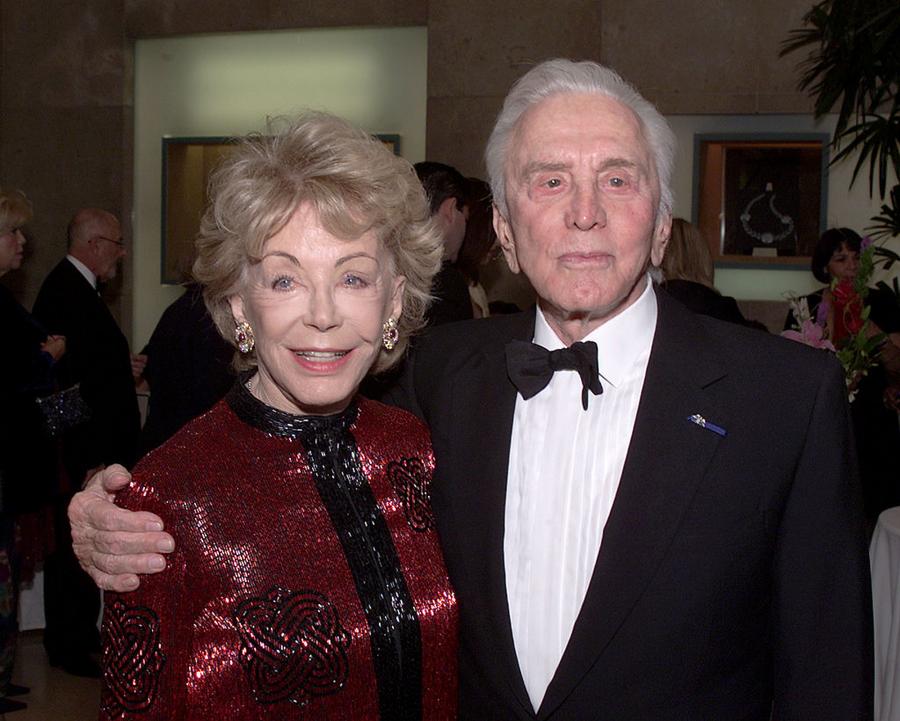
Kirk and Anne Douglas (Photo by Kevin Winter/Getty Images.)
A Near-Death Experience Changed His Priorities
Kirk’s desire to give away the money did not come entirely out of nowhere.
In 1991, Douglas was a passenger in a helicopter that collided with a small airplane near Santa Paula, California. The two people aboard the airplane were killed. Kirk survived, but the accident forced him to confront the uncomfortable question of why he had been spared when two other people had not.
In the years that followed, he became more interested in spirituality, reconnected with the Jewish faith of his childhood, and devoted increasing amounts of time and money to philanthropy.
The Douglas Foundation had actually existed since 1964, but giving became a defining mission for Kirk and Anne later in life. By the time Kirk discovered the $80 million sitting in their trust in 2012, the couple already had decades of philanthropy behind them. Now they were prepared to dramatically accelerate it.
The First $50 Million
In 2012, Kirk and Anne announced plans to commit $50 million to five institutions that had become particularly important to them: the Motion Picture & Television Fund, the Anne Douglas Center for Women, St. Lawrence University, Sinai Temple, and Center Theatre Group.
The largest single beneficiary of Kirk and Anne’s philanthropy was the Motion Picture & Television Fund, an organization that provides healthcare, housing, and support to people who spent their careers working in entertainment.
Their relationship with the MPTF stretched back decades. In the early 1990s, Kirk and Anne helped raise approximately $2 million to establish Harry’s Haven, a residential facility specializing in the care of people with Alzheimer’s disease and other forms of dementia. Kirk named the facility after his father, the ragman whose difficult life had shaped so much of his childhood.
In 2012, Kirk and Anne gave the MPTF another $20 million.
Three years later, they learned that Harry’s Haven was running out of room. Kirk’s response was perfectly in character. He gave them another $15 million.
And he announced the gift on his 99th birthday.
Instead of receiving the biggest present at his own birthday party, Kirk Douglas gave away $15 million to help build the Kirk Douglas Care Pavilion, an expanded facility for people suffering from Alzheimer’s disease and dementia.
Those three major commitments alone total $37 million. The MPTF later said Kirk and Anne’s overall support ultimately exceeded $40 million, making them two of the organization’s largest individual benefactors.
$15 Million For Homeless Women
Anne Douglas was not merely the person who managed Kirk’s money. She developed a formidable philanthropic legacy of her own.
One of her signature projects was the Anne Douglas Center for Women at the Los Angeles Mission. The center assists women experiencing homelessness with shelter, counseling, healthcare, addiction recovery, education, and job training.
The Douglas Foundation ultimately committed $15 million to the center.
The cause resonated deeply with Anne, whose own childhood had included instability, separation, and the upheaval of Europe before and during World War II. After eventually building extraordinary financial security in America, she devoted a substantial amount of her wealth to women who had none.
$9 Million For The College Kirk Couldn’t Afford
Remember St. Lawrence University? The school Kirk had essentially talked his way into attending because he couldn’t afford the tuition? He never forgot what that opportunity had meant.
Kirk and Anne created scholarship programs intended to help disadvantaged and underrepresented students attend St. Lawrence. Their support eventually reached at least $8 million.
Then, in 2025, years after both Kirk and Anne had died, the Douglas Foundation gave another $1 million toward the long-term maintenance of Kirk Douglas Hall. That’s at least $9 million directed back toward the college that once took a chance on the ragman’s son.
408 Playgrounds, An $8 Million Preschool And “Spartacus”
The list of Douglas projects goes well beyond a few enormous institutional donations.
At Sinai Temple in Los Angeles, the Foundation committed $8 million to what became the Douglas Family Early Childhood Center.
Anne also became disturbed by the condition of playgrounds in Los Angeles public schools. The Foundation ultimately contributed more than $1.5 million directly to an improvement program and helped attract additional outside donors.
By the end of the effort, recreational facilities had been improved at more than 408 Los Angeles public schools.
Then there was Children’s Hospital Los Angeles. In 2015, Kirk and Anne gave the hospital $2.3 million to purchase a da Vinci robotic surgical system and train doctors to operate it. The hospital gave the robot a nickname: “Spartacus.”
Perfect.
And the $2.3 million was not the end of the Douglas family’s support for Children’s Hospital Los Angeles. Their Foundation continued making substantial grants to the hospital after their deaths.
Millions For The Theater
Kirk also directed some of his fortune back toward the profession that had made him rich.
He and Anne helped Center Theatre Group transform a deteriorating old movie theater in Culver City into the Kirk Douglas Theatre. Over time, their support grew into a major philanthropic relationship involving millions of dollars for the theater, new theatrical work, and continued operations.
The Douglas Foundation now describes an $18.25 million endowment connected to Center Theatre Group and the Kirk Douglas Theatre.
It is worth thinking about the symmetry for a moment.
A kid who once couldn’t afford college spent decades making movies, accumulated a fortune by gaining more control over the economics of those movies, then used some of that fortune to create a theater where future generations of actors, directors, and writers could develop their own work.
So, How Much Did Kirk And Anne Actually Give Away?
This is where the story becomes even more remarkable.
The Douglas Foundation itself says that since Kirk and Anne created the organization in 1964, it has awarded $118 million.
But that’s not all.
Kirk died on February 5, 2020, at the extraordinary age of 103. Anne died the following year at 102.
Public tax filings show that the Foundation ended 2019 with less than $1 million in net assets. During 2020, it received $15 million in contributions and distributed roughly $10.7 million for charitable purposes.
Then came 2021, the year Anne died. That year, the Foundation reported receiving an astonishing $122.1 million in new contributions.
The publicly available tax filings do not identify the source of the entire $122.1 million contribution, so it would be irresponsible to simply declare that Anne’s estate wrote a $122 million check. But given the timing, what else makes sense?
What we know for certain is that the Foundation was suddenly endowed with enough money to continue Kirk and Anne’s mission for decades. And it has continued writing checks.
It distributed roughly $4 million for charitable purposes in 2022, around $4.4 million in 2023, and approximately $4.7 million in 2024. And at the end of 2024, the Douglas Foundation still controlled $118.3 million.
Putting it all together: In 2012, Kirk Douglas was shocked to discover that he and Anne had accumulated $80 million in a trust. Not only did they give that all away, but a decade later, they had another $120 million to donate! Call it $200 million set aside for charity.
Did Michael Douglas Get Nothing?
Given everything above, it would be easy to assume that Kirk’s family — including his already-wealthy son Michael Douglas — was essentially cut out of the estate. Newly revealed trust documents actually show that wasn’t the case.
Kirk and Anne appear to have made a deliberate distinction between passing down enormous amounts of financial wealth and passing down the possessions that represented their lives. Their children and grandchildren received an impressive collection of artwork, jewelry, awards, memorabilia, and family heirlooms.
Michael received several sculptures along with 19 Marc Chagall lithographs from “The Bible Series.” His wife, Catherine Zeta-Jones, was left a piece called “The Friendship Bench.” Kirk’s son Joel received his father’s honorary Academy Award from 1996, a three-dimensional set of miniatures depicting Kirk and Anne, and several paintings, while his son Peter Douglas received additional artwork. Michael, Joel, and Peter were also each given the opportunity to select up to $100,000 worth of memorabilia.
The grandchildren received some of Kirk’s most meaningful honors. Michael’s son Cameron received Kirk’s Presidential Medal of Freedom, which had been presented to him by President Jimmy Carter in 1981. Other grandchildren received awards and jewelry.
So Kirk and Anne did not leave their family empty-handed. They preserved the irreplaceable pieces of the Douglas family’s history for their descendants while directing much of their financial wealth toward a philanthropic institution designed to keep helping people long after they were gone.
Not bad for the son of a ragman.