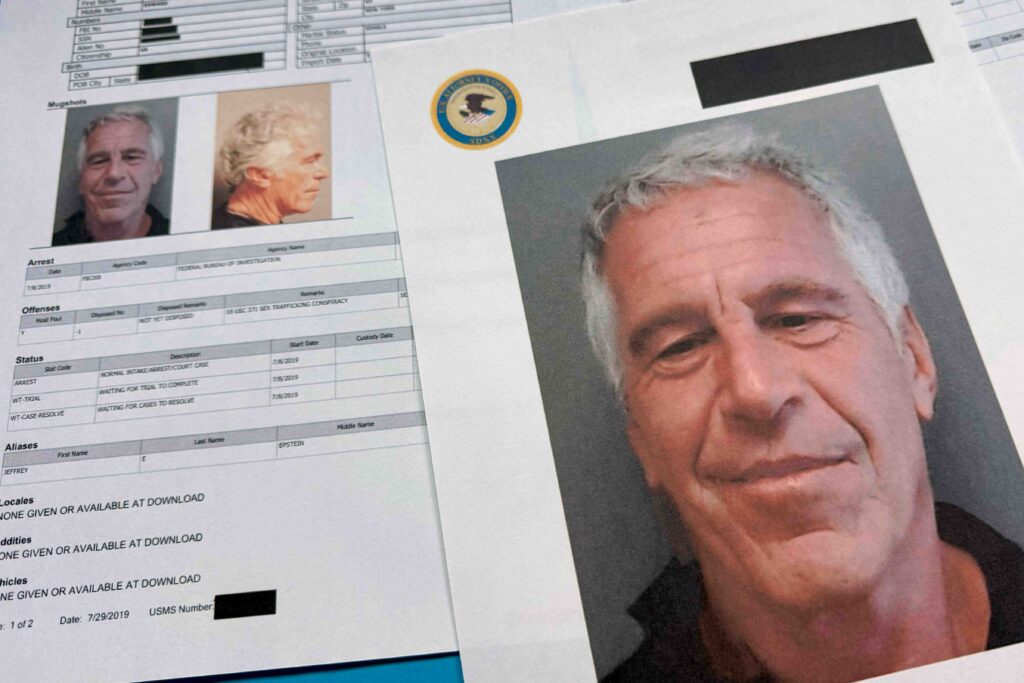

Jeffrey Epstein’s death in federal custody still dominates online conversation six years later. Fresh document releases in 2025 and 2026, plus steady polling, keep the subject trending. Readers want a clear ranking of the theories that refuse to fade.
Generic murder claim leads every poll
Half of Americans in a 2025 Economist/YouGov survey said Epstein was murdered. Change Research found the figure closer to 75 percent. The idea that powerful associates ordered a hit remains the umbrella theory that feeds every variant.
Documented jail failures—sleeping guards, falsified logs, a missing minute of footage—supply the main fuel. Official reviews from the DOJ Inspector General and a 2025 FBI memo found no homicide evidence, yet distrust keeps the numbers high.
The phrase “Epstein didn’t kill himself” crossed party lines and turned into a meme staple. Recent file dumps simply reset the cycle rather than close it.
Clintons top the named-perpetrator list
Epstein’s flights on Bill Clinton’s plane gave this version early traction. Trump retweeted related clips on the day of the death, and right-leaning forums revived older “Clinton Body Count” lore.
Multiple official checks, including the 2023 OIG report and 2025 FBI review, found no link. Snopes collections list the claim as unproven, yet the theory still surfaces whenever new Epstein files appear.
Its staying power comes from partisan branding more than fresh evidence. It serves as the clearest example of how specific names attach themselves to the broader murder narrative.
Faked-death theories ride AI imagery
Claims that Epstein escaped and relocated to Israel spiked again after January 2026 file releases. Viral photos and a Fortnite username rumor spread on X before CBS News traced the images to AI generators.
Autopsy fingerprints and post-mortem photos match Epstein records. A draft DOJ statement dated the day before his death turned out to be a simple typo, according to BBC Verify.
The theory appeals to readers who reject both suicide and murder explanations. It offers narrative escape without naming a killer, which keeps it circulating in meme spaces.
Guards as direct actors or enablers
Two MCC guards were charged with falsifying checks and later resolved their cases. Their cellmate was removed the night before the death, creating another window for speculation.
The 2023 OIG report and a 2026 New York Times investigation found no evidence of an elaborate guard-orchestrated hit. Security logs and staffing patterns made a coordinated inmate or staff killing unlikely.
This angle sits between negligence findings and full conspiracy. It attracts readers who accept foul play but stop short of implicating outside elites.
Intelligence-agency variants stay mid-tier
Theories tying the death to Mossad or other foreign services gained modest traction after Ghislaine Maxwell’s family background resurfaced in 2026 releases. Cross-partisan posts on X amplified the speculation without new documents.
Official reviews have turned up no supporting evidence. The angle functions mainly as a subset of the generic murder claim rather than a standalone driver of polls.
Its persistence reflects broader institutional skepticism more than specific proof. It offers readers another named actor without displacing the Clinton-focused version in popularity.
Document dumps reset the conversation
The January 2026 DOJ release of millions of pages and the July 2025 Axios memo both reaffirmed the suicide ruling. Each cycle still produced fresh social-media spikes rather than closure.
Reporters noted that prior suicide attempts and mental-health notes, detailed in a June 2026 New York Times Magazine investigation, received less attention than the new files.
The pattern shows how volume of material can outweigh content when trust is already low. Future releases are likely to follow the same loop.
Polling stability reveals deeper distrust
YouGov and Washington Post surveys from 2019 through 2025 show murder beliefs holding between 44 and 50 percent. Suicide acceptance rarely exceeds 23 percent in the same samples.
The consistency tracks with wider polling on government credibility rather than case-specific developments. Partisan gaps exist but remain narrower than expected.
Epstein death theories therefore serve as a durable litmus test for institutional skepticism across the electorate.
Meme culture keeps theories visible
The original “Epstein didn’t kill himself” line moved from niche forums to cable-news chyrons within weeks of the 2019 death. Business Insider and Know Your Meme tracked its spread across both political audiences.
Recent file releases simply supply new quote-tweet material. The phrase functions less as an argument and more as a standing disclaimer attached to any Epstein-related post.
Its endurance illustrates how shorthand skepticism can outlast detailed reporting cycles.
Media incentives favor ongoing coverage
Outlets across the spectrum continue to frame each document release as potentially revelatory. The 2026 New York Times investigation that supported suicide intent received less pickup than the conspiracy-framed stories that followed the same files.
Audience metrics reward the conflict angle. Readers already primed by polls encounter coverage that reinforces existing assumptions rather than challenging them.
The result is a self-sustaining loop between public opinion and story selection.
Future releases will test the same fault lines
Additional Epstein material is scheduled for 2027. Early indications suggest the same mix of administrative records and redacted investigative notes that drove prior cycles.
Without new forensic evidence, the ranking of theories is unlikely to shift. The generic murder narrative will probably remain the default frame for online discussion.
Readers tracking the next dump can expect the same pattern: quick social-media spikes, steady poll numbers, and little movement in official conclusions.