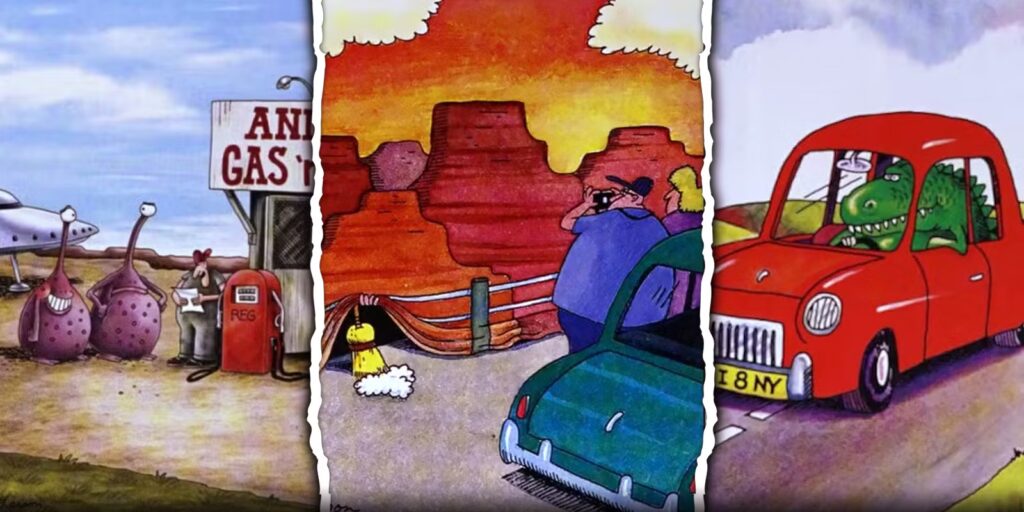

During his work on The Far Side, creator Gary Larson delivered an abundance of humorous comic strips worthy of the attention they continue to garner. His artistic and comedic styling were both unique and revealing of Larson’s incredible intellect. Each era possessed its own unique charm, though some years resonated with readers more than others. Larson was able to hone his craft even more and continue to make The Far Side memorable.
Many issues of The Far Side prove that Larson was, in his own right, a genius. Each year of the series includes a collection of comics that support this idea. Those from 1985 do so through the use of social commentary and presentation of original concepts that inspire as much critical thought as they do laughter.
The Far Side Reveals The Truth Behind Tourist Attractions
Publication Date: June 13, 1985

Larson often employs social commentary in his work. On occasion, the result is a display of genius. In this instance, there is a high level of intellect expressed concerning the understanding of tourism and its functions. Larson’s depiction of fake scenery has humorous and insightful implications for tourist attractions. The strip inspires thoughts regarding the false front many locals put on during the influx of outsiders.
Tourism is a large part of the economy in numerous areas. As such, there is a need to maintain a certain image. A primary inspiration for traveling is the appearance associated with the location. A camper expects pristine grounds, a hiker expects clean trails, and so on. Larson’s Illustration speaks to the importance of an attraction’s upkeep and tourists’ acceptance of a certain amount of illusion.
The Far Side Discusses Common Connections Between Different Cultures
Publication Date: April 6, 1985

The Far Side has many funny strips featuring aliens, but few show Larson’s genius concerning cultural similarities, as well as the aliens seeking directions at an Earth gas station. At first glance, the comic provides a laugh with its situational humor. A closer examination reveals insightful ideas about common events experienced by people worldwide.
Embarrassment and anger are depicted in the aliens’ facial expressions, coupled with other objects in the scene, to tell their story without a need for captions. The purpose of the text is to inspire thoughts concerning the common act of getting lost and all it can entail. Aliens winding up in the wrong solar system is akin to traveling Americans who find themselves in the wrong state. The use of alien creatures and exaggeration provides readers a sound connection to the concept of cultural similarities.
A Far Side Breakdown in Communication Proves Insightful
Publication Date: Sep. 25, 1985

A study of dolphins in The Far Side presents readers with a humorous scenario involving miscommunication. The successful gag-a-day also contains a more enlightened theme that speaks to Larson’s genius. Specifically, the comic poses the idea that communication issues aren’t as complicated as some might believe and could very well boil down to overthinking.
The chalkboard in the background effectively explains to readers that the men have been receiving continued information in support of a single theory. The dolphins’ use of Spanish is suggestive of missing the obvious. In overthinking a problem, simple, obvious facts can easily be missed due to the expectation of complication. Larson’s illustration relates the concept as it connects to breakdowns in communication in a wholly original and insightful manner.
The Far Side Uses Dark Comedy to Enlighten
Publication Date: April 1, 1985

The Far Side is known for its controversial material as much as it is for its humor. An April Fool’s installment of the series is just that, but it also presents a relevant concept regarding new social standards and practices. Larson’s diction speaks to humanity’s loss of empathy. Specifically, the use of a numerical term instead of a reference to a name.
Larson’s word choice in the comic relates to a loss of identity. Referring to an individual using a number instead of a name is a well-known contributing factor to dissociation from society and one’s feelings of individuality. This concept is typically connected to life in prison. Larson’s use of the idea in a hospital shows how it also relates to the current state of American society.
A Problem With American Culture is Revealed in Offensive Far Side Fashion
Publication Date: June 14, 1985

As mentioned, there are many issues of The Far Side that readers have found offensive. One such issue is a misunderstood strip that enlightens the audience to a serious problem in American culture. Common responses to the comic upon initial release indicated that the joke was taken at face value, resulting in a largely offended group of readers. An unfortunate circumstance, as the gag was intended for more than a quick laugh.
Each element of the strip works perfectly with the next to inspire critical thought on an important issue. Larson’s illustration reveals the negative effects of categorization. The body positioning of the family, expressions, and captions all suggest that the American need to categorize individuals can lead to dehumanizing those within certain categories.
A Familiar Monster in The Far Side Embodies Larson’s Comedic Genius
Publication Date: May 15, 1985

Genius comes in many forms, including in the field of comedy. An intentionally familiar-looking monster from The Far Side is a prime example of Larson’s comedic genius as a cartoonist. By combining three simple items, Larson creates an amusing comic strip available to a broad audience. A known reference, a verb, and an unexpected situation function well in crafting comedy. The genius of the gag is found in the formula used by Larson.
Simplicity is the name of the game when it comes to meeting deadlines. A streamlined formula or process to act as a backup plan in times of need is a must. Time waits for no one, so when a cartoonist or similar content creator is pressed, having a simple way of finishing the job effectively is essential. In Larson’s case, the use of a comprehensible reference, action word, and new activity results in a winning formula he can rely on.
A Far Side Chicken Reveals Artistic Genius
Publication Date: Jan. 12, 1985

Larson’s comedic genius isn’t limited to crafting jokes. He is also well-versed in creating visual comedy that requires no explanation. A chicken preparing a cake mix in a beautifully illustrated issue of The Far Side presents a sound piece of supporting evidence. Readers require no explanation for the gag due to the recognizable nature of the scene. Each object has plain, bold text that helps the print stand out clearly.
The suggestive nature of the scene is a bit dark, but hilarious, nonetheless. A primary reason behind the comic’s success is the recognizable objects previously mentioned. Because the situation and ingredients involved are common, readers can grasp the humor at a glance. Most readers will likely enjoy an extended viewing experience thanks to Larson’s visually appealing style.
A Recognizable Far Side Situation Exposes Meaning Behind Awkward Events
Publication Date: July 6, 1985

Readers familiar with the film Zootopia will recognize the situation involved in this Far Side scene from 1985. An awkward scenario develops following the reveal that the mail carrier has mace. The look on the dog’s face implies no malice, making a can of mace unnecessary. The suggestion of broken trust inspires laughter and critical thought about similar moments.
A keyword of importance used by Larson is “significance.” Because readers only need to know that the object on the ground is a can of mace, Larson’s word choice in the captions holds exactly that. The well-worded and lengthy sentence suggests that, because of the broken trust involved in these kinds of situations, they should be considered significant events.
Literal Interpretations Are More Than Just Larson’s Cup of Tea
Publication Date: Sep. 26, 1985

The Far Side is full of literal interpretations intended for comedy. An issue of the series from 1985 that uses this technique also proves revealing of Larson’s comedic genius. While grizzly in its implications, the content of the illustration doesn’t cross lines like other installments would, excluding any material too suggestive or gruesome.
The primary aspect that reveals Larson’s genius is the setup. A typical cartoonist might use the idea in a simpler fashion for a face-value gag-a-day. However, Larson’s choice of words and lengthy text before the punchline provides a brilliant build that results in hilarity. The visual accompaniment is also crucial, as the depictions of stated objects are necessary in holding the reader’s attention for the appropriate amount of time.
The Far Side Gives Readers a Look Into The Consequences of Being Unaware
Publication Date: July 27, 1985

The topic of awareness is as relevant now as it ever was. With an abundance of distractions available, remaining aware of one’s surroundings is becoming increasingly difficult. Back in 1985, The Far Side revealed Larson’s genius when showing humorous consequences to the act of ignoring. With a pouncing cat as the obvious consequence, humanity’s representation by the bird becomes hilarious and insightful.
The world is an active place, no matter the location. Larson’s comic shows that the unexpected could occur at any moment, making situational awareness a crucial part of daily life in terms of survival. The illustration needs no color or text to express its intended message. The recognizable scene tells an important story that remains a lesson of critical importance, while still accomplishing its mission of providing entertainment.

- Writer
-
Gary Larson
- Publisher
-
Universal Press Syndicate
- Artist
-
gary larson