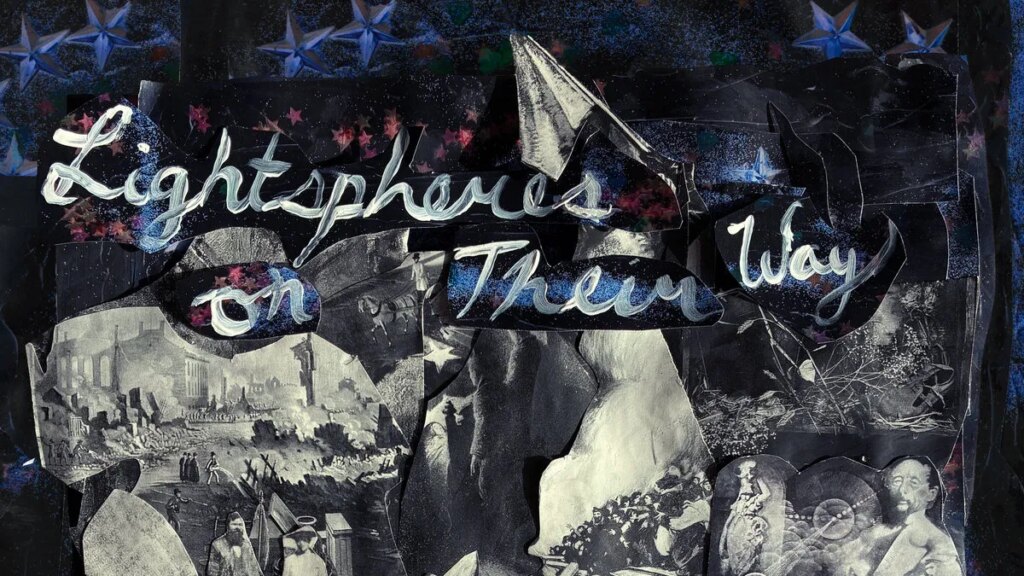

Lily Seabird has a history of finding beauty in sordid places. Her stage name was borne of an insult riffing off her actual last name, Seward: An ex-boyfriend disdainfully said she ought to be called “Lily C-word,” before a friend compared her more favorably to a “seabird.” Her last record, Trash Mountain, was named for a decommissioned dump on which she and other artists shared a beloved home. On her latest, Lightspheres on Their Way, she chooses seemingly unexpected moments to swap out her raspy, twangy voice for a more straightforwardly beautiful tone. Her voice never sounds more crystalline, for example, than when she opens a track by singing—with utter sweetness—about “vomiting in the Whole Foods.”
The twang comes courtesy of her childhood in rural Pennsylvania, where Seabird lived before moving to New York City for college. The expense and the scale of the city overwhelmed her, so she dropped out; she fared better in the bucolic landscapes of Burlington, Vt., where she crashed with a friend for a weekend and decided she never wanted to leave. She’s lived there now for the better part of a decade, part of a burgeoning indie-rock scene that also includes Greg Freeman and Robber Robber.
No score yet, be the first to add.
Seabird has a particularly close musical relationship with Freeman; they were early cheerleaders for each other’s work and have since played on each other’s records. Like him, she mines the DNA of rootsy forebears to make empathetic, rambling rock songs; there’s a little Gillian Welch, a little Adrianne Lenker in her languid, forlorn voice; some Crazy Horse in her latest album’s thrashier breakdowns; something vaguely Springsteenian in her rugged resolve. On Lightspheres, she refines her singular perspective as a songwriter, one continually willing to seek out glimmers of redemption among detritus.
Loss and grief have long been embedded in Seabird’s music, including many songs written in the aftermath of a friend’s suicide. She continues to mine these themes on Lightspheres, pondering “the great divide of the living and those who chose not to,” singing of a spirit that “haunts these halls like a ghost of the undead.” Nearly all the album’s songs are beset by existential questions: “What choice is there if there’s nothing left to lose?”; “How’d we get so far from where we started?”; “Will I regret every choice I ever made?” There’s an ease in the way she lets her lines tumble into each other—deceptively conversational but gutting upon closer inspection, the weight of her words underscored by lap steel, harmonium, and cello.
Often, Seabird presents music itself as a transcendent force, an answer to some of her most pressing queries. On “Slipswitch,” she’s at a show, considering “quitting and going home,” until someone tells her: “You’re staying here and it’s gonna be fun.” And so she does, and it is; from the stage, she sings, the crowd “looked just like angels.” Elsewhere, the transcendence comes through when she finds meaning beyond words: in the relationship between her fingerpicked guitar and Eliza Niemi’s mournful cello on “Pennsy”; in the way the band rises to match her vocal inflections on “Portal to the Past”; in the anguished, wordless refrain of “Election Day”; in several tracks’ long, meandering outros that seem to work through her quandaries—repeating them, turning them over, seeing them from new angles. Maybe it’s my bias as a New Englander, but I think you can hear Seabird’s natural affinity for the region in the songs’ moody sprawl. “Blackstar” ends with nearly two minutes of repeated, downcast guitar riffs and muted percussion, which briefly perk up only to immediately slump; it captures something of the experience of driving through a northeast winter sunset, realizing total darkness is upon you and it’s hardly past 4 p.m.