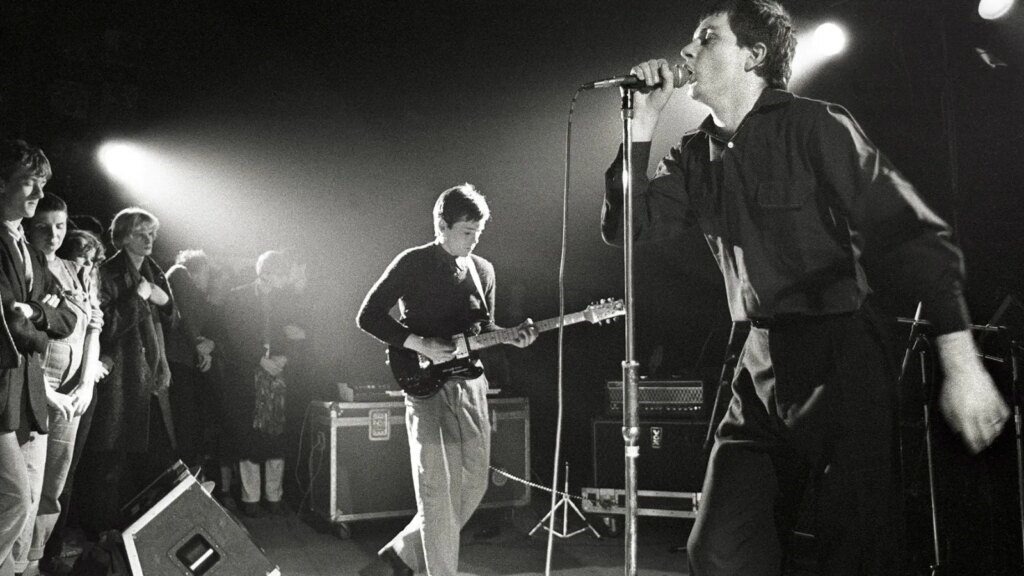

A little over a year after Joy Division frontman Ian Curtis committed suicide, the remaining members of the band — who were already touring and recording under the name New Order — released the compilation album Still. It’s a collection of studio outtakes and live performances, including Joy Division’s final concert.
“We felt that was everything,” Joy Division/New Order drummer Stephen Morris says today, sitting in the office of his home in Rainow, England. “We were tying up all the loose ends. ‘Thank you, there won’t be anymore.’ We were naive because that never really happens, does it? There’s always something lurking somewhere.”
There was indeed. And in the decades that followed, even though New Order took up much of their time, they still released several Joy Division compilation albums, concert recordings, their BBC Recordings, the John Peel Sessions, and deluxe editions of 1979’s Unknown Pleasures and 1980’s Closer.
But this wasn’t nearly enough for Joy Division’s rabid fanbase, and there’s been a thriving black market for bootleg concert recordings for decades, even though the sound quality of most of the tapes varies from half-decent to borderline inaudible.
That’s changing on Sept. 25 with the release of the 14-disc box set Eternal (Live). It’s an assemblage of 16 Joy Division concerts, including two that have never been heard anywhere, all of which have received significant sonic upgrades. There are also two DVDs that contain two hours and 30 minutes of concert footage, along with a new edit of the 1982 movie Joy Division – A Malcolm Whitehead Film.
To be clear, many of these live recordings are sourced from fans who snuck cassette recorders into concert halls. Much of the footage is also quite rudimentary. And even though the original cassettes were tracked down and engineers at Abbey Road Studios extracted every bit of possible data, there are limits to what they could have achieved considering the source material.
Still, this is a dream project for hardcore Joy Division fans. To learn all about it, we chatted with Stephen Morris. The conversation also touched on Joy Division/New Order’s upcoming induction into the Rock & Roll Hall of Fame, the “personal health matters” that are keeping him and his wife, New Order keyboardist Gillian Gilbert, off the band’s upcoming South American tour, and the war with former New Order bassist Peter Hook that’s been raging for well over a decade.
You still live near Macclesfield?
Yes. I’ve never moved, really. I’ve stayed here all my life. It’s easy because I know where the shops are.
Let’s get into this new live box set. Joy Division bootlegs have been a cottage industry since the 1980s. How did you feel about that?
I like bootlegs. I collect them. I can see the point of them. And I think early on, people must have liked us because they were going to the trouble of bootlegging us. We were very naive though. As you said, it was a cottage industry.
They were making money off your work and not giving you a dime.
Yeah, I did say I was naive. It’s a double-edged sword. Half of them you can say, “Oh, it’s great. People are taking the time to make these bootlegs. That’s lovely.” And then eventually you think, “Hang on, we make absolutely zero money from this.”
You began putting out your own live shows eventually. The Paris show you released in 2001 sounded incredible.
Les Bains Douches. Sonically, it’s really good. I could go on and on because I’ve been working on this [box set] for years, and it’s finally coming September. What will I do with my life afterwards?
Tell me the backstory of Eternal. Fans have wanted all the shows in one place for years. How long ago did you start actually making this happen?
There have been so many bootlegs. And if you go and do this thing, it’s kind of, “We’ll get the best of the best ones and we’ll do a definitive thing.” And you would think, considering it’s all out there, that would be quite an easy thing to do, but it turned out it wasn’t.
You don’t realize that bootleggers have it easy. They’re free to break the law, and it seems that nobody does anything about it, and it’s great. I’d love to be an outlaw. But when you do it yourself, the record company is quite conscious of being litigated against. So we have to do everything by the book.
For instance, the Paris show, which Tony [Wilson] put out first. It was like, “Yeah, okay. Yeah, it’s fine. We’ll license it. Yes, you can license it. We want a lot of money. And then you can …” “No, no, no. That’s too much money.”
You bargain. You get to the end. We’ve reached an agreement. “Okay, let us have the tape.” “Tape? We’ve not got a tape. We thought you had the tape.” “No, we’ve not got the tape. Why do you think we’re trying to give you money for it?”
And so you get the tape because it was a radio broadcast. I think it was broadcast two or three times. A lot of it had the DJ talking over the top of it, which was funny, I suppose, but not really what you want. To have someone talking over the top of it, it would’ve been unusual, but I think it marred the experience somewhat so that we had to do a number on that to find different versions, find the better version, get the DJ off, edit it all together. So it ends up being a bit of a compromise because of that.
Many of the other tapes on here were sourced from fans who snuck recorders into shows. How did you get the master tapes and clean them up? I’m sure that wasn’t easy.
No, because then you discover the people who do these, they’re quite…fanatical? I don’t know if that’s right. They’re very enthusiastic about it. And some of these tapes are very closely guarded. They’re very precious to them. And there probably is only one original tape, but people have gone home and tinkered with them and said, “My tape, a cassette that I’ve done sounds better than the original. I’ve done a boost roundabout 4K that makes all the difference. Ian comes alive.”
And it’s like, “Well, look, all we want is that earliest generation one, it might not sound as good as your one, but then we’ll be able to do a number on it and make it sound better. If you’ve already done it, then we are kind of stuck with what you’ve done.”
But yeah, the fans are great. They’re very passionate, that’s the word, not fanatical. They’re very passionate about it. And by and large, they were good, willing to help.
So they passed along the master cassettes?
That’s right. Also, we used to record Joy Division gigs on a reel-to-reel. And a lot of cassettes were based on these reel-to-reel originals because they mysteriously disappeared, as these things do. We did find first generation copies in [Joy Division] Rob Gretton’s archive, and we used some of those, the ones that weren’t stolen.
You even give credit to the audience tapers by name, like Jonathan Crabb and Duncan Haysom. You don’t usually see that on official releases.
That’s only fair really, because we wouldn’t have been able to do this without their cooperation. You got to acknowledge it, really.
So you take these tapes to Abbey Road and use basically the best equipment to clean them up?
It seems ridiculous, doesn’t it? I mean, I think there was one, I can’t remember, it might have been the Hope and Anchor one, which was exceedingly precious. He wouldn’t give us the tape. He had to go to Abbey Road to supervise the cassette being transferred, but that’s okay. Takes all sorts.
Cassettes from 45 years ago can be pretty fragile. You can play it once and watch it turn to dust.
Tell me about it. I’ve got a box full of tapes. I’m not very good at labeling tapes. The great thing about these bootleggers, they’re quite meticulous about keeping notes, which is what you want. Me, not so much. And so I got this bunch of unlabeled cassettes and I’m going through them. I found one and it just said “rehearsal.” I placed it in the cassette player, and went, “Oh my God. This is Joy Division in 1976. This is great…” Then..snap.
No!
I had to relearn how to edit.
Were you able to save it?
Yeah. It didn’t dissolve. It only snapped. I used to be able to edit tapes, but it was an art I’d lost. But I did it and sorted it out and maybe we’ll use that on something else.
This box starts in March of 1979, but there are recordings of Joy Division in 1977, when you were still called Warsaw. Did you not want to go back that far?
Right. There are recordings. I mean, the first thing that somebody said, “Oh, well, you should use the Live at the Electric Circus,” which was Warsaw. We said, “Okay, fine. Where is it?” We were going to have to make a copy of the bloody [bootleg] record, but do that … It didn’t feel right, really. And also, it was only one song, I believe. I mean, I used to have it. That’s why I was going through the box of cassettes. I used to have a cassette of two songs. I think it had “Novelty” as well on the recording for Live at the Electric Circus, but I couldn’t find it.
And it was really okay, “If we’re going to have one criteria, it should be the whole gig.” And if you can’t even do that, then just sticking the one song on…
It’s interesting that there’s assorted bits of 1977 live material, but then really nothing from 1978. It’s sort of this lost year.
Yeah. I mean, there must be stuff somewhere. I mean, I’m sure there is, but if it’s not out there, there’s probably a good reason for it.
The set starts with Hope and Anchor on March 1, 1979. That’s a fascinating moment in time since it’s right before you recorded Unknown Pleasures. It’s basically how Martin Hannett heard the band before he produced the record?
Yeah, that’s right. That’s actually what we sounded like and how we thought the record was going to sound. [Laughs]
I know you’ve gone over this a lot, but tell me how you felt about the sound of the record back then, and how you feel now?
How did it feel then? Well, you see, I’m biased because I was Martin’s victim in this thing. I spent an awful lot of time doing those drums. I mean, the thing is, it’s like the first time you hear your voice on a tape recorder, you go, “That’s not me. I don’t sound anything like that.” Yeah, your reaction is one of disgust.
I think people thought they were going to sound like the Stooges, which was never ever going to happen with Martin. We knew that wasn’t going to happen. But, yeah, there was a bit of shock, but you couldn’t do it again. There was no money. That was it. It’s too late. We were doing it on [poet and performance artist] John Cooper Clarke’s clock. It was his downtime we were doing it on. It’s great to say, “Now I want him to do it again. It was so terrible.” No, it was just different.
And it was the difference that made it a great record. The unusual thing, which I should just point out, is I’ve been doing some Atmos stuff with Steven Wilson. We’ve done Unknown Pleasures, which is finished, and I’m not entirely sure what we’re going to do with it at all, but it was absolutely fascinating to go back to the original multi-tracks. It sounds like another band.
Listening to the shows on the box in sequential order, it’s fascinating to hear how the four of you evolved as a band. You got tighter and tighter.
Yes, that’s what I thought as well. It’s great how it kind of starts off like that. There’s a point where we’re almost professional and then the equipment lets us down.
The Factory show from July 13, 1979, was also previously unheard. Where did that one come from?
That was one of the ones that we recorded on reel-to-reel that was in Rob’s attic. That’s how he found that one. He had two tapes, and that one had never been out before.
Tell me about the process of cleaning up the sound at Abbey Road. What technology were you using?
Expensive technology. [Laughs] I mean, there’s only so much you can do, really. You can only do your best with what you’ve got. And there’s a very fine line because sometimes you can push it too far and end up with something that actually … Although it might be technically better, it actually doesn’t sound any better. I mean, the worst thing of all was the Plan K gig that’s on the DVD. I mean, we’ve had that for years and people went, “Why have they not put it out? Why has it remained under wraps? Why are they hiding it?” Because it sounds like a washing machine.
That’s pretty unfortunate.
It was recorded just on a VHS camcorder. Wasn’t even a camcorder, but a video microphone which compressed it. And God knows, we’ve tried everything. I think we even recruited an AI at one point, which refused it.
Peter Jackson developed that stem separation technology for the Beatles’ Get Back project. Did you try anything like that?
Yeah. We separated out six tracks from the Plan K show. We just got six tracks of washing machine.
Did you use stem separation technology on the cleaner audience tapes?
There was no stem separation used on it. We did try. Actually, I think there were a couple where we’ve done some of these as matrixes, which is like the equivalent of stem separation where they mix together an audience tape and a desk tape, and that was one technique that got used.
The holy grail for so many Joy Division fans is the full “Ceremony” from the Birmingham show. This is the first time it’s been heard from beginning to end.
That’s right. It was a shock the first time I heard it as well, because I’d just been listening to just bits of it when I finally heard it all together. I was like, “Is this another gig that someone has stuck on?” But yeah, it’s all there, although there’s a certain difference in quality. I mean, it was always a disaster because the microphone wasn’t on really. I mean, that’s the thing. If there’s nothing actually on any tape, you can’t improve it. But we did what we could.
How did you guys even get the lyrics right when you redid it in New Order if every version is so muffled?
Because we’d rehearsed it and recorded the rehearsals. Although Ian did change the lyrics as he went on. That was one of the most painful things we had to do after Ian went was to sit down and write the words. Yeah, that was painful.
The books and documentaries always talk about how Ian’s seizures were getting really bad near the end. I can’t imagine the stress of playing a show when you didn’t know if your singer was going to be able to get through it.
We never really thought like that because Ian would always say, “I’m all right. I’m fine. I’m fine. It’s okay. It’s okay.” Even though you’d look at him and think, “Well, maybe you’re not feeling too good?” So no, he wouldn’t … I think he was frightened of letting you down or something. But yeah, it was pretty awful sometimes.
I’m sure you’ve thought about what could have happened if he had lived. Are you able to imagine how the ’80s and beyond might have unfolded?
Yeah, I’ve got several timelines of that. My favorite one that comes closest to a happy ending is that he gave up, because he was very literate, he was great at writing his lyrics in particular and poetry, he was into poetry and all that. I like to think he might have left music and taken up some sort of literary career as an author or something like that, which is a far less taxing career than being the singer in a band. I think that way we could have all had reasonably happy lives.
For so many fans, his death and the circumstances behind it cast an enormous shadow over all of the work and the entire saga. There’s this impression it was just an incredibly morose time for everyone. I’m sure that’s not how it felt as you were living it.
No, completely the opposite. People’s idea of Joy Division is from a series of black and white photographs, which give you a very skimpy impression of somebody. But you could be forgiven for looking at those photographs and thinking he was some kind of terminal depressive, but it wasn’t really. Ian was just a normal person who liked normal things, and most of the time he smiled and laughed and joked.
The one that always makes me laugh nowadays is particularly young people seem to think that Joy Division in the late ’70s was some kind of massive band that played stadiums. We actually played every night to maybe 200 people. That would be it.
When I walk around New York now, I see so many people, including teenagers, wearing an Unknown Pleasures t-shirt. It’s just everywhere. That must blow your mind.
Yeah, that does. It’s weird. I mean, it’s a meme or whatever you call it. [Art director] Peter Saville was always good at coming up with intellectual explanations of things. But it means absolutely nothing, and so you can take this thing and make it mean whatever you want. And people have no idea what it is. It’s a pulsar signal. But it’s something that you can put your own interpretation on, and that was what we liked.
As you said, the sound of the Plan K footage is about as bad as it gets. But it’s still revelatory to see Ian perform for that long. I’ve really only ever seen the BBC and Something Else clips.
Yeah. I mean, we have cleaned the video up and cleaned the sound up as much as we can. And you wouldn’t think it, but I really enjoyed watching it and I got quite emotional watching it because all the previous times have been like, “Oh God, this sounds terrible.” But I did actually enjoy the last iterations of it, and I think we did a good job there. And Ian looks great. If it wasn’t for that pillar [blocking a portion of the stage].
Is the Joy Division vault totally empty now?
Well, there’s my cassette, which has a song nobody has heard before, and there’s a few other things. But forgetting that, there is the Atmos stuff which is already mentioned, which is sounding really good. I mean, Unknown Pleasures is frightening.
Are you going to make an Atmos mix for Closer next?
Closer is pretty much there as well. I think the idea was to do an everything, the complete studio works, and put it all out.
After that, will the vaults be empty?
We thought that when we did Still. Somebody will always have something.
Maybe some future technology can take the Plan K footage and make it look amazing and sound amazing.
Yeah. And get rid of the pillar. That’d be good.
Moving into the present, you’re getting inducted into the Rock & Roll Hall of Fame in November. Are you going to go to that?
Right, that’s a good question. I’ve got to hold my hands up and say…I don’t get awards. I do get awards, and in a way that’s the problem. I don’t understand the point of them. I’ve tried. I have really, really, believe me, tried. Unsuccessfully, I’ve tried giving awards. I’ve tried receiving awards. I’ve just gone and watched other people getting awards, and I’ve just come away feeling a bit like Peggy Lee. “Is that all there is? What is it about?”
I don’t get it. I don’t get it … And the Rock & Roll Hall of Fame in particular, I mean, I must admit at the beginning, I was suckered as we all were three years ago. Oh, it’s great when it first came up. It’s the fans who were voting for this, and that’s great. And I was there voting for myself trying … And then we didn’t get in.
And then I realized that I was being duped. It wasn’t entirely the fans. That’s what I could understand. The people who came last got in, and the people who came top just were like, “Oh, see you later, alligator.” Which I felt was a bit unfair to the people who went to the trouble of voting.
So you might go in November? You just don’t know yet?
I’ve got a bit of a health problem at the minute, which precludes leaving the country for any length of time. We did try. We went to an exhibition, the Ian Curtis lyrics exhibition in New York a few months ago and thought, “We’ll see how this goes. If this goes all right, it might be worth thinking…” And that was only two days, and it just ended in disaster. So maybe not, maybe, but I can’t really say things will get better, because they won’t.
New Order are touring South America in November. You won’t be there and Gillian won’t be either, correct?
That’s right.
Do you hope to be able to return to the band at some point?
I don’t know. I really don’t want to dwell on what this illness is, but it’s pretty serious. It’s not something that someone’s going to come up with a cure for.
I’m really sorry to hear that. I won’t pry.
Thanks. I can’t really not do music. That’d be a bit like losing a leg or something far worse. So, yeah, and I can’t really see me… I still see Bernard [Sumner] and Phil [Cunningham] and Tom [Chapman] and we’re all mates, it’s fine. I’m sure something will … I mean, if it was a gig down the road, I’m sure we’d be all right.
It’s the traveling.
Right. You can’t really do that sort of thing if you’ve got to do another country, which is … I can say it’s the interesting part. I do enjoy going to new places and seeing new things. And that’s how you make money these days. You can’t just do a gig at the village town hall, but it would be fun.
Are you still playing drums?
Oh, yeah. I’m still playing drums. I’ve unfortunately discovered YouTube videos, which tell you how to play drums better. So, yeah, it’s very interesting. They say “play drums like the pros.” And I can’t do any of those things.
You’ve always sounded like a pro to me.
I may start doing my own series of YouTube videos along those lines. “Don’t listen to everybody. Use the link below. Sign up and subscribe.” [Laughs]
There’s never been a New Order gig without you. I’m sure it’s strange for you think about that happening.
Yeah, it is strange. It’s very weird, but it’s kind of like it was the only way really, because what would’ve been worse to say, “Yeah, yeah, yeah, we’ll do it.” And then to get there and think, “Oh God, we’ve got to go to hospital now. Oh, I’ve got to cancel the gig. Sorry about that.” That wouldn’t be fair at all. It’s better to be upfront and just say, “Look, can’t do it. Sorry.” And I am sorry.
Peter Hook has been very vocal in the press about, well, most everything. Are you hoping one day there can be a reconciliation?
Peter can be very vocal about everything, really. He’s quite an angry person. Basically, he doesn’t seem happy. He doesn’t strike me as being happy. He was happy in Joy Division, I think. But even that I’m not entirely sure of because he doesn’t seem happy about anything. He didn’t seem happy in New Order. He doesn’t seem happy playing New Order songs. And we’re awful, awful people that we’ve been to him. And, yeah, that’s a bit upsetting, really. Will there ever be reconciliation? I don’t know. I don’t know. They do say life’s too short.
The dream for a lot of fans is for the four of you to get together somewhere and play one last song. But that feels more like fan fiction than any reality.
That would be a song with a long intro.
Getting back to the box set to wrap up here, it really is an amazing thing to just be immersed in the world of Joy Division for hours. It’s like this lost world.
I’m glad you like it. It was something that needed doing really, and I think we’ve done a pretty good job on it really, considering.
Might you do something similar with New Order, or if there are simply too many tapes and it’s completely overwhelming?
Yeah. I can see it. We’re doing the definitive album box sets. I think that Technique is the next one, which is going to be interesting how we approach it. But I enjoy it. I like going through the tapes and pointing out, “This isn’t the right one.”
Well, at least you guys are finally in the Hall of Fame. I know it may not mean a lot to you, but…
No, don’t get me wrong. I’m not ungrateful. I think it’s fantastic. I really appreciate that the band is being appreciated, but more than that, I think it’s well over…I mean, Gram Parsons? He should have been in years ago.
Same with you guys.
I know it’s a bit of a cheat. We only get in as a double header. We got Joy Division/New Order. It’s kind of like, are we a bargain basement thing?
When the Small Faces and the Faces got in together, Ian McLagan told me the same thing. He was pretty furious about it.
I’m not furious. I mean, it’s great. It’s really good that people acknowledge that you might have done something good. I just personally cannot see the point of an award ceremony or receiving in any way, shape or form. I’m sorry. I’m not ungrateful. I just don’t get it.
So it might just be Peter Hook at the podium accepting for all four of you?
Yeah. That’ll be an angry speech, won’t it. Maybe I’ll go with a therapist or something.
That would be amazing. I’ll let you go now, but I’m sorry to hear you’re dealing with health problems.
That’s life. And who knows, one day…you never know, do you?
You’re remarkably cheerful and positive.
Well, the alternative isn’t worth considering.