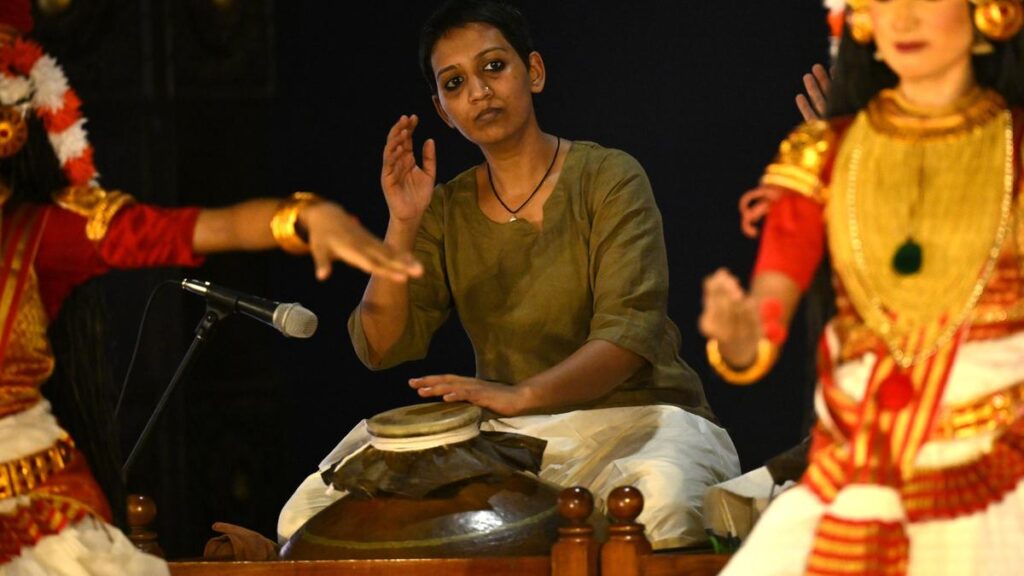

It is a cloudy morning on August 15 at Kerala Kalamandalam in Cheruthuruthi, near Thrissur. Families and well-wishers gather outside the koothambalam, a quiet buzz of anticipation filling the air. It is one of the annual arangettam (stage debut) days at the 96-year-old institution, with mizhavu and Koodiyattam scheduled for the morning session. On this day, theatre practitioner Apurva Arthur makes history, becoming the first woman to have her mizhavu arangettam at Kalamandalam. A second-year post-graduate student in the mizhavu department, she is among the few women who have taken to learning the instrument.
The mizhavu is a large, copper, pot-shaped percussion instrument that accompanies Koodiyattam and Koothu forms such as Nangiarkoothu and Chakiarkoothu. The hide stretched across its narrow mouth serves as the playing surface. Since the percussionist sits behind the performer, they cannot see the happenings on stage and must therefore have a deep understanding of the art form and its attaprakaram (text and abhinaya manual).
The mizhavu is not an easy instrument for a woman to pursue. From the playing posture to stepping into its wooden case known as the mizhavanna and perching on its edge, it’s quite challenging. It makes one wonder what drew Apurva to it.

Apurva Arthur says the mizhavu found her, calling it ‘love at first sound’.
| Photo Credit:
THULASI KAKKAT
“Everybody asks me this question. I didn’t take to the mizhavu, it found me,” says Apurva. She was around 18, when she first saw the instrument being played at Ranga Shankara in Bengaluru, where Adishakti Theatre Arts, Auroville, was performing their production, Ganapati. “It was love at first sight, rather, at first sound,” she says with a laugh.
She later joined Adishakti, where she began to learn to play the instrument and also to become an actor. “The first few years were spent in training [of the instrument]. Then, Veenapani, the founder, told me that I could be part of Ganapati, and it felt like I had climbed one of the biggest mountains. The other artistes were traditional performers who had already been practising and performing for over 20 years when I joined.”
Apurva’s journey with the mizhavu began in 2011 at a 10-day workshop and has chosen to take the contemporary route.
Her decision to study the mizhavu at Kerala Kalamandalam “in the classical language” was to understand its roots and locate it within a cultural context. “The latter is important because I remember once, in Bengaluru, I was asked to play it softly to suit the milieu. My determination to learn the instrument brought me to Irinjalakuda to train with Rajeevettan [Kalamandalam Rajeev].” While on a trip to Kalamandalam, she learnt that she could do her Master’s in mizhavu. With Rajeev’s go-ahead, she attended the interview.

Apurva at her arangettam
| Photo Credit:
THULASI KAKKAT
Apurva began her journey as a student at Kalamandalam in August, 2025. But as someone who is into contemporary theatre, what does she intend to do after completing the course?
“My ideas are always going to be influenced by Veenapani. Her works, from Ganapati and Brhannala to Bhima, are deeply immersed in Koodiyattam, or draw from its ideas. During the creative process, her relationship with the mizhavu was almost co-dependent. She couldn’t function without having the instrument around,” shares Apurva.
“For me too, the mizhavu became a kind of dramaturg. Many times, as an actor, I want to create a silent moment on stage, but then I’m playing the mizhavu in my head. It helps me connect the dots.”
Wittingly or unwittingly, she has created history, which she confesses she did not set out to do. Arangettam is just the beginning for Apurva. “I intend to do shows, and hope people will start calling me slowly. There is a lot more learning for me.”
The fact that mizhavu is part of a ritualistic art form, and that she is a Dalit Christian practising it, makes her journey all the more interesting. “My father moved from Gulbarga to Bengaluru; his parents moved from a smaller town to Gulbarga. Ancestrally, we were leather workers. And I am now playing an instrument whose surface is made of leather. I often find myself wondering, ‘Who made this? My forefathers!’ It feels good,” says Apurva with a smile.
Published – September 08, 2026 05:23 pm IST