
WHAT ARE MY THOUGHTS ON PRESSURE?
Who would’ve thought that the events of 6th June 1944, arguably the most significant turning point in the Second World War, hinged entirely on a simple weather forecast? Playwright David Haig certainly thought it, as his 2014 stage play Pressure focused entirely on the efforts of Scottish meteorologist James Stagg to accurately predict whether or not what would become universally known as D-Day could ultimately go ahead, on account of the harsh waves caused by heavy rain.
Now adapted into a feature film by director and co-writer Anthony Maras (with Haig also credited for the screenplay), Pressure carries the monumental task of making a story about the unpredictable nature of weather into something cinematic – and, most importantly, interesting. Luckily, Maras is able to create a decently suspenseful atmosphere out of the limited scope of his source material, enough to make his film a formidable character-centric piece that does the job just fine.
Set just days before the launch of Allied forces to the beaches of Normandy for a full-scale invasion of Nazi-occupied Europe, Pressure begins when Stagg (Andrew Scott) is summoned away from his pregnant wife Liz (Tamsin Topolski) to the estate of Southwick House, where US General Dwight D. Eisenhower (Brendan Fraser) has set up a makeshift headquarters to plan the invasion down to the letter. All that’s missing, according to Eisenhower, is a weather forecast that will ultimately determine whether D-Day can proceed as planned or be delayed, which is the mission that Stagg is assigned alongside American meteorologist Irving Krick (Chris Messina). However, whereas Krick relies on historical pattern readings to determine that the invasion – currently scheduled for launch the following Monday, the 5th of June – will be accompanied by good weather, Stagg draws ire and frustration with his more comprehensive prediction that incoming low-pressure storms will wipe the soldiers out before they get a chance to land in Normandy.
Of course, history ultimately dictates which one of them is ultimately correct in their forecast, but Pressure isn’t really about who’s right and who isn’t in this scenario. Rather, it’s a film that shows how the weight of this imminent event is taking its toll on these characters, and how they respond to their own pressure inflicted upon them. Eisenhower, for instance, quietly confides in his private secretary Kay Summersby (Kerry Condon) about the fears of potentially sending thousands of men to their deaths, especially after a disastrous rehearsal that is briefly glimpsed in the film’s cold open. There’s also British Army General Bernard Montgomery (Damien Lewis) who’s arguably applying the most pressure on the main protagonists to launch the invasion regardless of the weather, but even he seems at the end of his rope when it comes to making sure there are no slip-ups that could tilt the war in the Germans’ favour.
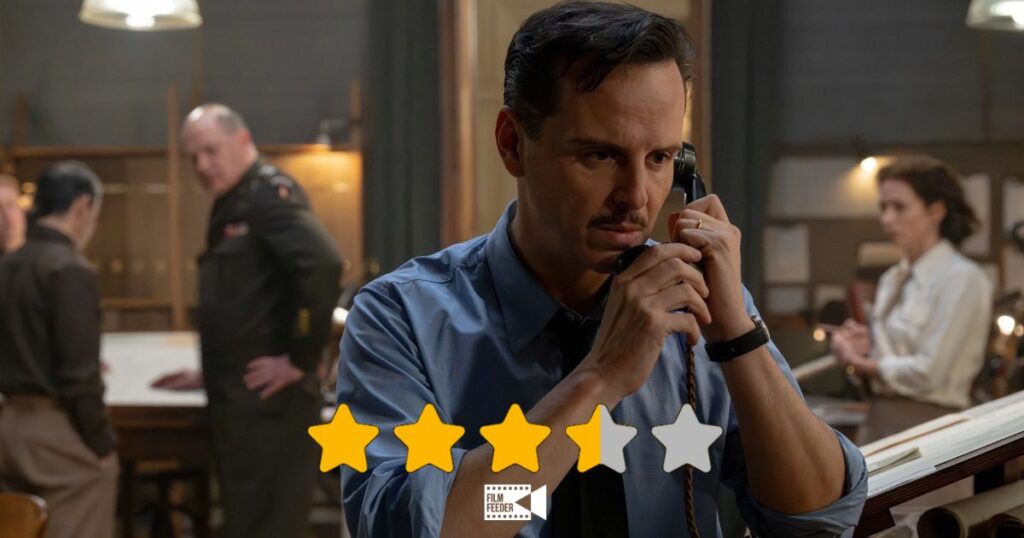
As for Stagg, brought to life by a magnetic and soft-spoken Scott, his pressure is three-fold. On top of the orders given to him by Eisenhower – whom Fraser applies his cuddly on-screen persona to with a reserved ferocity, to largely effective results – he’s also dealing with conflicting opinions and an inflated sense of overconfidence from his American equivalents, and then later on with a potentially devastating personal development that foregoes historical accuracy to give the character and narrative an extra dose of drama. Throughout, you can start to feel the cracks in Stagg’s reserved mannerisms as he succumbs to the incessant demands of giving his superiors what they want to hear, when to him it’s more important to favour the facts over the fantasies, a sensible approach that ultimately works out in his favour.
Maras and Haig’s script reflects the shared strains of these characters in a straightforward narrative that is built to withstand such tension, making the race-against-time template compelling enough to where you are able to sense the clock ticking as it all comes down to the wire. As director, Maras is also able to bring this out in a string of scenes where the classic ticking-clock motif is present in sharp sound design, Volker Bertelmann’s suspenseful score, and the effortless performances of his cast that add various emotional layers to the pressure being applied.
However, their narrative doesn’t always generate the exciting or even the emotional results that they perhaps hope for, with the film falling back on a number of repetitive scenes where characters share more or less the same conversation with each other. More crucially, for all of Scott’s power as an actor, he’s not quite able to overcome the character of Stagg, who is perhaps a bit too reserved and strait-laced within the script for the viewer to fully get on board with his own arc which, again, feels like an unnecessary addition to keep the dramatic momentum going.
It isn’t perfect, and in more than a few ways it pales compared to similar character-centric wartime thrillers like The Imitation Game, but Pressure manages to work just fine as a formidable and cosy war thriller that anyone can enjoy at any time, come rain or shine.