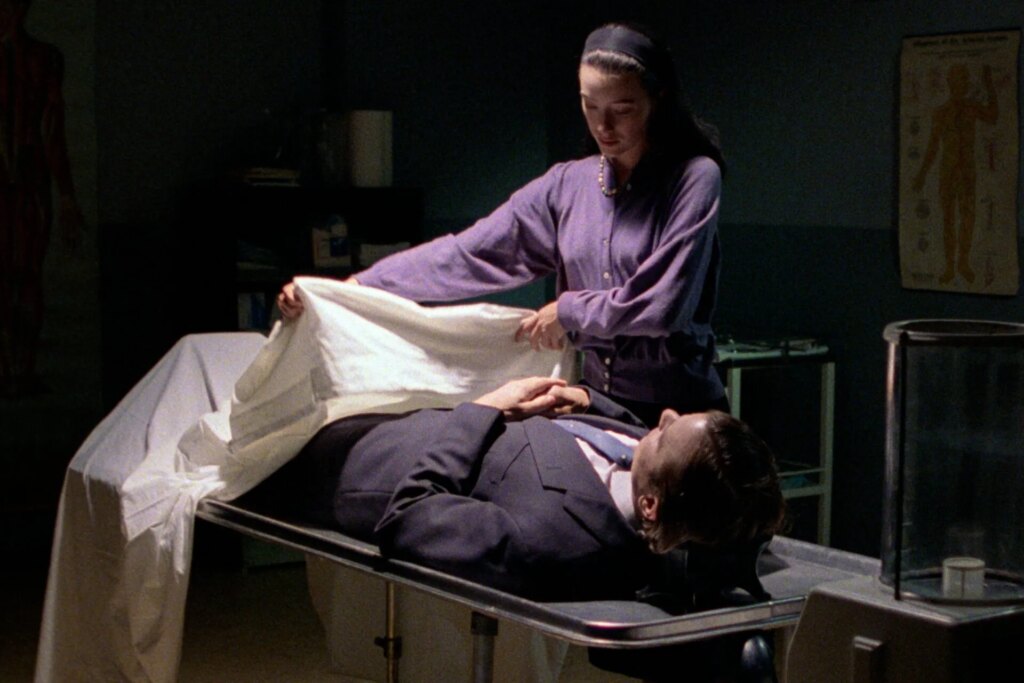

“Ban this sick filth!” That was the headline sprawled across the Daily Mail when 1996’s Kissed found itself at the mercy of the British press. Adapted from a short story by Barbara Gowdy, and partially based on the life of Karen Greenlee, the film follows Sandra, a necrophile, as she begins to explore her sexuality and the bodies of the dead.
“We got all these people telling us that the film was horrendous and that it should be banned. Even the Vatican came out against the movie at the time. It was on the pope’s hit list, apparently.” Kissed’s director, Lynne Stopkewich, couldn’t help but laugh when talking to FILMHOUNDS about the backlash that the picture received upon release. And yet, despite the row it caused at the time, with American Baptists incensed, Members of Parliament calling for a ban on the flick, and even the Catholic Church trying to take it down, Kissed has been all but forgotten in the thirty years since.
Discussing the flick’s origins, the director explains, “The film was made as a thesis film for my master’s degree in film production, and it was made with students and with equipment from the film school.” Barbara Gowdy’s short story ‘We So Seldom Look On Love’ seemed to come to Stopkewich at exactly the right time. In the middle of writing another screenplay for her thesis, the director read Gowdy’s work and immediately began optioning the story. “All of a sudden, in the middle of getting ready to shoot this other movie, I dumped that movie and decided I was gonna make Kissed instead. Then when everyone read what the story was, they thought I was crazy.” With the clock ticking, Stopkewich and her co-writer Angus Fraser immediately got to work on the script. “We just worked it day and night until we got ready to shoot,” Fraser recalled.
The subject matter is so taboo that the synopsis alone has been turning audience members away for decades, but Stopkewich and Fraser approached the story with nothing but respect. Fraser explained, “Obviously, you have to suspend your judgement because it’s just a two-dimensional work if you just go ‘Oh my god this is wrong, how could anyone do this?’” Likewise, Stopkewich felt it would be too easy to make the movie salacious or exploitative. Instead, she joked, “We were trying to make a Disney film about necrophilia.”

The film’s Director of Photography, Gregory Middleton, felt it was just as important to approach the visuals as delicately as the writing. “We did not shoot it so explicitly in terms of showing what we show; we tried to show what she felt.” Middleton further explained, “It’s like when you’re in love with somebody, you see the twinkle in their eyes, you see something in them that only you seem to see. We tried to convey that with how she looks at the world.”
The gamble paid off when the picture had its world premiere at the Toronto International Film Festival, where it surprised critics and wowed audiences. Macleans called it “eerily tasteful,” Variety claimed it was “surprisingly endearing,” and the flick went on to earn two thumbs up from Siskel & Ebert. Thinking back on the experience, Stopkewich recalled, “It was much more well received and popular than I thought. The film just kept going to these very prestigious festivals and really just hit a chord with people.”
Regardless of all the attention it received at the time, both positive and negative, the feature is barely remembered today. Rarely screened over the past thirty years, Lost Reels’ Geoffrey M. Badger revealed to FILMHOUNDS that the previous rights owners charged excessive licensing fees to those wishing to programme the film. “I don’t understand it. They were charging, I would say, about double what would be the high end of what you would pay. Something that would be totally uneconomical.”
One of the rare screenings of Kissed during that time was brought to audiences by the London-based horror programming duo of Scary Claire and Molly Miles, also known as Category H Film Club. Discussing the mission behind Category H, Claire stated: “We are trying to encompass lots of subgenres of what horror is and expanding what people think of as horror.” Explaining the decision to screen the film, Molly added, “Despite not being a horror film, Kissed has a kind of gothic sensibility, but it is also a film that works in a late-night environment. It was an interesting way to show it to an audience & to recontextualise it like that.”
Talking about the movie being recontextualised through the horror lens, Fraser argued that the movie was never intended that way, but conceded that it was an interesting take on the picture. Similarly, Stopkewich felt that Kissed being viewed from multiple lenses “gives the film even more value.” The director also acknowledged the film’s overlap into the horror genre. “It’s a pretty well-trodden trope in horror films where the adolescent is feeling like they’re turning into a monster. I wanted to explore that, but not alienate people.”
Although the specific experiences that Molly Parker’s Sandra goes through may be unique, the heart of her journey is one that is all too recognisable. “At its core is someone who is struggling with their sexuality and is then given the freedom to explore it.” In this sense, Category H’s Scary Claire feels that Sandra is, ultimately, a relatable character. Discussing the movie’s exploration of sexual repression, Claire claims, “Isn’t everyone trying to figure that out? She just has a very extreme way of trying to go about it.”

As for why Kissed has failed to find an audience over the decades since its release, there seems to be no singular train of thought. The filmmakers involved with the feature feel as though the picture centering on a necrophiliac might have played a role, with Stopkewich confessing: “I think that the subject matter does make it a little more challenging.” On the other hand, Geoffrey M. Badger feels that there is a “myriad of reasons” why Kissed has gone unseen for so long, and argues that the flick is not unique in being forgotten, while Molly Miles claims that the film being directed by a woman is “probably part of the reason why it has stayed in obscurity for so long.”
Regardless of why it may have gone underappreciated, the picture is soon to get a second life in a matter of days, with Lost Reels screening their rare 35mm print in London this weekend and with the world premiere of a brand new 4K restoration taking place at TIFF only a few days later. Speaking on the restoration, Lynne Stopkewich shared her hopes for the movie going forward: “My hope is to preserve the film for the future and to hopefully get it out in the world again.”
Despite its controversial subject matter and its nineties sensibilities, Miles summed up what makes Kissed a film worth seeking out now that the restoration is on the horizon. “I think it stands up exceptionally well. It’s still a topic which is very taboo, and in that way the film is still very shocking and provocative. I really can’t think of another film that is anything like it.” Discussing the importance of a movie like Kissed being rediscovered, Badger added, “It’s not just the preservation of history. People put a lot of effort into it; it’s a historical part of the landscape of cinema, and it simply shouldn’t be lost. It should be available. Good, bad or indifferent, it should be available.”