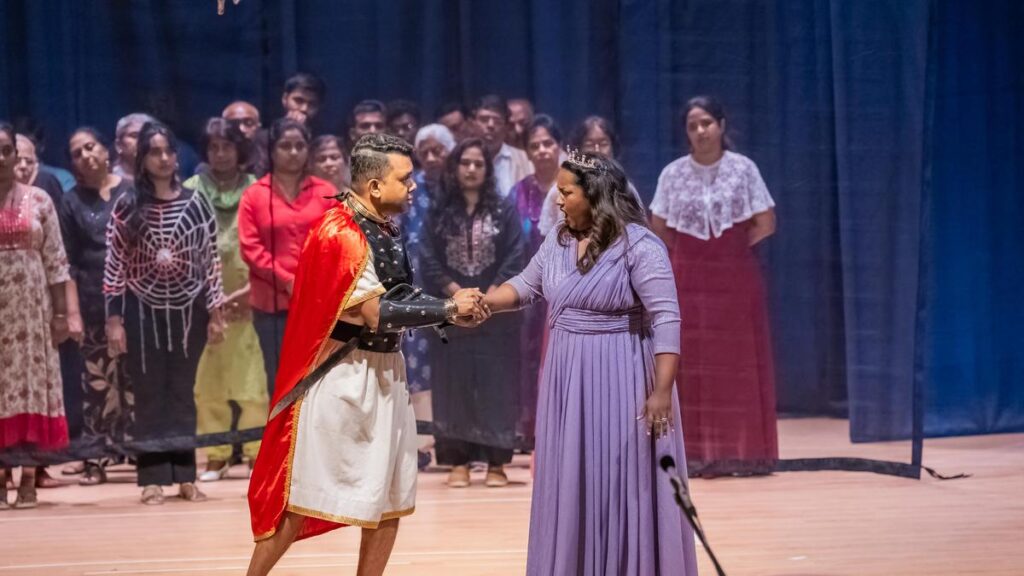


Scenes from a rehearsal of ‘Dido and Aeneas’
| Photo Credit: Special arrangement
Henry Purcell is a celebrated English composer of the baroque era, a man who lived and died in the shadow of Westminster Abbey. The great strains of music that spilt over from the abbey’s organ influenced his score, and when he died in 1695, he was buried adjacent to the organ.
In Purcell’s vast repertory, Dido and Aeneas stands as bright as a lighthouse, casting its searching light on Dido, the queen of Carthage and her beloved, the Trojan hero Aeneas. A story of love, duty, betrayal and loss, it is an opera that singers often flock to with Dido’s ‘Lament’ a crowning highlight. The opera is drawn from Roman poet Virgil’s Aeneid. Across the world, the opera has had its seasons in the sun and later languished in obscurity for years.
Now, the 133-year-old Madras Musical Association and its Chamber Orchestra will perform the opera at the exalted stage of the Museum Theatre, Egmore. But why Purcell, I ask MMA conductor Augustine Paul.

“English operas are few. The ones by later composers like Benjamin Britten are complicated. Purcell is the opera star, later followed by Handel. He wrote in English, the latter wrote in Italian. Over the years MMA has performed plenty of songs from the operas of Gilbert and Sullivan and Rodgers and Hammerstein. But we have not performed Purcell,” says Augustine.

Scenes from a rehearsal of ‘Dido and Aeneas’
| Photo Credit:
Special arrangement
Dido and Aeneas, an hour-long production, requires spare backdrops but demands emotional heft from its performers. “Another reason why this was chosen is because it is a smaller production, only three acts, in comparison to the ones by composers Wagner or Verdi that run to at least three hours,” says Augustine.
Purcell’s work also suits a smaller cast and a chamber orchestra. The MMA’s live chamber orchestra will perform from the pit of the Museum Theatre — its acoustics require fewer mikes. “The Museum Theatre does not have a large pit so we have to really scramble if we choose a bigger production. For Purcell, we have exactly the right number of instruments needed. The audience can see both the production onstage and the musicians. Opera is the ultimate test for an artiste to express oneself as a singer and emote at the same time as an actor. It requires mastery of both. The production is entirely sung,” adds Augustine.

This immersive experience of soaring music, dramatic storytelling and theatrical spectacle is choreographed and directed by Deepa Nambiar, who has worked in theatre for 22 years and directed five productions so far, including last year’s MMA production Cinderella. “This is my first experience in direction and choreography for an opera,” says Deepa. “What is common to all productions is the ability to bring a narrative alive. The difference in opera is how we do it. It has a quiet intensity that it brings to the audience and the actors/musicians have to keep alive that inner fire of paradoxes to live the character authentically. When I heard the music, the only visuals that danced before me were that of the period in which this music was created.”
The entire cast and crew is drawn from the MMA, whose members also handle costume design and music. “The orchestra, though small, comprises young musicians, mostly college students and professionals,” says Augustine. Principal soloists will include Roshni Sharon, Prashanth Gasper, Cathlin Esther and Ebenezer Arunkumar.
Dido and Aeneas will be staged at Museum Theatre, Egmore on September 10 and 11 at 7pm. Tickets priced at ₹500, ₹1,000 and ₹2,000 are available at BookMyShow, MMA Choristers, Aspire Music Conservatory, Etude School of Music and Musee Musicals. For details, call 9840485558.
Published – September 08, 2026 04:33 pm IST