
No disrespect to the more high-minded entries, but a ripe genre detour can often be just what you crave during an intensive festival. Paolo Strippoli’s The Spiral (L’Estranea) scratches that itch with a psychological thriller seeped in supernatural horror, dread and vicious satire of middle-class Italians who would sooner sell their souls to the devil — or some random woman in a hospital chapel — than risk the embarrassment of damaged children. Led by a nail-biting performance from Jasmine Trinca and wicked support from Valeria Bruni Tedeschi, who really should play bad-bitch emissaries of evil more often, this is juicy entertainment that ought to travel well.
Though neither of them was widely seen internationally, Strippoli’s Flowing and The Holy Boy saw him honing his skills with dark-hearted chillers, dipping into nightmarish family friction and religious horror, respectively. His taut, stylishly directed third solo feature returns to the sacred institution of the well-heeled Italian family — affluent, beautiful, chic, prominently positioned in society — and the panic that can ensue when something threatens to dull their enviable golden glow. Even if the movie gets a bit crazy in an apocalyptic epilogue, its picture of bourgeois smugness due for a takedown is delicious.
The Spiral
The Bottom Line
Delectably nasty fun.
Venue: Venice Film Festival (Competition)
Cast: Jasmine Trinca, Romana Maggiora Vergano, Adriano Giannini, Valeria Bruni Tedeschi, Gabriella Telegrafo, Mariandrea Cesari, Andrea Genovese, Alessandro Carbonara, Andrea Rossini, Marina Limosani
Director: Paolo Strippoli
Screenwriters: Paolo Strippoli, Salvatore de Chirico
1 hour 55 minutes
There’s an amusing, retrograde cruelty in the suggestion that a status-conscious Italian mamma might completely lose it at the prospect of having a child with a disability or — Mio Dio! — obesity issues. Or one who’s a lesbian. The script by Strippoli and Salvatore de Chirico shrewdly underplays that hand, instead cushioning the vanity factor in sincere parental concern for the children’s health, well-being and preordained path to success.
The movie opens with Trinca’s agitated character Anna flying to Rome, where she turns up unannounced at the apartment of her semi-estranged daughter Alice (Romana Maggiora Hergano) in the middle of a Biblical thunderstorm. Alice is a theatrical costume designer; the rushed exit of her female “director” and everyone’s awkward embarrassment are a clear hint that Anna might be uncomfortable with her daughter’s sexuality.
Wasting no time, Anna blurts out that everything Alice has ever been told about the family is built on a lie, a secret that now must be shared for grave reasons revealed as the plot unfolds. That happens over four chapters, titled The Daughter, The Son, The Father and The Mother, each of them jumping back to various points in the past 25 years in Anna’s trembling account.
The family’s misfortunes began in 1999, when they moved into a sumptuous villa in Bari, acquired with profits from what used to be grandpa’s tailoring business, since transformed into the swankiest clothing boutique in town. With two magnificent external staircases leading onto pristine lawns dotted with palm trees, it’s obvious that the fancy villa will need to be shown off at a garden party.
When she’s not berating the housekeeper over some minor slip-up, Anna drapes herself over the outdoor stairs, eyeing her domain with satisfaction and kvelling over the news that 7-year-old Alice (Gabriella Telegrafo) has booked a pasta commercial. Never mind that the dream of becoming an actress is more about Anna’s ambitions than her daughter’s.
The moment is shattered, in front of the guests, when Alice is brutally attacked by the family’s bull terrier during a dance recital with her friends, one of whom has already caught her eye in what looks like presexual longing. She’s rushed to hospital with serious injuries and Anna is horrified to learn from doctors that her daughter is at risk of losing a leg.
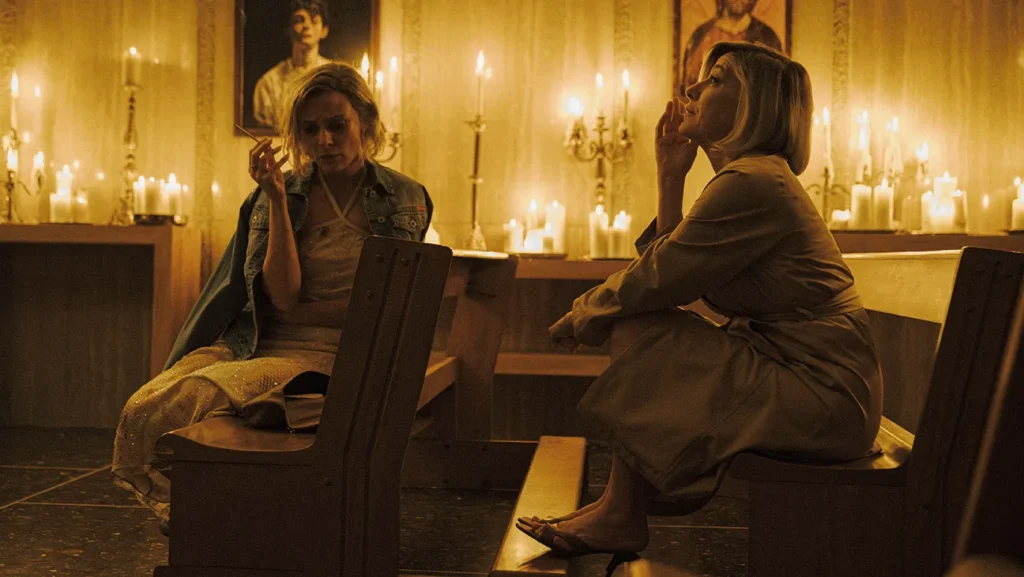
But it seems there’s a rescue plan. Still shellshocked, Anna drifts down a long corridor lit like a surreally unsettling dream to visit the medical facility’s chapel. A trenchcoat-clad woman with good hair and expensive highlights (Bruni Tedeschi) at first comes off as sympathetic, though disconcertingly, she seems to know an awful lot about Anna’s family. The stranger informs her matter-of-factly that Alice’s leg will be amputated unless Anna opts into her payment-plan bargain. Saving Alice will require risking the health of her older sibling.
The two women’s performances are so locked in that we don’t even question why Anna would buy the creepy proposal. The witchy stranger speaks with such cool authority and lights up a cigarette with such flagrant disdain for the etiquette of this house of worship and prayer that she seems all-knowing. (The movie features much fabulous screen siren-style smoking, with both Anna and the stranger constantly sucking on super-slim lady cigs.)
Alice gets to keep her leg, albeit with extensive scarring, and Anna does her best to forget about the sacrificial part of the pact until she is awoken one night by a noise downstairs. Upon investigation, she finds Alice’s 13-year-old brother Tobia (Alessandro Carnbonara) gorging on sweet treats under the Christmas tree. The teen’s alarming weight gain and declining health over the next few years are especially irksome to his fitness-obsessed father Walter (Adriano Giannini), whose oily complacency almost makes Anna look humble. Walter is even more pissed when Tobia’s expanding body mass kills his football prowess, fat-shaming be damned.
Again, the mysterious stranger appears, offering a way out and establishing the domino-effect pattern by which every person saved from some grim fate demands that another be thrust into misery, or worse. When Anna urges the stranger — by now we can guess the identity of her infernal master — to take her instead, she’s told that’s not an option.
It’s around this point that the scenes between Trinca and Bruni Tedeschi really start to cook, dialing up the mordant humor. The stranger treats her traumatized pawn with tickled condescension, teasing and mocking her while rolling her eyes each time Anna pathetically scrambles to find a loophole in the deal. A psychosexual Sapphic frisson edges into their rapport, with a never-better Bruni Tedeschi hilariously nailing her character’s mix of mischief and malevolence.
As the Mephistophelian stranger’s conditions grow increasingly stringent, the family’s woes continue escalating, financial troubles included. The action cuts back and forth from Anna and Alice in Rome, the latter still deeply resentful and convinced the whole elaborate story is just some morbid fantasy hatched out of her mother’s self-absorption.
Eat-the-rich thrillers have been multiplying like rabbits over the past several years, but the diabolical scenario outlined in Strippoli and co-writer Salvatore de Chirico’s screenplay is a particularly toothsome variation on the price to be paid for vainglorious perfection.
The director and his DP Cristiano Di Nicola create striking visuals, with a strong sense of composition and lots of woozy, disorienting angles. And Quentin Collette’s turbulent soundscape — rumbling, clanking, with the unrelenting downpour stirring in elemental fury — mixes seamlessly with the tense synth riffs of French electronic composer Robin Coudert, known professionally as ROB. Strippoli also makes effective use of the 1998 Euro hit “Narcotic,” by German band Liquido.
The entire cast, which includes actors playing both of Anna and Walter’s children at three diifferent ages, is solid. But the movie very much belongs to Trinca and Bruni Tedeschi, just as Anna belongs to the merciless stranger. (The Italian title translates as The Stranger; presumably the switch was intended to let people know this is not Camus, especially coming so soon afer François Ozon’s film of the French lit classic.)
The movie seems a likely candidate for a U.S. remake and stands to be an international calling card for Strippoli. But The Spiral is well worth a look in its original form, its nefarious developments tied into European class pride and vanity with savage glee. It’s easy to imagine it catching on with audiences beyond Italian borders, hankering for atmospheric horror with a subversive twist.