
There are whole movies that get by without music, but it’s rare. It stands out when something like Dog Day Afternoon or No Country for Old Men makes an artistic choice to have sparse music, or no music at all, and then it can also stand out when a movie has almost constant music (like the last few Christopher Nolan movies, with Oppenheimer and The Odyssey being almost relentless with their respective Ludwig Göransson scores).
When the music outshines just about everything else going on… well, that’s also rare. But it arguably happened with the following movies. These ones differ in quality, with some being good movies with great music, and others being not-so-great overall, but having music that stands out as good. Basically, they’re movies where the music is debatably the best thing on offer.
8
‘Tron: Legacy’ (2010)

Tron: Legacy has its defenders, but Tron: Legacy defenders who don’t cite the score as one of the main reasons why the film’s not all that bad? Good luck finding too many of them. Daft Punk were behind it, and though it doesn’t have quite as much to offer as the duo’s other “actual” albums, it still delivers as a pretty great electronic score that also has some elements that foreshadowed where the duo would go on 2013’s Random Access Memories, which did end up being the final Daft Punk album (unfortunately).
The story here… it’s more Tron. Tron is hard to get excited about, and Tron: Legacy was an attempt to do a legacy sequel to Tron. These movies look and sound cool, and that’s always been about it. There was a third movie in 2025, called Tron: Ares. It came out and the world collectively asked, “Why?”
7
‘The Mission’ (1986)
.jpg?q=49&fit=crop&w=500&dpr=2)
Of all the movies here, The Mission does have the most interesting story and non-music elements, being set during the 18th century and focusing on a mission (and those who live and work there) in South America. Robert De Niro plays a mercenary who goes there seeking redemption, and he ends up finding a new lease on life while getting wrapped up in a conflict that the titular mission is caught up in.
It’s really slow-going at times, and the quest for redemption clashes a bit with the conflict-heavy story in the second half, but the film always soars whenever Ennio Morricone’s music is playing, and you get a lot of it here. And it’s some of Morricone’s best music, which is saying a lot. The second-best reason to watch The Mission is the cinematography, because it looks great, and then what it goes for narratively and thematically does prove to be moving as well, at least at certain points.
6
‘Electric Dreams’ (1984)

You get a good score and a good soundtrack of sorts here, in Electric Dreams, with music being an important part of the overall movie, to say the least. As for what the movie is actually about, it’s a bit wild and high-concept, since it focuses on a man who buys an advanced computer, and uses it to get advice about how to approach a woman he has romantic feelings towards, but then complications ensue when the computer also falls in love with that woman.
If you can go with it, it’s a fun movie. Though you do have to put aside modern notions of AI, because it was all a bit more enjoyable to think about and play around with, as a concept, back in the 1980s. Hell, the same can be said for the 2010s, with the movie Her. If you can’t get around the story in Electric Dreams, though, there is still all that very ‘80s music to enjoy.
5
‘Top Gun’ (1986)

With Tron: Legacy, you had a legacy sequel to something that came out in the 1980s, and then with Top Gun, you’ve got a movie from the 1980s that also got a legacy sequel some decades later. That legacy sequel was better than Top Gun overall, but not in one regard. Sorry to Top Gun: Maverick, but Top Gun was where it was at, music-wise. There’s no competition, really.
It’s hard to remember too much of the music from Top Gun: Maverick, while it’s difficult to forget some of the songs used persistently throughout Top Gun. Okay, with that sequel, “Danger Zone” is memorable, but only because it’s reused from Top Gun (and used in a basically identical way). Nothing original, music-wise, in Top Gun: Maverick can touch “Danger Zone” or “Take My Breath Away.” Aside from the music, though, nothing in Top Gun can really touch Top Gun: Maverick, which feels like someone sat down and said, “What if we made Top Gun again, but it was good this time around?”
4
‘Streets Of Fire’ (1984)

Nice and over-the-top, even for its decade, Streets of Fire is a cult classic that unashamedly dips its toes into almost every genre (action, romance, thriller, musical, crime, adventure, drama) to tell a remarkably simple story that doesn’t really need to jump into so many genres. Hmm. Maybe that’s why the plot’s a bit of a mess. You’ve got one hilariously stoic guy and his friends rescuing the kidnapped love of his life from a gang of thugs, led by a deliciously evil Willem Dafoe.
Without the music holding this one together, it’s almost nothing; maybe some decent-looking and colorful image here and there. The paper-thin characters and simplistic plot are just that thin and that simplistic. Thankfully, Streets of Fire is book-ended by two great songs written by Jim Steinmann, and then various other songs heard throughout make it a mostly okay movie that is elevated considerably by its music being stronger in quality than anything else it has to offer.
3
‘Bohemian Rhapsody’ (2018)

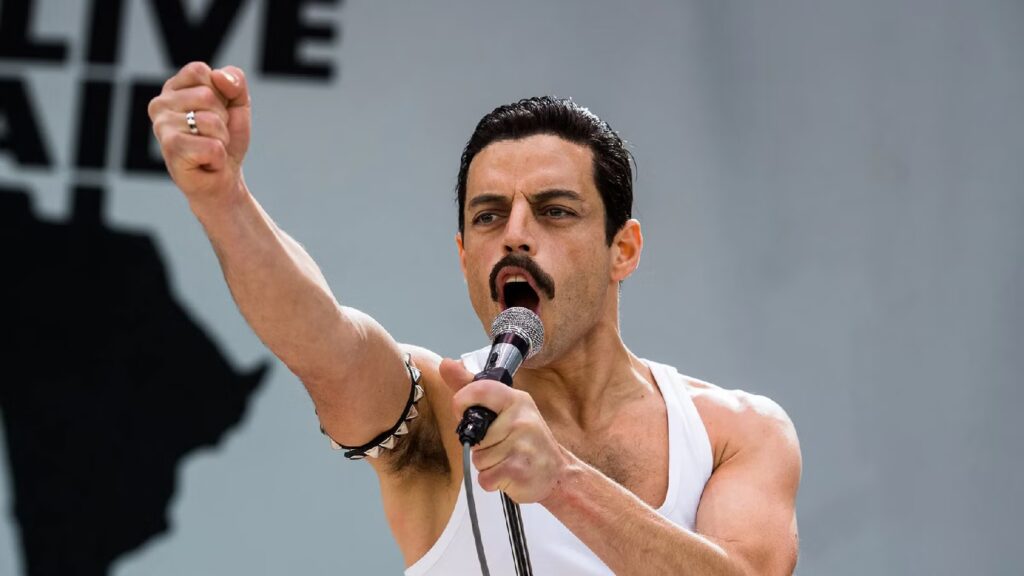
Bohemian Rhapsody is a biopic covering the rise of the legendary rock band Queen, with particular focus on their larger-than-life lead singer, Freddie Mercury. Maybe it should’ve just been Freddie Mercury, because there’s an awkwardness here with the occasional focus on other band members: Roger Taylor, Brian May, and John Deacon. It didn’t hurt the film’s box office earnings, though, and it performed quite well during the 2019 awards season (honoring the films of 2018).
Bohemian Rhapsody is not the same some years later, with the passing of time, and it’s too unambitious as a biopic overall.
It’s not as fondly remembered today, and it’s also possible it created such a stir because of Queen’s music, more than anything. They remain a much-loved and very popular band, to say the least, and watching in a cinema meant experiencing Queen’s music through an amazing sound system and in a way that recreated some of their most iconic live performances on screen. Bohemian Rhapsody is not the same some years later, with the passing of time, and it’s too unambitious as a biopic overall, but the quality of the band’s music remains hard to deny.
2
‘Star Wars: Episode II – Attack of the Clones’ (2002)
While messy and largely underwhelming, at least John Williams does his thing in a reliably great way in Star Wars: Episode II – Attack of the Clones. It’s almost like the film itself doesn’t deserve music this good, especially the love theme, “Across the Stars,” which is easy to point out as more effective, sweeping, and romantic than the romance it’s supposed to accentuate (it is the film’s love theme, after all, and the love story part of Attack of the Clones is pretty central).
Otherwise, there’s some real dreariness here narratively, and it exists to make Anakin go into a little darker territory, as a character, before Revenge of the Sith had the whole tragedy of the prequel trilogy get paid off (and properly realized). Still, Attack of the Clones is better than some other recent Star Wars movies, like The Rise of Skywalker and that Mandalorian movie everyone has already forgotten about. And when all else fails, at least you’ve got that Williams score.
1
‘Purple Rain’ (1984)

The album Purple Rain deserves its reputation as one of the greatest in the history of music, containing nothing but amazing songs that showcase Prince at his best, and then all those songs add up to a remarkably consistent whole. That album is everything, but it is technically a little more, since it’s the soundtrack for a movie of the same name… but to be perfectly blunt, the movie isn’t so great.
It has a bit of charm as a product of its time, and can be likened to Electric Dreams, Top Gun, and Streets of Fire as movies that feel intensely (or maybe even aggressively) 1980s in nature. Prince has some presence as an actor, but he’s not great at acting the way he was great at singing and songwriting. Honestly, if you didn’t even realize the far more celebrated album of the same name is even a soundtrack to the film, then that’s kind of understandable.