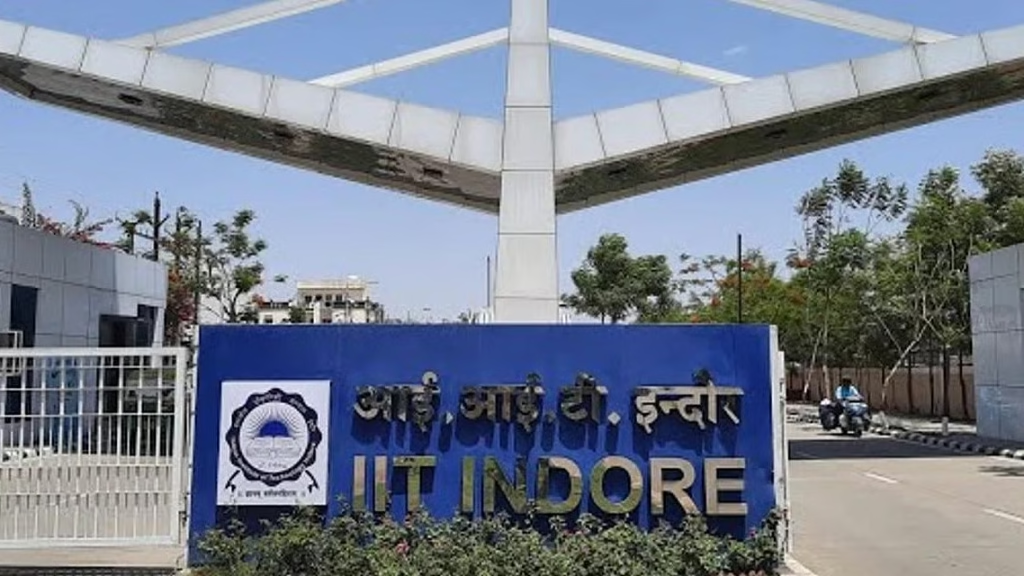

IIT Indore Scientists Crack Open AI’s ‘Black Box’, Find Machines Can Learn Laws Of Chaos | Representative image
Indore (Madhya Pradesh): IIT Indore scientists have found evidence that artificial intelligence (AI) can learn physical laws governing sudden changes in complex systems rather than merely memorising past patterns, potentially making AI more transparent and trustworthy.
The study, led by Prof Sarika Jalan, used a machine-learning technique called Reservoir Computing to examine how an AI model predicts critical transitions, or “tipping points”. The research is part of PhD scholar Dishant Sisodia’s doctoral work.
AI’s “black box” nature remains a major challenge: systems can make accurate predictions, but how they reach them is often difficult to understand.
The IIT Indore team developed physics-based tools to compare the AI’s internal dynamics with the physical systems it was trained to model. Researchers found that the AI closely mirrored real systems, including subtle statistical features emerging fractions of a second before a crisis.
The finding suggests AI was learning fundamental dynamical rules rather than simply recalling patterns. Similar behaviour across several chaotic systems strengthened the evidence.
IIT Indore Director Prof Suhas Joshi said the research could help make AI more reliable and explainable. “Since AI is used in more areas of daily life, it’s becoming essential for people to be able to trust and understand its decisions,” he said.
Jalan said research combining dynamical systems and machine learning remains limited globally and is at a nascent stage in India.
“By combining our core expertise in chaos theory and non-linear dynamics with modern artificial intelligence, we are paving the way for efficient, predictable, and controlled AI,” she said.
The research could eventually improve early-warning systems for climate tipping points, financial market crashes and medical events such as epileptic seizures.
It could also help scientists use physics to understand machine-learning models and transparent AI to better predict complex systems.