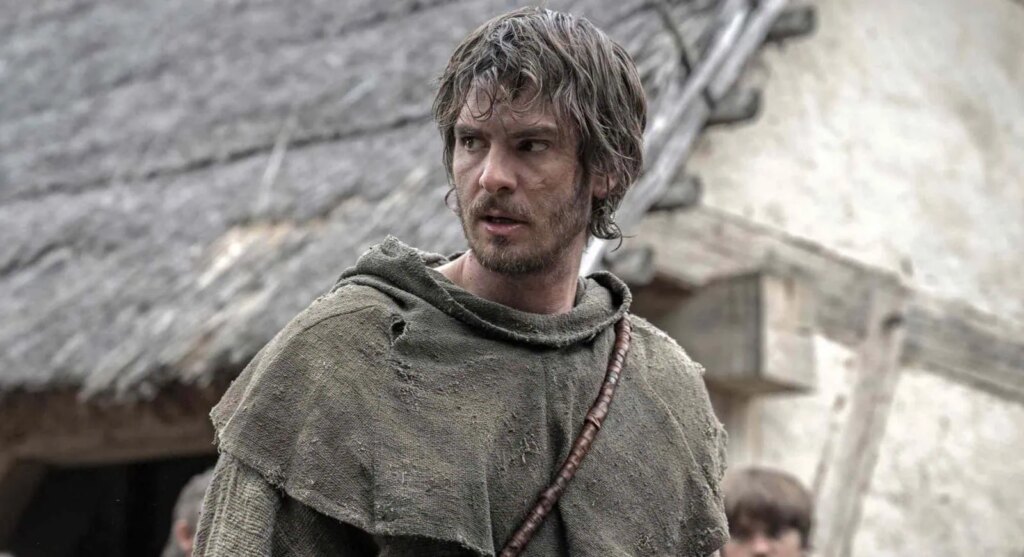

The Uprising, 2026.
Written and Directed by Paul Greengrass.
Starring Andrew Garfield, Jamie Bell, Stephen Dillane, Tom Hollander, Cosmo Jarvis, Thomasin McKenzie, Jonny Lee Miller, Woody Norman, Katherine Waterston, Stanley Townsend, Sky Yang, Helena Wigan, Dónal Finn, Charly Kuschel, Mark Redhead, Gerald Tyler, Luke Booys, and Simon Kunz.
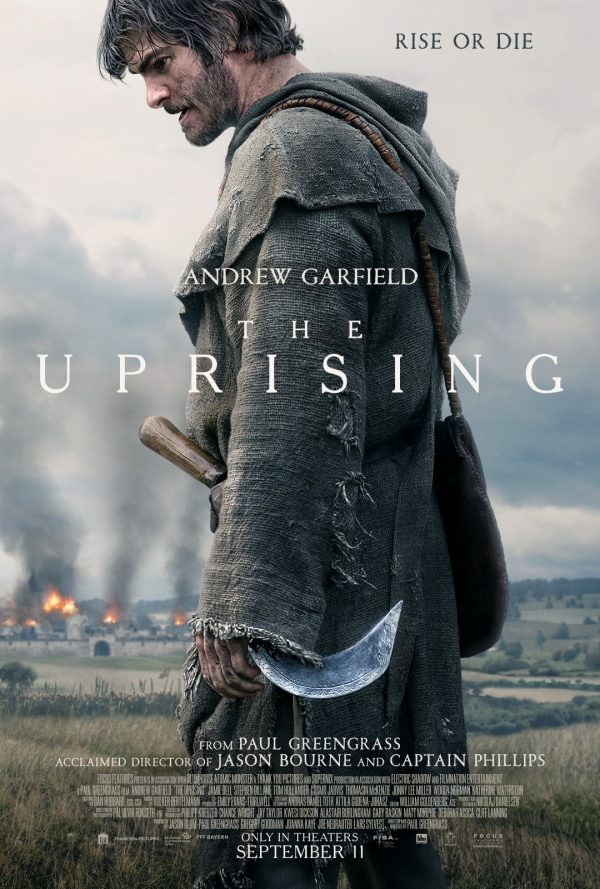
SYNOPSIS:
The leader of a ferocious rebellion against the tyranny of King Richard II forms an army of the people to face the King’s might in a fight for justice.
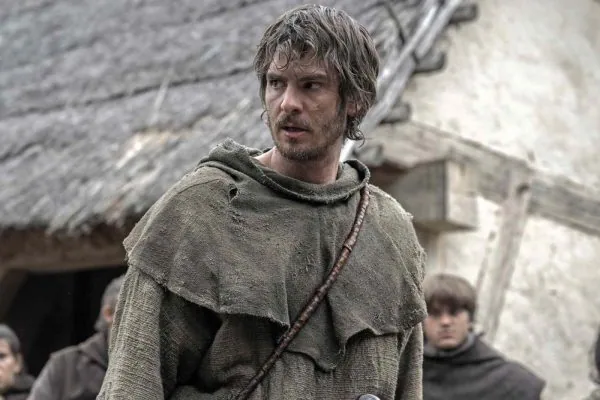
One way to get viewers on board with a film, as is the case with writer/director Paul Greengrass’ The Uprising, is to have Andrew Garfield’s peasant ploughman (or any actor and character for that matter) pummel a tax collector.
Here, following a plague that cut the population in half, it is straight to the point, which is perhaps for the best since the story is deceptively simple in its plotting. In what became known as the 1381 Peasants’ Revolt, he, alongside a priest (Jamie Bell), a soldier (Cosmo Jarvis), and another farmer (Thomasin McKenzie), coming from all over England, unite forces with a handful of factions (since the cinematography by Pål Ulvik Rokseth is constantly challenged by the need to capture these characters within a single large group, the production’s sizable scale and photography underscore that, while there are a couple of primary characters here, this is a story much bigger than them) to march over to King Richard II (Woody Norman in such a quietly manipulative turn yet snivelingly cunning and commanding when needed) in London and plead demands for more humane living, wages, and working conditions. In addition, one character has some demands regarding his council.
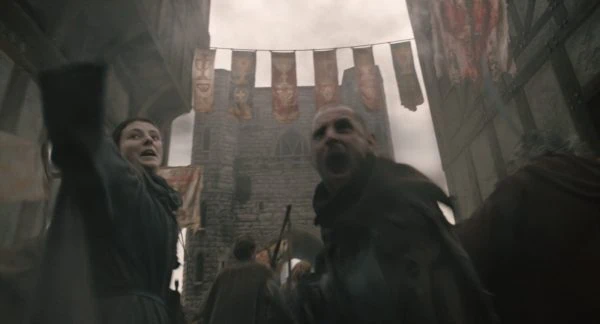
However, King Richard II is less a leader and more a nepotistic ruler, surrounded by that sycophantic council of yes-men advising on chess moves and strategy. Everyone from the priest to the Countess (Katherine Waterston) believes that maybe, just maybe, if Richard were allowed to govern without such a board, he would make popular choices befitting of a worthy leader. Others, such as Alyce (McKenzie), believe that they can’t be trusted no matter what. As for Andrew Garfield’s grieving farmer (he is haunted at night by his family’s voices), he is in the middle of the situation, which also extends into a conversation about faith, in that this journey will result in a miracle. Such religious conversations are also present within King Richard II’s inner circle, posing a question of faith as a motivator and how that can be shaped and used as a weapon from scenario to scenario.
As previously mentioned, though, this is mostly a straightforward, brutally satisfying story of rebellion complete with contemporary shouts of “no kings,” not to mention the juxtaposition of a current-day president who behaves like a petulant child with Richard, a teenager. It works, in part, due to Woody Norman’s duplicitous, snaky turn, and also the costume design by Tóth András Dániel and Godena-Juhász Attila, which works overtime to emphasize the contrast between the lavish, colorful outfits and headpieces of the elite and the ransacked, dirty, colorless garbs of the poor peasants. There is also a point where Richard and the Ploughman relate emotionally, giving the antagonist some depth and credibility and making it plausible that anyone would consider trusting him.
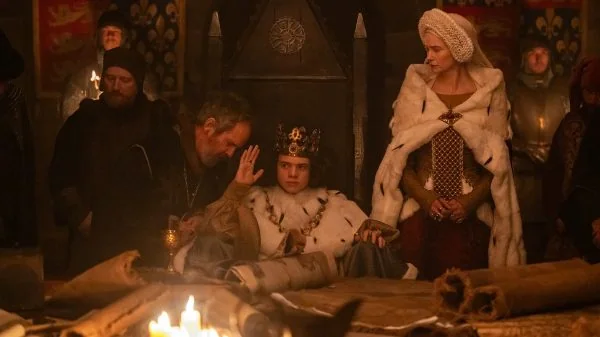
Once the bloodshed starts, The Uprising also depicts the line when such violence goes a step too far (the unflinching execution here is unsparing, even in beheadings), with Ploughman (as the character is credited) contemplating whether this is what he signed up for. This also allows for some character beats between him and Alyce, among others, all approaching this revolt from different perspectives toward a single collective goal, though it would be a stretch to say the narrative is deep or well-fleshed out.
Even the climactic transition into Robin Hood, which is somewhat detached from the event depicted here and almost enough to make one do a double take and wonder if it was tacked on to send audiences home on a crowd-pleasing note, is jarring and feels entirely out of place. It sort of comes off as a last-minute reshoot so the film could slap some brand recognition into the trailer that went viral for justifiably confounding reasons. What can be said is that Andrew Garfield is entirely convincing in the transition, with muddied war-face paint and all, and is outstanding in every other aspect of the role.
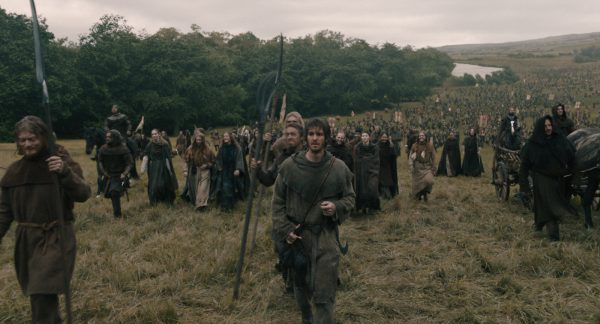
It’s also not enough to ruin or dismiss the preceding grounded and gloomy 100 minutes, which at times comes across as the original “January 6th,” but if it were done by the good guys, per se. One could continue further with those modern-day parallels by taking the plague in place of the most recent pandemic. Nevertheless, everyone’s pain, outrage, and anger here are palpable, with the eventual tragic spectacle carrying emotional heft. The Uprising is a savage rallying-cry of a film, proud not to be subtle in its modern-day comparisons. No kings indeed.
Flickering Myth Rating – Film: ★ ★ ★ / Movie: ★ ★ ★
Robert Kojder
https://www.youtube.com/watch?v=embed/playlist