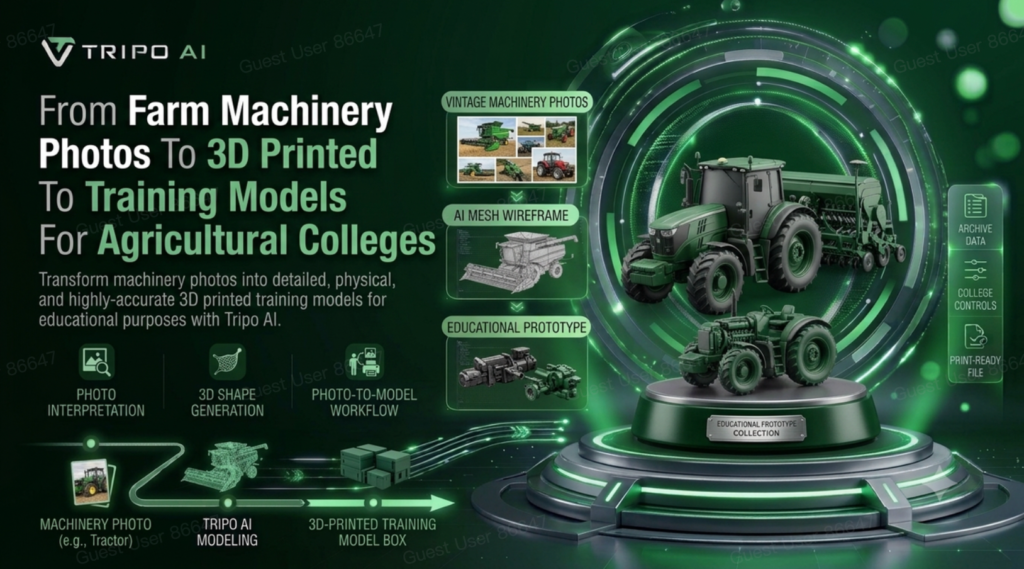

Practical learning has always been the basis for agricultural education. Before entering the workforce, students must be familiar with the operation of the various types of equipment that are used on farms, such as tractors and harvesters, seed drills, irrigation systems, etc. But having access to all the equipment in situ is often very costly, time-consuming, and difficult to implement in schools.
Luckily, with the emergence of modern image to 3D technology, new opportunities are opening up for agricultural colleges. By transforming images of farming equipment into accurate digital figures, instructors can produce authentic training resources to help facilitate student learning regarding how to comprehend and use various aspects of the equipment. With the assistance of Tripo 3D, colleges are able to quickly build 3D digital resources and 3D printed representations of agricultural machinery, which enhances the learning experience and reduces the need for actual agricultural machinery.
Agricultural equipment used in the classroom
In today’s farming context, farm machines are playing a crucial role in modern farming, but many farm machines are quite large and cannot be accommodated in traditional learning environments. Although it is possible to get equipment from the campus, it may not always be convenient and suitable for use in lecture demonstrations. That’s where 3D models are of great value.
These days, there are many opportunities for teachers to use detailed digital replicas of machinery rather than just diagrams and photographs – something that enables students to investigate that machinery from all perspectives. Tripo is a 3D app that allows teachers to take standard photographs of machinery and create valuable learning resources about technical concepts through the use of 3D-rendered equipment.
Why visual models are more effective for future farmers.
The agricultural machines usually have complicated systems, which can be hard for novices to visualize.
Exploring equipment without limitations
Once a student looks at a digital model of a machine, he will be able to see parts and structures that could otherwise remain hidden or out of reach of the real machine. Familiarity with machines prior to actually receiving hands-on training experience is incredibly valuable.
Using technology in a more engaging way
When students learn about equipment, they are generally able to understand real, functional equipment models much better than they would if they only had to view static images of those pieces of equipment. Visual exploration can be more effective and can increase comprehension and retention. Applying today to a new era of agricultural education.Adapting to a new generation of agricultural education.
Technology plays an increasing role in the agricultural sector, and educational institutions are adapting to current developments by incorporating new teaching materials in the curriculum, which are suitable for modern agriculture.
Turning photos of the machines into very effective learning materials
Photographs of all types of machinery are available to every agricultural college. Images may be from campus equipment, manufacturers, demonstration farms, or field studies.
These photographs are not meant to be a collection of reference images—these images can be the basis for detailed training materials. Tripo 3D allows educators to transform machinery images into a digital model, using which they can demonstrate these machines in the classroom, teach these machines online, create lab exercises, and make a physical copy of these machines. This way, colleges can use their education without constantly buying brand-new things.
From field equipment to learning tools with Tripo 3D
Building machinery models may seem like a complicated process, but with Tripo 3D, it is simple and accessible for teachers.
Step 1: Select Tripo 3D
First, open the Tripo AI workspace and choose the creation method that suits your project the most. You may select any one of the following: Image-to-3D, Text-to-3D, or Multi-view Images.
Step 2: Upload image and configure settings
Upload a photograph of your machinery in JPEG, PNG, or WEBP format and start creating the model. Then, make adjustments to the model generation settings according to your educational aims. Set up mesh quality options like Ultra or Smart Mesh and texture resolution. These settings will dictate the amount of detail that will be captured in the end machinery model.
Step 3: Generate and refine
Once you click on generate, Tripo 3D generates the first model in seconds. The textures can be further refined, parts separated by asset extraction, and visual adjustments can be applied with the Magic Brush to produce a realistic image of the equipment.
Step 4: Export
After making your model, export it as desired. Tripo is compatible with STL, OBJ, FBX, GLB and USD formats, making it easy to integrate with educational software, design applications, simulation software and 3D printing workflows.
Programs designed for students to learn about machines before entering the profession
Agricultural colleges’ goal is to equip students to face the realities. Knowledge of machines is a significant component of preparation. Digital models will allow teachers to introduce equipment concepts prior to working with the equipment in the practical. This basic knowledge helps to build confidence and makes field training sessions more about operation and problem solving and not basic identification.
These educational models are created with the help of 3D Modeling Web, which will make the process much quicker than making them by hand using 3D design techniques. Without the need to have specialized modeling teams, colleges can construct wide-ranging digital libraries of machinery.
Some before the tractor: additional educational opportunities
The use of 3D models goes beyond large farm machinery. Agricultural colleges may develop models of irrigation systems, livestock handling equipment, greenhouse technologies, soil management and harvesting mechanism. These assets may be used for presentations, e-learning, research and student assignments.
With the flexibility of Tripo 3D, it is possible to create reusable and educational materials from virtually any agricultural object.
Bringing concepts of machinery into students’ hands
While digital models are an effective learning tool, physical models have other benefits. Students will be able to look at scale models and interact with them to better understand equipment structures, as well as identify individual components.
Small-scale replicas are also more portable and convenient for storage than full-sized machines. They are readily available in the classroom, for outreach programs, workshops, and demonstrations, and don’t require expensive equipment to use. A lot of institutions are using an image to STL workflow to set up machinery models for 3D printing. It enables colleges to develop long-lasting learning resources that can be reused in the classroom and cause less damage to real equipment.
Educating the future of agricultural workers
Farmers keep innovating, automating, and using hi-tech solutions to improve the farming process. Schools need to adapt to it and implement tools that will facilitate learning and make it more engaging.
Using Tripo 3D, agricultural colleges can convert photos of farm machinery into lifelike digital models and physical training tools that enable students to truly develop an understanding of the equipment that they will use for the rest of their careers. Any tractor, harvester, irrigation system, or specialized equipment can be a learning aid.
All set for modernizing agricultural education? Give Tripo 3D a try now, and see how easy it is to get farm equipment photos to look fantastic on screen and translate to 3D models you can print to build a new farm equipment training set that guarantees success.