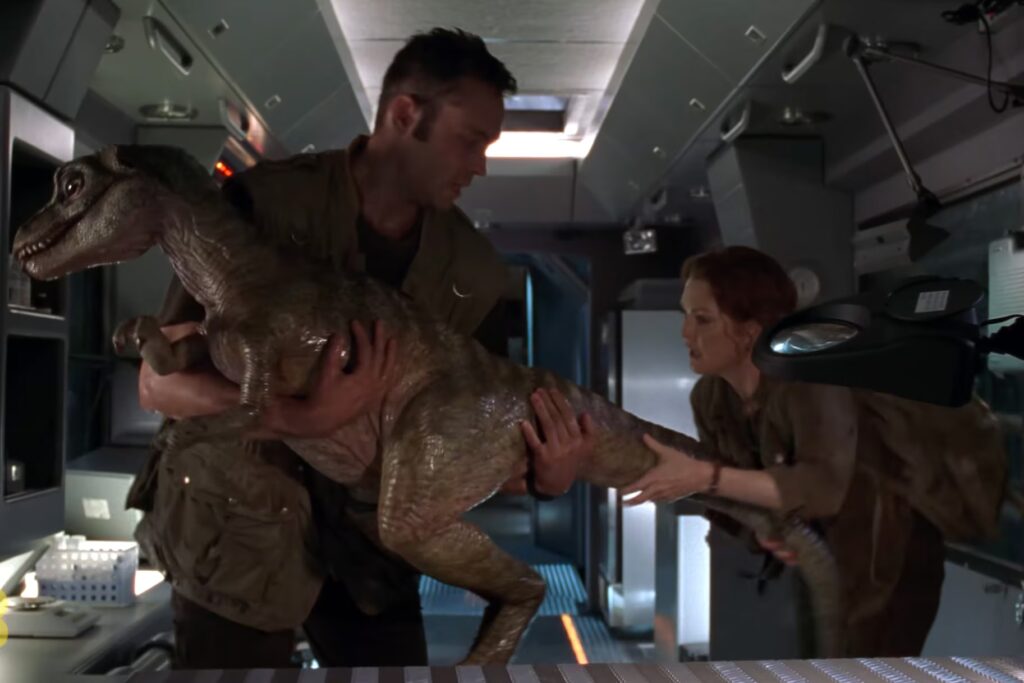

For better or worse, 1997’s The Lost World: Jurassic Park doubled down on the dino-action of its 1993 predecessor, with not one but two T. rexes.
The dual Tyrannosaur attack on the trailer in the middle of a tropical rainstorm, for instance, mirrors the rex breakout in the first movie, while amping up the danger by a considerable amount.
Ian Malcolm (Jeff Goldblum) sums it up best when he says, “Mommy’s very angry.”
It doesn’t matter that Nick Van Owen (Vince Vaughn) and Sarah Harding (Julianne Moore) are trying to help the couple’s baby. How do you even begin to explain the concept of a broken leg to a pair of 15,000-pound predators that lived 66 million years ago?
The short answer is you don’t. You just set the fracture quick as you can, give the child back and pray your little heart out there’s no retaliation from the highly territorial parents with the strongest bite force of any creature that ever walked on dry land.
But here’s the thing: Nick and Sarah weren’t working on a single baby dinosaur—they were working on three (designed by Joe Orosco, who had helped bring the sick Triceratops to life in Jurassic Park).
Why The Lost World: Jurassic Park Built 3 Different Versions of Baby T. rex
As revealed in James Mottram’s Jurassic Park: The Ultimate Visual History, Stan Winston Studios built a trio of animatronic infants for the Steven Spielberg production (technically four if you count the CGI build used for Peter Ludlow’s demise).
According to the The Ultimate Visual History, the three variations included, “a hydraulic-operated version for close-ups; a version with limited head and tail movement for long shots; and an entirely self-contained battery-powered unit that could be clipped onto the actors via a belt and carried freely during tracking shots.”
The third version can be seen when Nick carries the creature into the trailer for triage.
“The whole thing was done with remote-control devices off-camera,” Spielberg said in Mottram’s book. “One controller for the tail, another controller for the eyes and mouth. And, of course, these controllers are working in all-metal trailers. So there was often a lot of interference and unexpected [creature] movement that was never planned for.”
He continued: “It was a schlep for Vince Vaughn to carry that thing right into the trailer and set it down on the table. But it looked so real in every shot. And by the way, it never failed—it worked perfectly, every time.”