
‘I met with people who had their flats redeveloped. I saw this was a real human struggle.’
‘People get caught in the middle between their dreams, wishes and their community.’

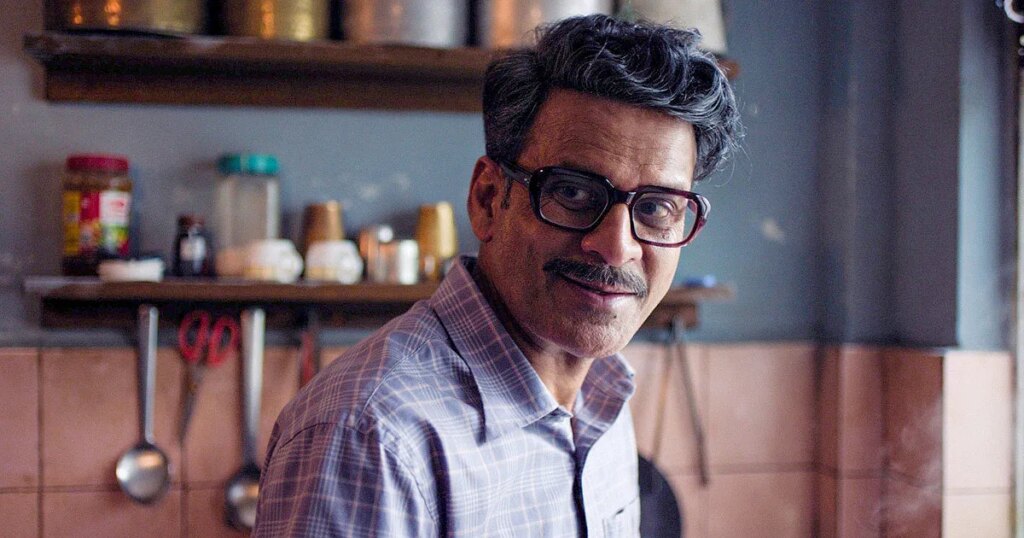
IMAGE: Manoj Bajpayee in the Last Man In Tower.
Key Points
- ‘It took me about a year to convince him to do it. The reason he’s such a great actor is because he’s highly selective. He’s very much in demand. He says no to like 90 percent of projects that come his way.’
- ‘When I saw Divya Dutta’s take on the character, I was blown away. She could be sincere, manipulative, warm, and cunning, all at the same time. Very few actresses have that kind of range.’
- ‘Rana Daggubati is quite a rebel to be out there pushing alternative cinema and believing that there’s an audience for these films.’
California-based filmmaker Ben Rekhi has made a range of films, from Breaking The Code (2026) a new documentary on his father and IT pioneer Kanwal Rekhi to a thriller Waterborne (2005) in which Shabana Azmi played a Sikh woman.
Rekhi’s latest film is an ambitious project Last Man In Tower, an ensemble piece based on Booker Prize winner Aravind Adiga’s novel. The film stars Manoj Bajpayee as Masterji, the last man holding on to a flat in a run-down society in Mumbai. Divya Dutta and Chandan Roy Sanyal play Masterji‘s neighbours, who are desperate to cash in by selling their flats to the greedy developer, Shah (Boman Irani).
Rekhi worked with scriptwriter Sooni Taraporevala (Salaam Bombay and The Namesake) to adapt Adiga’s book. Juhi Chaturvedi (Piku) was brought in to write the bright, sharp Hindi dialogues.
Rekhi’s biggest supporter on this project was the Telugu actor Rana Daggubati, whose company Sprit Media produced the film.
Moving and well-acted, Last Man In Tower is a strong story of one man’s struggle against an unjust, uncaring world.
Aseem Chhabra spoke to Ben Rekhi about the making of the film, the 10 years it took him to mount the project and how many times he faced disappointments.
“It’s almost a miracle when a film like this comes into the world and gets a theatrical release,” Ben says.
Ben, I read Sooni’s post on Instagram. You two have been working on this film for a very long time. How did it start?
Yes, 10 plus years. I got involved in the project after reading the book. A friend got me reading it after The White Tiger had been a huge success. The White Tiger movie had not been made yet.
I had just left the film studio I was working for, and reached out to Aravind to see if the rights were available for Last Man in Tower. They were, but it took me several months to gain his trust that I would take good care of the book.
Sooni was the first collaborator that I brought on board because I wanted someone who could adapt this for a global audience, and who had that sort of experience. I raised a little bit of money to do the development, but it went through many different false starts, almost getting made and then falling apart.
It was a long journey of resilience to bring this story to the screen. It’s almost a miracle when a film like this comes into the world and gets a theatrical release.
Ten years is a very long time, but did you have the actors attached to it? I heard that at one point, you were considering Irrfan Khan for the main role.
It’s like the whack-a-mole game. Every time you get one thing in the hand, the other thing falls out. There were financiers who would say, ‘If only you get this actor.’
You would pursue an actor for a while but then the financing would fall out.
Sometimes, the best ones take the longest to put together, and they also happen to come into the world at the moment that the audiences are ready to receive them. Ultimately, we ended up with a dream cast.

IMAGE: Manoj Bajpayee, Divya Dutta along with Director Ben Rekhi and Producer Rana Dagubbati. Photograph: Kind courtesy Divya Dutta/Instagram
Eventually, you reached out to Spirit Media to produce the film.
I had known Pratiksha Rao from Netflix for a while, and she was a huge fan of the project. When she joined Spirit, she said, ‘Hey, is this something you’d want to do with Spirit? Why don’t you talk to Rana?’
They were just starting to distribute these types of films. I met Rana and realised he shared a vision for doing something different with the film and how to bring it to the world.
It’s very impressive considering he’s such a solid star in Telugu cinema, yet he stepped forward to distribute Payal Kapadia’s All We Imagine as Light.
It’s brave. Not many people will put their star equity at risk for launching other types of stories and films. He’s quite a rebel to be out there pushing alternative cinema and believing that there’s an audience for these films.
You are an Indian American, born in California. I know you have had connections with India. You had the source material — the book, and also Sooni’s script. But how did you get comfortable with understanding the Indian middle class and its nuances?
I lived in Mumbai for about four years over the past 10. I spent a lot of time on the ground here, even sometimes getting flats in these societies. But I am a documentary filmmaker too. Much of what I do on the nonfiction side is research, not just behind a computer, but out in the world talking to people.
I would sit with residents and talk to them. I met with a lot of builders. I met with people who had their flats redeveloped, people who were crying on my shoulder that their builder had screwed them.
I saw this was a real human struggle. People get caught in the middle between their dreams, wishes and their community.
I think in some ways, being bicultural allows me to look into this world from a unique perspective. America is a very diverse place. We have to try and sort through our differences all the time, sometimes less successfully than others. And so, this microcosm of multiculturalism, like how people come together in a society, was something I intuitively related to. I didn’t realise how much I was prepared to understand.
Of course, then you work with the actors and say, ‘Okay, this character is Gujarati, this character is Punjabi. How does that inform you how they speak? What are their values?’
Also, it’s a collaboration in the end, and I am not shy to ask for help.

IMAGE: Divya Dutta in the Last Man In Tower.
In the book, there are a lot of details about the other characters and their own arcs. I know you had to tighten the script and focus on the main narrative, but how did Sooni and you decide what stays in and what doesn’t?
Adaptation is an art form in itself. Initially, because there were so many characters and storylines, we had tinkered with the idea of doing this as a series. But without giving anything away, the film has a finite end.
With series, people always want it to be ongoing so that you can have season 2, 3 and 4. We thought of it as a limited series, with say five episodes. But finally, we arrived at the format of the feature film, where you get in, see the story, get your heart broken, mind blown, and then get out. It seemed the best way to tell the story because of the structure of the book.
So then you have to think what stays in and what goes, and that’s where Sooni was my partner in crime. She’s been down this road before. It’s sort of like doing surgery where you pull out the skeleton and then have to build new flesh around it for the film.
What is the essence of this? What’s the soul of this? How do we say this with less characters, in less scenes?
In some ways, that forces you get creative.
How do you honour the original work but recognise that it’s a new medium?
Of course, the book was always our north star. If there were any questions or thoughts about the characters, we would go back.
We did take some liberties in the storytelling that deviated from the book.
A big one was Masterji‘s reasons for not wanting to sell his apartment. It was one of the biggest questions where I think even he, as a character, doesn’t know. He has his surface reasons, but as he goes deeper into himself, he realises that there’s a part of him that’s broken and hurt, and this is him trying to fix that.
We spoke a lot about it, even with Manoj because it’s not in the book.
In the book, it was enough that he just doesn’t want to sell the flat.
But in the film, you want to give the audience more insight into this guy’s mind. So we put a little more backstory into the characters.
The biggest change was focusing on the housing society, and not get too caught up with all the family and friends of the residents.
In the trailer, there’s a dialogue that Mrs Puri (Divya Dutta) says about Masterji — that he’s like a jackfruit with spikes outside, but soft and sweet from inside. /strong>
Yes, stuff like that was Juhi Chaturvedi’s contribution. She came up with brilliant lines that encapsulated so much about how they saw each other.
Tell us about that process. Once the script was done, and Sooni writes in English, then Juhi stepped in?
We always knew this was going to be a Hindi film to keep the authenticity, and Juhi is brilliant at finding those emotional and colourful descriptions, being poetic, but also plain spoken as well.
From a story point of view, with Aravind Adiga, Sooni and Juhi, I mean, that’s the triad right there. It’s amazing that these three giants came together for this epic story.

IMAGE: Boman Irani, Manoj Bajpayee, Divya Dutta on the Last Man In Tower poster. Photograph: Kind courtesy Divya Dutta/Instagram
Let’s talk about the actors. You have a fine collection of actors. How much did you work with each of them?
The first order of business was figuring out Masterji, because the whole story rests on his shoulders.
Like so many people, I have been following Manoj for years, especially in the last seven-eight years. He has really come into his own as this incredible force, someone who people are excited to see.
It took me about a year to convince him to do it. The reason he’s such a great actor is because he’s highly selective. He’s very much in demand. He says no to like 90 percent of projects that come his way.
We had met in New York. I was introduced through Rahul Chittella (Gulmohar director). Once Manoj read the script, he was intrigued. One of the first things he said to me was, ‘Masterji is not a simple character. This guy is very complicated. There’s a lot going on.’
We spoke a lot.
This guy isn’t likable a lot of the time. He’s very cranky. He can be brash. He can be righteous. We talked about how to find the humanity in him and make him morally gray.
Once Manoj was on, it was a race to find who else was going to be around him because the film is an ensemble piece. Mrs Puri’s character was important because in many ways, there is a psychological warfare between her and Masterji.
When I saw Divya’s take on the character, I was blown away. She could be sincere, manipulative, warm, and cunning, all at the same time. Very few actresses have that kind of range.
Chandan Roy Sanyal was another great find. He was a real estate broker. You know he could be a little slimy, but he was also fast talking and smart. We didn’t want him to be too much of a scumbag or too far in the comical direction.
Boman Irani is known as a comic actor, and now he’s been doing more drama like in his own film (The Mehta Boys). But it was new for him to play a villainous and sinister character, with blunt wisdom. He played with a straight face. It could be funny but he was able to do that in a sincere way.
What do you think the audience will get out of the film?
On the surface, the film is about redevelopment, which everyone understands. But beneath that, it’s about change.
The world is changing fast, whether it’s AI or climate or technology, and it’s very disorienting.
But do we need to rush ahead?
Are we losing something in the process?
Masterji is trying to tell everyone, ‘Hey listen, you guys are rushing. We have this beautiful family here. If you chase material things, you are going to lose what makes us special.’
Photographs curated by Satish Bodas/Rediff