
Frequently asked questions
How do LED face masks work exactly?
LED (light-emitting diode) masks use specific wavelengths of light that penetrate deep into the skin to stimulate natural repair processes, says Joshua Zeichner, MD, a board-certified dermatologist and associate professor of dermatology at Mount Sinai Hospital in New York City. This can help improve skin texture, tone, and elasticity, while addressing concerns like acne (and acne scars), dark spots, rosacea, eczema, hyperpigmentation, redness, fine lines, wrinkles, and even psoriasis.
You might be wondering, “Do they actually work?” Well, according to numerous studies “LED light therapy can aid in skin healing, improve chronic conditions like acne and rosacea, and enhance overall skin health,” says Viktoryia Kazlosukaya, MD, PhD, a board-certified dermatologist in New York City. “That said, the results are often modest and gradual. It’s essential to set realistic expectations—LED masks are not a substitute for professional skin care, cosmetic procedures performed by board-certified dermatologists, or prescription medications. They are best viewed as a supplementary tool in a broader skin care routine.”
As far as how long they take to work, LED face masks generally begin to show noticeable results within three to four weeks of consistent use (consistency is the key word here). Initial improvements often include smoother skin texture and reduced acne inflammation. For more significant benefits, such as diminished fine lines and enhanced skin tone, it may take two to three months of regular treatment. Results will vary based on your skin type, the concerns you’re trying to address, and the quality of the device.
The most effective LED face masks emit wavelengths of red light between 620 and 750 nanometers, blue light between 405 and 420 nm, and infrared light between 760 and 1,400 nm, says Anna Chacon, MD, a board-certified dermatologist in Miami. Consistent use (approximately three to five times per week) at this level should produce results within about two months, she says.
How to choose an LED face mask
When choosing an LED face mask, start by considering the light modes, design, and safety features.
- Light modes: Most masks use red light or a combination of red and infrared, but some include blue or amber lights to target specific concerns. Common wavelengths (measured in nanometers) and benefits include:
- Red-light therapy (620–750 nm): Penetrates deeply, reduces inflammation, stimulates collagen and elastin, and helps minimize fine lines and wrinkles
- Blue-light therapy (405–420 nm): Targets acne-causing bacteria with antimicrobial properties
- Infrared, near-infrared, and amber light therapy (760–1,400 nm): Helps reduce redness and even out skin tone, including dark spots and sun damage
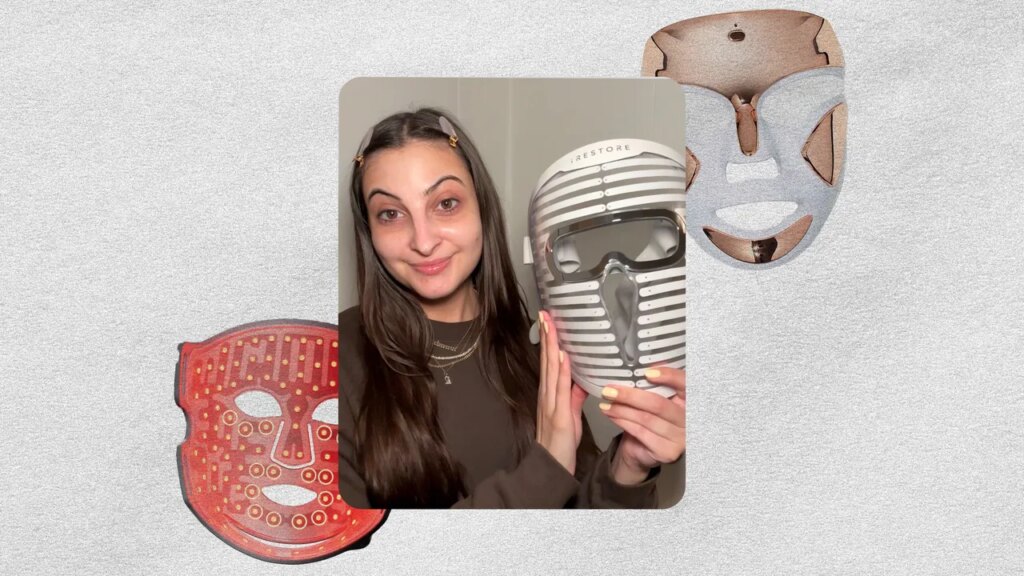
- Design: Masks can be structured and molded or flexible silicone. Structured masks may sit closer to the skin, while flexible masks are often lighter and more comfortable. Fully wireless designs are ideal, though some masks include clips to help offset bulky battery packs or controllers.
- FDA clearance: Safety and efficacy are critical. All the masks on our list are FDA-cleared, a point emphasized by both the Mayo Clinic and the dermatologists we consulted.
Tips to start using an LED face mask
When using an LED face mask, start by cleansing your skin thoroughly to remove makeup, dirt, and oil, and make sure it’s completely dry—any products left on the skin can interfere with light absorption. For best results, fit the mask so it sits flush against your face, then turn it on.
Usage frequency and session length depend on the product’s instructions. Most masks recommend 10-minute sessions, though some can be as short as 3 minutes or as long as 20 minutes. After your session, you can immediately follow with your regular skin care products, such as serums and moisturizers. There’s no required time of day—morning or evening works equally well.
How long does an LED face treatment last?
According to the experts we spoke with, you should only leave an LED face treatment on for 10-20 minutes. “Most devices have protocols from three to twenty minute treatments and some twice a day,” says Lloyd Nelson, CEO and president of LED Technologies. Start by confirming that the product is FDA-cleared, he says, which will ensure that the proper treatment times from clinical research are built in. “Usually, the shorter the treatment time, the more powerful the optical output is,” says Nelson. It’s important to follow device instructions and not leave the mask on longer than intended, as this can lead to sensitivity, redness, or increased pigmentation (which is kind of the opposite effect of what you want!).
Are LED face masks safe for your eyes?
Yes, red-light therapy face masks are generally safe for your eyes. “Most lights aren’t likely to damage the eyes, unless we are talking about ultraviolet light (UV) or staring at intense bright light (think of looking directly at the sun during a solar eclipse),” says Michael Brusco, MD, FADCS, medical director and surgeon at Brusco Vision in Washington, DC.
If the mask feels very bright or causes glare, it’s usually more annoying than harmful. If you have sensitive eyes, make sure to select a mask with built-in eye protection. And if you experience any dryness, Dr. Brusco recommends using eye drops.
Can you overdo it with an LED face mask?
You can overuse an LED face mask, though any side effects are unlikely to be significant. “Overusing an LED face mask can lead to skin irritation, dryness, or sensitivity,” says Kristina Collins, MD, a board-certified dermatologist in Austin, Texas. “While LED light therapy is generally safe for most skin types, excessive use—beyond the recommended frequency—does not necessarily yield better results.” Follow your product’s instructions, and if you experience burning, stinging, or redness, stop using the mask and consult a dermatologist.
What color LED is best for various skin concerns (like rosacea, dark spots, or acne)?
“Blue and red are good for acne,” says Amy Taub, MD, a board-certified dermatologist based in Illinois. “Yellow light is good for hyperpigmentation, and green light is good for aging,” she adds. If you have rosacea and discoloration, red light should do the trick, or if your concerns are mainly wrinkles and loss of volume, a combination of red and infrared can help plump and soften skin. Red light is also a proven method for increasing hair growth, if that’s a concern as well.
Should mature skin use LED face masks?
In most cases, mature skin needs the most collagen boosts, so it is recommended to try LED light therapy. “As we mature our overall metabolism declines which includes what happens within our skin, LED light energy penetrates deep into the skin to reenergize the collagen cells to stimulate additional production,” says Nelson. Red light is best for wrinkles, while green and infrared can help combat deep creases and sagginess.
Who should not use LED light therapy?
Avoid using LED light therapy if you have any active inflammatory skin conditions or are immediately post-procedure from things like microneedling or laser resurfacing, says Meredith Price, MD, a board-certified dermatologist in Grosse Pointe, Michigan. “I always advise caution to patients with melasma, as this is a light- and heat-sensitive condition. I’ve seen red-light therapy masks help melasma, and I have also seen them worsen it,” she says. “Most LED devices have not been assessed for safety in pregnancy and breastfeeding, so I advise avoidance during that time as well.”
Is LED light therapy safe for dark skin?
“LED masks are generally safe for dark skin,” says Asmi Berry, DO, FAAD, a board-certified dermatologist in Los Angeles. “Unlike lasers, LED light doesn’t target melanin, so there’s no increased risk of burns or hyperpigmentation for deeper skin tones.” She advises sticking with FDA-cleared, dermatologist-recommended brands, which tend to be more extensively tested on all skin types. “If you’re using an at-home mask, make sure it doesn’t get hot. For sensitive skin, too much heat or irritation could trigger inflammation, which in darker skin can sometimes lead to post-inflammatory pigment changes,” she says.
We test red-light therapy face masks by surveying popular, well-reviewed devices and consulting dermatologists for their personal and professional recommendations. Our testing includes a wide range of FDA-cleared masks, with wavelength measurements of between 633 nanometers and 830 nanometers. All masks we tested had to have a comfortable fit, plus other features, like a cordless battery pack or cooling setting. Our testers brought various skin concerns to the table, from acne, to rosacea, wrinkles, sagging skin, and more, and they evaluated each mask for comfort, design, treatment time, and ease of use.
Because red-light therapy takes time to show results, we encourage testers to keep and use the masks consistently over several months (and ideally longer), giving us a clear picture of long-term performance and effectiveness. We also continuously test new and next-generation models to update this guide with fresh insights on efficacy, durability, and overall experience.
- Amy Taub, MD, a board-certified dermatologist based in Illinois
- Y. Claire Chang, MD, board-certified cosmetic dermatologist at Union Square Laser Dermatology in NYC
- Jessica Weiser, MD, dermatologist at Weiser Skin MD in NYC
- Joshua Zeichner, MD, board-certified dermatologist and associate professor of dermatology at Mount Sinai Hospital in New York City
- Kristina Collins, MD, board-certified dermatologist in Austin, Texas
- Lloyd Nelson, CEO and president of LED Technologies
- Michael Brusco, MD, FADCS, medical director and surgeon at Brusco Vision in the Washington, DC, area
- Meredith Price, MD, board-certified dermatologist in Grosse Pointe, Michigan
- Anna Chacon, MD, board-certified dermatologist in Miami
- Viktoryia Kazlosukaya, MD, PhD, board-certified dermatologist in New York City
- Asmi Berry, DO, FAAD, board-certified dermatologist in Los Angeles