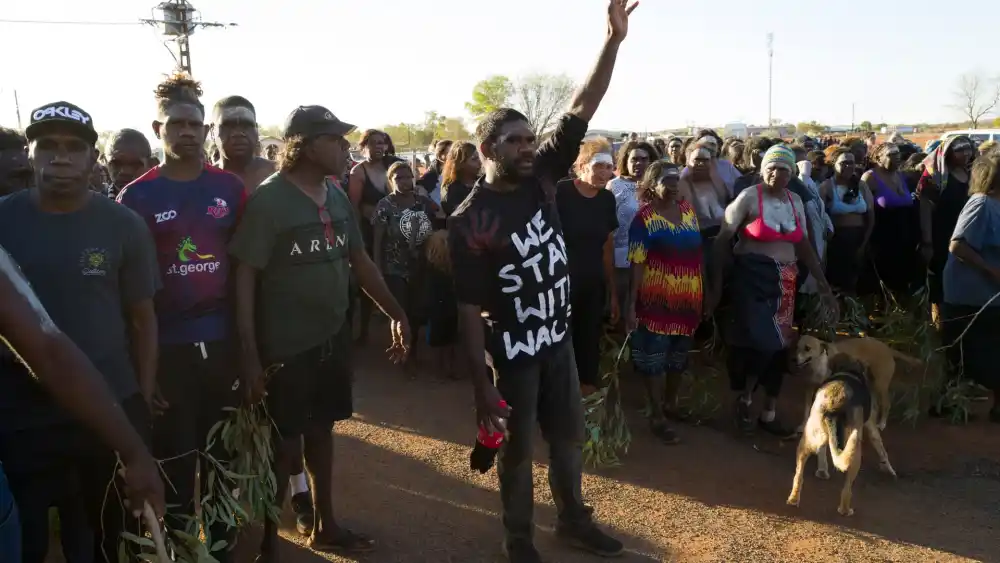

Australian docuseries “2.6 Seconds: Death in the Outback,” which world premiere at Toronto Sept. 10 as part of TIFF‘s Primetime strand, has just been the subject of a preemptive Netflix buy for the world.
That speaks well for a four-part series examining the fatal shooting of 19-year-old Kumanjayi Walker by Northern Territory police officer Zachary Rolfe in the remote community of Yuendumu, tracing how the 2.6 seconds between the first shot and the last upended the lives of those involved as well as the national discourse.
In his directorial debut, Darren Dale uses archival footage, courtroom testimony and intimate interviews with both families to reconstruct the case from multiple perspectives.
Produced by both Dale and Jacob Hickey for Blackfella Films, “2.6 Seconds: Death in the Outback” is co-commissioned by SBS and NITV, with major investment from Screen Australia’s First Nations department and Screen NSW, and produced in association with All3Media International. The series arrives on the heels of Dale’s 2012 production “The Tall Man,” about the death of an Aboriginal man in police custody on Palm Island, and his AACTA-winning drama “Total Control,” which also premiered at the Primetime strand at TIFF in 2019.
“Primetime introduces audiences to the best in global, episodic storytelling,” said Geoff Macnaughton, TIFF’s VP of market programming and theatrical. “International programmer Jason Ryle discovered ‘2.6 Seconds’ during the summer. We’ve programmed other Blackfella Films productions at TIFF, including ‘Total Control’ in 2019, which went on to win best TV drama at the AACTA Awards. We’re excited to see how audiences respond to ‘2.6 Seconds’ this September.”
Variety spoke with Dale about making the series and what he hopes international audiences take away from it.
What led to your covering this case? And what did filming the series reveal to you about Australia?
Dale: We made a film in 2011, “The Tall Man,” about the death of Mulrunji Doomadgee in police custody on Palm Island. In 2019 you have nearly the same thing play out again, a young Aboriginal man dead at the hands of police. What struck me was the disparity in how Aboriginal people are treated by the justice system when a calamitous event like this happens. It was about trying to make the country care: to see that this young man’s life is as valuable as if it were anyone’s own grandson, son, brother. Two men, eight or nine years apart, from two very different places, come together in a room, and within a short space of time one of them is dead. What led us to that point? For me the project was: How do we make the country care, how do we make the world care?
The series centers around a moment, expanded over four episodes. How did you decide what needed to be unpacked in order for an audience to understand what happened in that moment?
Dale: We live in a world where conversations quickly turn to binaries: people jump to certainty rather than sitting with what’s difficult. Either the cop is the villain or the victim had it coming. I thought if we ever want to truly understand, we have to be curious about the moments we’re uncertain about. So the series looks at both men, and both sides: what it’s like to be a young police officer in Alice Springs, where 90% of whom you police is Aboriginal, and you’re seeing the fallout of domestic violence, alcohol, substance abuse, alongside a young Aboriginal man’s own life and circumstances. We never wanted the film to shout. Everyone in it speaks with real grace and humility. It’s true crime, but told with composure. This case has already been pored over in a murder trial and a coronial inquest, so the job was bringing those threads together for a contemporary audience to actually feel what happened, and make their own assessment. It’s easy to look away now; algorithms feed us what we want to see. The series asks what we’ve all been complicit in by looking away.
You’ve spent most of your career as a producer. What put you in the director’s chair for the first time?
Dale: I’m deeply fascinated by these stories, by what documentaries can do as a window into ourselves. Andrew Boe, the writer, had been the barrister on the Kwementyaye Doomadgee case that “The Tall Man” was based on, and we’d stayed in that conversation for years. I went to Alice Springs, sat in on the coronial inquest hearings, and met the family. After that, I couldn’t see how I’d hand this to another director and have them just plug in; the complexity and the emotion of it made that feel wrong. I raised directing it myself with SBS, half-expecting pushback, and they said it was music to their ears. Two and a half years later, here we are premiering two episodes at TIFF.
For an international audience who knows nothing about Kumanjayi, what do you hope they take away?
Dale: Two things. I hope it puts an uncomfortable spotlight on Australia and how race relations play out here: we’re an island continent, easy to feel remote, but just as connected to the world as anywhere else. I want people to understand the conditions First Nations people still live in in Central Australia, and how present the effects of colonisation still are. But I also think there are parallels everywhere in how marginalised groups are treated. This story is an invitation to care, to have empathy for someone else’s experience, to ask what leads a country to a point where a man can walk into a room and, within two minutes, another young man is dead on the floor, and that’s allowed to happen. It’s been told and told, but do people actually care? I think people everywhere, whatever the divide, feel the margins more than ever, and this asks all of us to question ourselves.