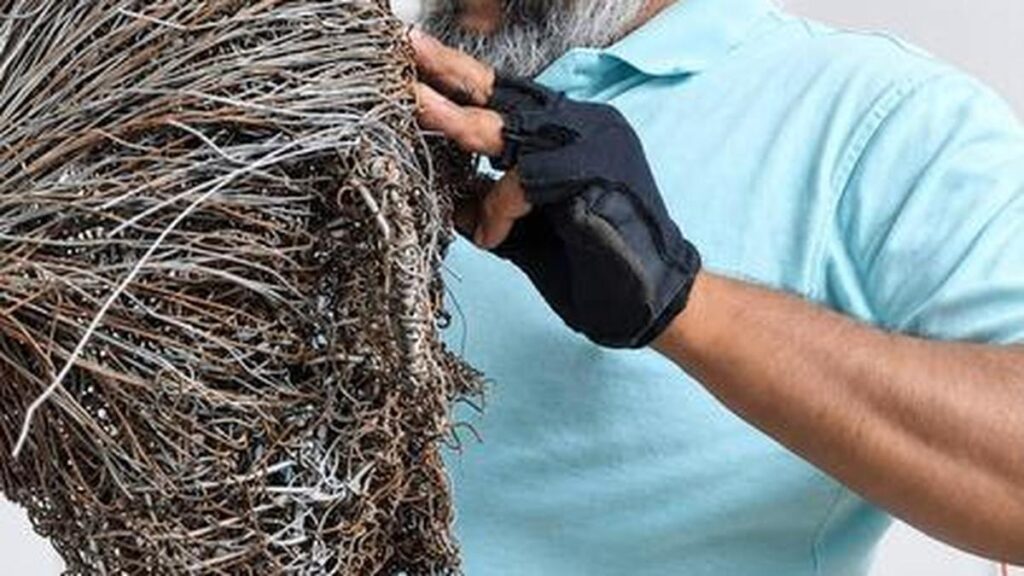

At first glance, it resembles a pile of wires. On closer look, the contours of a face become evident. That is the idea behind G. Sooriyamoorthy’s “The Imaginative Metal Wire Portrait of an Artist”, one of two sculptures he is preparing for Aurae Elemental, an art show where he will stage his experiments with unconventional materials and painstaking techniques spanning 26 years. His second work, “Within the Armour”, engaged with a different material and manages a distinct effect: nuts and bolts assembled into the form of a warrior.
The works might differ in appearance, but both reflect Sooriyamoorthy’s preference for materials that demand time, precision and physical effort.
“People ask me why I am using metal wire when it is so time-consuming,” he says. His welding shop is in Tambaram, requiring him to travel back and forth from his home in Ayanavaram as he works on the sculptures. “People ask why I put in so much effort when there are easier ways of creating art. For me, the effort is part of the process.”
To reach its final form, the wire portrait consumed three months. The idea came from drawing: Sooriyamoorthy imagined a face made up of multiple lines, with each wire functioning like a line on paper. Instead of lying flat, however, the lines intersect and move through space, gradually forming the figure.
The process involved little machinery. Using cutting pliers, he cut, stretched and tightened the wires before weaving them together. Continuous work for even 30 minutes to an hour could leave his hands hurting. The ponytail was particularly demanding, with individual wires cut to different lengths and shaped by hand. “No large machines were used,” he says. A small skull-like structure sits at the centre of the composition, helping hold the interwoven wires together. The construction, which resembles basket-making, gives the sculpture stability despite the thin material. The metal was also treated to achieve an antique finish.
His second sculpture began with a different challenge. Sooriyamoorthy had been looking for an opportunity to experiment with nuts and bolts when he conceived the idea of a warrior. But before he could begin welding, he had to work out the figure itself. He first made a clay model, shaping and carving the anatomy while leaving spaces for the nuts and bolts to fit. The model was then used to make a plaster of Paris mold.
The choice of plaster was practical. Welding generates considerable heat, and Sooriyamoorthy says plaster of Paris absorbs the heat and helps keep the metal cool. Fibre, another material that is generally used for larger sculptures, could pose a fire risk under welding conditions. The nuts and bolts were welded from inside the sculpture. For the warrior’s hair, he used 8 mm metal rods, bending and shaping them before welding them into place. The clay model was started around four months ago, while the welding took four days.
“I was able to finish it in a short span of time because I made sure the clay model was perfect in shape. This allowed me to easily weld the nuts and bolts according to my requirements,” he says.
The contrast between the two sculptures also points to Sooriyamoorthy’s larger approach to materials. Stone remains his favourite, largely because of the difficulty involved in working with it. Fibre is comparatively easier, he says, while metal and stone require greater time and effort. That difficulty, rather than convenience, appears to be what keeps him experimenting. As he gets the two sculptures ready for Aurae Elemental, the material is as much a part of the work as the form it eventually takes.
An eclectic mix of artists
Aurae Elemental, an art exhibition featuring artists at different stages of their creative journeys, will be held from 10 to 15 October 2026 at Lalit Kala Akademi, Thousand Lights. The exhibition, which will be inaugurated on October 9, at 5.30 p.m., brings together emerging artists, first-time exhibitors, passionate learners and experienced professionals, creating a space for diverse artistic practices
and perspectives.
The title Aurae Elemental reflects the exhibition’s focus on the energy and presence surrounding artworks and the raw, instinctive nature of creativity. “Aurae” refers to the subtle energies associated with each work, while “Elemental” represents creativity in its pure and unrefined form. The exhibition explores how artistic expression takes shape through instinct, intuition and creative impulse.
Bringing together painters, sculptors, visual artists, designers, art educators, installation artists, digital artists and practitioners from various disciplines, the exhibition presents a range of mediums, approaches and artistic journeys.
Published – September 13, 2026 08:12 am IST