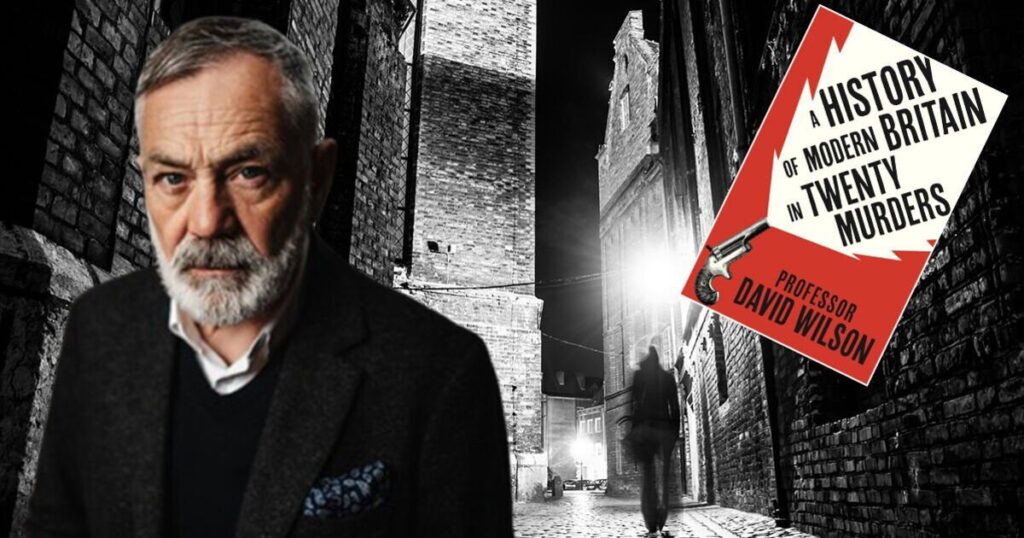


Professor David Wilson with his new book A History of Modern Britain in Twenty Murders (Image: -)
Britain’s biggest police force is “not fit for purpose” and needs “radical” reform to prevent murders like that of Sarah Everard from happening again. That damning indictment of the Metropolitan Police comes from Professor David Wilson, a leading criminologist who has devoted his career to trying to understand the murders that have gripped the nation and what can be done to prevent them in the future.
For his latest book, A History Of Modern Britain in Twenty Murders, which is out now in paperback, Prof Wilson, 69, examines shocking cases from 1885 to 2025 to see what each one reveals about British society and how it has developed. This includes the crimes of Jack the Ripper, the shocking “Brides in the Bath” deaths, through to the tragic murders of James Bulger and Sarah Everard.
The final murder covered in the book was that of Miss Everard, a 33-year-old marketing executive who was abducted as she walked from a friend’s house in Clapham, south London, in March 2021.

Sarah Everard was raped and strangled by off-duty Met Police officer Wayne Couzens (Image: PA)
Wayne Couzens, an off-duty Met Police officer, used his position to handcuff and drive her to Kent where he raped and strangled her, before burning her body and disposing of her remains in a pond in woodland. He was given a whole life prison sentence for this.
Prof Wilson, who will be a special guest at Bloody Scotland crime writing festival in Stirling next weekend, says: “I chose to end the book with Sarah Everard’s murder even though it took place in 2021 because so many of the themes that surround that murder continue to resonate in British culture, such as concerns about the safety of women.
“A myth about Britain has always been that the British police are the best in the world. Well that kind of myth is completely and utterly undermined by everything we know now about the vetting procedure that allowed Wayne Couzens to be recruited first into Kent Police, then the Civil Nuclear Constabulary and then the Met Police.
“This is someone who had pleaded guilty to three indecent exposures, two of which took place in the months preceding Sarah Everard’s murder. If those incidents had been taken more seriously there is absolutely no doubt that Sarah Everard would be alive today.”
He adds: “It was also a murder I could use to say we have to take those type of incidents more seriously – one in 10 men who indecently expose will go on to commit more serious sexual offences. We know that Wayne Couzens committed six types of indecent exposure during his career.
“In reports he was seemingly known by his colleagues as ‘The Rapist’. In what way is this man a suitable person to become a Met Police officer? It’s absolutely absurd.
“So I used Sarah’s murder to talk about the safety of women but also to begin that sense of, we need to think about who polices us and who holds them accountable, and how fit for purpose is the Met Police?

Renowned UK criminologist Professor David Wilson (Image: -)
“And the answer to that last question is that it is not, and we have to really consider radical ways of reconstituting policing in London to better fit local communities. The Met Police is too big. It is the largest police force in the UK and serves 13 million people and the next largest is Police Scotland that serves five million.
“You have got to start saying how centralised and bureaucratic it is, it needs to be de-centralised. There are 11 ranks between a basic police constable and Sir Mark Rowley (Met Police Commissioner). This needs to be flattened as a hierarchical structure.
“So the book allows us to look at how Sarah Everard’s murder took place and what we can do to prevent that happening again in the future.
The criminologist, who was a prison governor before pursuing an academic career, worked on this book for more than a decade after the seed of the idea was planted when reading Nicci Gerrard’s book about the murders of 10 year olds Holly Wells and Jessica Chapman in Soham, Cambridgeshire in August 2002.
Her book, Soham : A Story Of Our Times, was published in 2004 and sought to look at the wider meaning of the hysteria and terror the murders generated, not just at their specific horrors.
Prof Wilson, who studied history at Cambridge University before going into criminology, was impressed by the conclusions of Gerrard, a novelist with a passion for true crime.
He says: “I thought she had a very good argument within what she wrote and then I thought that could be extended over a longer period to tell the story of Britain from the Victorian period to the present day.”

Murdered two-year-old James Bulger (Image: -)
The father-of-two, who lives with wife Anne in Buckinghamshire, started off with a long list of shocking murders but was stunned to find some of the cases covered by the Official Secrets Act until the 2050s, limiting the amount of information available to him.
One of these was Kelso Cochrane, a carpenter from Antigua, who was stabbed to death in May 1959 during an attack by a white gang in Notting Hill, west London. No-one was ever charged.
The murder came a year after the 1958 Notting Hill race riots, but police said there was no racist motive and that Cochrane had been killed for money.
Another was two gay men William Elliott and George Stobbs, who were killed by a former soldier Michael Copeland in 1960 and 1961, which was still included in the book.
Prof Wilson says: “A lot of the research was often frustrating, because I could not understand why I could not get information on murders which I thought should be in the public domain.
“I started thinking of murders that struck me as holding a bigger narrative, and often I then discovered others linked to them that I then had to consider. The title of the book is 20 murders but there are actually a lot more than that mentioned in it, more like 40.”
One of those was Gordon Cummins, a Blitz spree killer dubbed The Black-eyed Ripper for murdering three women under the cover of darkness in the 1940s.
The Blitz spirit has long been cherished by successive generations but lesser known is that the crime and murder rate skyrocketed during that period.
Prof Wilson says: “This was my way into discussing the prevalence of crime and how The Blitz could be used as a mechanism for people to kill and to rob and to rape, so The Blitz spree killer Gordon Cummins was one of the crimes that I very much focused on, how he used the darkness of The Blitz to kill three women and attempt to kill two others.”
Likewise he adds the 1960s is seen as a time of sexual revolution and liberation that is often harked back to. He says: “The 1960s is always seen as a time of mini-skirts and letting it all hang out, about sexual revolution.

A book cover image for A History of Modern Britain in Twenty Murders (Image: -)
“It’s a decade that has been almost mythologised as a period of radical social change, which was true to a certain extent.
“But the two murders I looked at in the 1960s were of a gay and a bisexual man in Chesterfield (William Elliott and George Stubbs), and our very first serial killer post Second World War was the man who killed them, Michael Copeland, a former soldier who came from Chesterfield.
“I wanted to use those murders to challenge the idea the 1960s were a time of sexual liberation, as for the two people who were murdered there was no revolution at all – their sexuality had to be well hidden.”
Another case covered in the book is the murder of Jimmy Mizen, a young man killed by Jake Fahri in a bakery in south-east London in 2008.
The author, who is Emeritus Professor of Criminology at Birmingham University and a co-host of the podcast This Much Is True Crime, adds: “I looked at the murder of Jimmy Mizen because I wanted to talk about murder stemming from young men fighting young men.
“That is really the story of murder in modern Britain, that it is young men attacking other young men as a kind of performance of masculinity.”
Prof Wilson says he is looking forward to talking more about his book in the closing event of Bloody Scotland crime writing festival in Stirling next Sunday (SEPT 20).
He says: “I went to Bloody Scotland in 2013, the year after it was established. I’ve been back on a couple of occasions but haven’t been back for five years, so I’m delighted to be closing the festival as it’s one I really admire.
“It’s the best of true crime and gives the public exposure to new ideas, even though it’s focus is largely fiction.”
*A History of Modern Britain in Twenty Murders by Professor David Wilson (paperback, £12.99) is out now. For more details about Scotland’s international crime writing festival go to bloodyscotland.com