
Toward the beginning of Tim Blake Nelson’s “The Life and Deaths of Wilson Shedd,” a downhearted but defiantly humane prison drama that skips around in time as it maps an Oklahoma man’s journey from childhood poverty to his taxpayer-funded murder at the hands of the state, someone comments that people don’t get out of prison without a little help. There’s always a guard on the take, a civilian who manages to lend an assist from the outside, or — as the case may be — a creative writing teacher who develops a crush on one of her inmate students. That much is self-evident.
Of ultimately greater interest to Nelson is the fact that people don’t get into prison without a little help either. Despite the infinite vastness of America’s carceral system, precious few of its convicted residents were born with some innate desire to kill. That’s not to say they’re innocent, of course (although far too many of them are), but simply to acknowledge the invisible weight of their circumstances. Nobody prefers a bruised apple, but we readily accept gravity’s role in making it fall from the tree. People do terrible things because they feel they have no other choice — to execute them for that is to ensure they never will. Man is an unknowable creature, and few things unsettle it more than forcing it to live within its mystery.


“The Life and Deaths of Wilson Shedd” endeavors to deny us any other choice, as its nonlinear timeline nakedly manipulates our feelings about its title character. The more sympathetic he becomes, the more we learn about why he’s been sentenced to lethal injection; the more we learn about the monstrousness of his actions, the more aggressively Nelson’s screenplay — inspired by unspecified true events — insists upon his fundamental humanity.
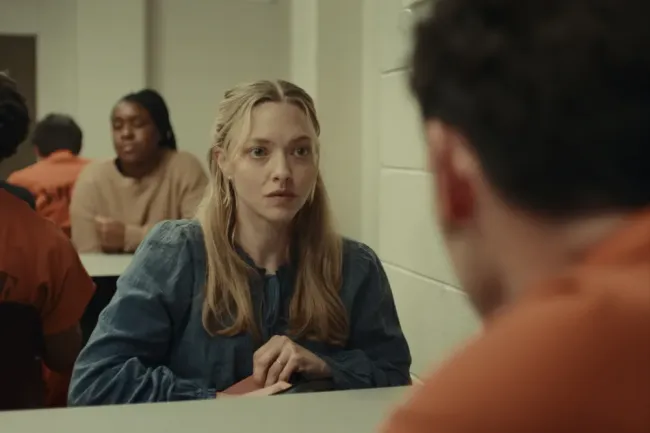
Needless to say, the writer-director does himself a great favor by casting an actor as likable as Scoot McNairy in the part. We first meet Wilson on the day that sets the endgame of his destiny in motion — the day that a beautiful but painfully unloved high school teacher named Karen (a southern-fried Amanda Seyfried) starts her new part-time job teaching fiction to a group of privileged inmates at Oklahoma’s biggest maximum-security prison.

Freshly uncoupled from her abusive husband and desperate for the money she needs to pay for her senile dad’s elder care, Karen doesn’t report to the jail any more willingly than her students once did. Most of the inmates react to her presence like chum in the water (there’s only so much a makeup department can do to soften the spectacle of dropping Amanda Seyfried into a room full of horny criminals who probably haven’t seen another woman in months). Wilson, meanwhile, seizes on the opening to play teacher’s pet. A rangy squirrel of a man whose artistic spirit has been as welcome and noticeable throughout his life as a floater in his eye, Wilson is obviously sincere about taking the class seriously. Still, it’s hard to know if that’s because writing sets him free, or because he enjoys having a pretty woman to look at, or because Karen sets his soul on fire in a way that nothing in this world ever has before. It could be all of the above, or it could be none of them — we may never know for sure, and Wilson probably wouldn’t be able to tell us.
In that light, it’s ironic that Karen is seduced by Wilson’s honesty, or at least the honesty that she perceives in his writing. She’s more predisposed to a crush on a prisoner than most doe-eyed civilians might be (her unseen brother is also in jail, and her awful husband deserves to be). Watching a wayward criminal like Wilson come alive in response to an Emily Dickinson poem gives her the human connection that she’s been starved for since her marriage went south. Hope is the thing with feathers, and whatnot. It isn’t long before she starts wearing blue to class as a sign of her affection for Wilson, and using writing assignments as a cover to exchange love letters without alerting the guards.
We already know this will not end well. We already know that Wilson, along with two of his fellow prisoners, will break out of prison at some point. Nelson frequently intercuts the A-plot with tense flashforwards of the escapees hiding from the law in the Oklahoma swamplands and killing anyone unfortunate enough to come across their path (although that sad task conveniently falls to Wilson’s less civilized pals).
Harder to account for, at least in the abstract, are the film’s strange detours into the life of a picture-perfect Tulsa family, whose parents are played by William Jackson Harper and Devyn Tyler. First we see them watch their kids absolutely crush it in the school musical. Later, we double back to watch them pack for a trip and discuss the intricacies of forgiveness as they drive to their destination. (“Why do we forgive?” the wife asks her minister husband. “For us, or for the person, or for God, which is also for us?”).
Anyone who’s seen a movie before will know to clench at Nelson’s close attention to such random and innocent people. Sure enough, they soon find themselves in a chilling spot of trouble — a situation that Nelson draws out and returns to for maximum effect. These poor characters may be condemned to the same fates as the real people who inspired them, but the way their story is presented here can’t help but feel almost exploitative, despite the purity of Nelson’s intent, for how their suffering is used as a lens to refract our understanding of the people who caused it. Of course, Wilson himself is subject to similar treatment. The glimpses we get into his formative years, and into his imagination, do surprisingly little to soften our feelings about where he ended up. In that way, if few others, Nelson declines to tip the scales.
“The Life and Deaths of Wilson Shedd” would prefer to believe that it’s perfectly neutral throughout, but though it arrives there by the end, it only earns that “we’ve done what we’ve done and we have what we have” impartiality by arranging itself in a way that constantly destabilizes our judgment. Much as its fragmented structure allows the movie to maintain a more gripping momentum than its dour events might have earned on their own, it’s hard not to feel as if you’re being toyed with along the way. (And if you are going to break the story up like that, at least find more for Wunmi Mosaku to do in her role as Karen’s only friend.)
Like a sports drama straining to contrive a suspenseful reason for its big final game to go into overtime, “The Life and Deaths of Wilson Shedd” puts in a lot of work — much of it raw and believable — just to knot up the score before the grand finale. By the time Wilson’s sentence is due to be carried out, everything that leads up to that point has been given sufficient context, which makes it all the more noteworthy that critical questions remain. Did Wilson manipulate Karen, or was he in love with her? Probably both. Is it the government’s place to seal his fate, or should that privilege fall to the family of his victims? Justice is too elusive a concept for us to grasp cleanly. Does he deserve to live, or does he deserve to die? Deserve has nothing to do with it. Even the most reflexive of answers are fringed with doubt, which to my mind is reason enough to ban the practice of capital punishment.
To judge by “The Life and Deaths of Wilson Shedd,” and in particular the unflinching focus of its final 20 minutes (which stand in stark contrast to the piecemeal structure of the previous 100, and effectively power-drive through the layers of plot to expose the most basic level of Wilson’s humanity), I would have to assume that Nelson agrees with me. It’s one thing to attack capital punishment in a film about an innocent man. It’s another, far more difficult and rewarding challenge to do so in a film about a guilty one. “Wilson Shedd,” which gradually assumes an outsized interest in the cold mechanics of state murders, does as much to reward the difficulties of that task as it does to reveal them.
Grade: B
“The Life and Deaths of Wilson Shedd” premiered at the 2026 Toronto International Film Festival. It is currently seeking U.S. distribution.