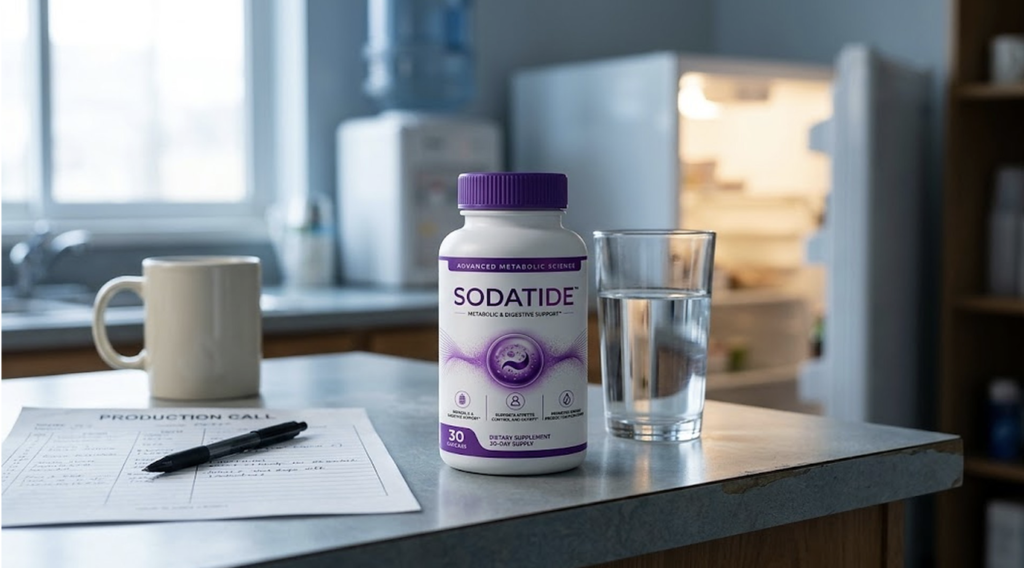


SodaTide reviews online tend to be either sales pages or complaint threads. This one reads the Supplement Facts panel line by line, puts each of the five ingredients next to the studies that exist at the amounts the label gives, and asks how a refrigerated once-a-day capsule fits a working life that rarely stops for lunch.
SodaTide at a glance
- What it is: a once-a-day synbiotic capsule (prebiotic fiber plus probiotic bacteria) for metabolic and digestive support, 30 vegetarian capsules per bottle, made in the USA, refrigeration recommended
- What is in it: 211 mg chicory root inulin, 100 mg potato resistant starch, and a 36 mg probiotic blend of Bifidobacterium infantis, Clostridium butyricum and Akkermansia muciniphila; every amount is printed, but no live-cell counts are given
- Sold: only through SodaTide’s own site; listings on marketplaces and look-alike “official” domains are not the brand’s
- In the news: USA Today’s report on SodaTide’s launch
SodaTide is a metabolic and digestive support capsule that sits in the newest corner of the gut-health market: the synbiotic, a single capsule that combines prebiotic fiber with probiotic bacteria. The purple-and-white bottle, stamped “Advanced Metabolic Science,” has spread through social feeds this year, and the SodaTide reviews that come up alongside it split neatly into sales pages and complaint threads, with very little in between that actually explains the capsule. What is in it, in what amounts, and does the research on those ingredients hold up at the doses a single capsule can carry? Those are the questions this piece answers.
The reason they matter to this readership is simple. A production schedule is hard on digestion: breakfast from craft services at 6 a.m., lunch whenever the scene wraps, dinner from a box at 11 p.m., and by the second week a gut that has stopped cooperating. Weeks in an edit suite finish the job. No capsule fixes that, and this SodaTide review will not pretend otherwise. What it will do is read the label line by line, put each ingredient next to the studies that exist, and answer the practical questions about fridges, timing and side effects that the sales pages skip.
What is SodaTide?
SodaTide is a once-daily dietary supplement in vegetarian capsule form, sold in bottles of 30. Its label describes it as metabolic and digestive support and lists three intended benefits: support for metabolism and digestion, support for appetite control and satiety, and support for energy production from fats. Those are the company’s words, and they carry the standard notice that they have not been evaluated by the FDA. The formula is a synbiotic: two prebiotic fibers that feed gut bacteria, and a blend of three live bacterial species. It is made in the USA with globally sourced ingredients, distributed by Instituto Experience of Lakeland, Florida, and sold only through the brand’s own site, where the full Supplement Facts panel is reproduced by SodaTide alongside its directions.
One detail on the label sets it apart from most capsules in this category: “Refrigerate for optimal quality.” That is a signal that the product is built around live organisms, and one of them, Akkermansia muciniphila, is famously fragile outside the gut. It also tells you something about the habit involved: this is a capsule that lives in the fridge next to the oat milk, not in the glovebox.
SodaTide ingredients: what’s on the label
The Supplement Facts panel on a SodaTide bottle reads as follows, per one-capsule serving:
- Chicory root inulin (Cichorium intybus, root), 211 mg
- Potato resistant starch (tuber), 100 mg
- Probiotic blend, 36 mg: Bifidobacterium infantis, Clostridium butyricum, Akkermansia muciniphila
- Other ingredients: hypromellose (vegetarian capsule), microcrystalline cellulose, magnesium stearate, silica
Two things deserve a closer look. The first is that the amounts are printed, which is more than many gut-health products offer, and the two fibers add up to 311 mg of prebiotic material per capsule, the figure USA Today highlighted when it reported on the launch. The second is what is not printed: the probiotic blend is given by weight, 36 mg, with no colony-forming units (CFU) and no strain identifiers. Probiotic research is strain-specific and dose-specific, so without a cell count and a strain code there is no way to compare SodaTide’s blend with the trials on the same species. That is the main limitation of this label, and it is worth keeping in mind through the next section.
Does SodaTide work? The research, ingredient by ingredient
The honest way to read the research is to ask what each ingredient does at the doses that have been studied, and then compare that with what a single capsule can hold.
Chicory root inulin is one of the most studied prebiotic fibers. It feeds bifidobacteria in the colon, and trials on satiety and weight have used between 8 and 21 grams a day; a well-known 12-week study using 21 grams of the closely related oligofructose reported a modest weight loss against a small gain on placebo. SodaTide’s 211 mg is about one percent of that. It is real inulin, but at this amount it is a starter, not a fiber supplement.
Potato resistant starch is the other prebiotic. It passes the small intestine undigested and is fermented into butyrate, and trials showing improved insulin sensitivity have used 15 to 30 grams a day over several weeks. Again, 100 mg is a token amount next to those doses.
Bifidobacterium infantis has the strongest human file of the three bacteria. A 2006 trial in the American Journal of Gastroenterology gave a specific strain, B. infantis 35624, to 362 women with irritable bowel syndrome for four weeks and found improvements in abdominal pain, bloating and bowel habit compared with placebo, at a dose of around 100 million live cells a day. The SodaTide label names the species but not the strain or the count, so the connection to that trial is suggestive rather than direct.
Clostridium butyricum is a butyrate-producing species that has been used as a licensed probiotic in Japan for decades, with trials mostly in irritable bowel and antibiotic-associated diarrhea. It is a reasonable inclusion in a digestive formula, with the same caveat: strain and dose unknown.
Akkermansia muciniphila is the ingredient that makes SodaTide interesting, because it is the species behind the metabolic claims. A 2019 proof-of-concept study in Nature Medicine gave about ten billion pasteurized Akkermansia cells a day to 32 adults with overweight and insulin resistance for three months and reported improved insulin sensitivity and lower insulin and total cholesterol compared with placebo, with a small, non-significant reduction in body weight. Two things matter for a reader. That study used pasteurized bacteria, not live ones, and it used a counted dose. SodaTide gives no count, and Akkermansia is oxygen-sensitive, which is the likely reason the label asks for refrigeration.
Taken together, SodaTide is a low-dose synbiotic whose case rests on the three bacteria, above all the Akkermansia, while the two fibers sit far below any studied amount. The label is candid about milligrams and silent about live cells, and the live-cell count is the number that would decide whether the research applies. The sensible expectation is a gentle daily habit; a SodaTide review that promises the results of a 21-gram fiber trial from a 311 mg capsule is not describing this product.
How to take SodaTide, and why it lives in the fridge
The directions are one capsule daily with an 8-ounce glass of water, stored in the fridge and kept away from heat, light and humidity. On a shoot, that means the crew fridge or a small cooler rather than the truck dashboard; in post, it is the office kitchen. Timing matters less than not missing days, so the trick is to attach SodaTide to something that survives any call sheet, most often the first glass of water after waking. The storage instructions and the label image are posted on the SodaTide site for anyone who wants to check the wording.
On timing, the probiotic studies cited above ran four to twelve weeks, which makes a month the minimum fair trial. What people tend to notice first from a synbiotic is regularity and less bloating; anything to do with appetite or weight, if it comes at all, comes later and more quietly. It also helps to be realistic about what else is going on: irregular meals, late-night eating, alcohol and poor sleep push the gut harder than any capsule can pull it back.
SodaTide side effects and who should avoid it
At these amounts, SodaTide side effects are likely to be mild and short-lived. Prebiotic fibers and probiotics can cause gas or bloating in the first days as the gut adjusts, although with 311 mg of fiber that is much less likely than with a gram-scale fiber product. The capsule is vegetarian and contains no common allergens on its label. The label itself excludes pregnant or nursing mothers, anyone under 18 and anyone with a known medical condition unless a physician agrees, and standard probiotic advice adds people who are immunocompromised, seriously ill or living with a central line, who should not take live bacteria without medical supervision.
It is also worth being clear about what SodaTide is not. It is not a treatment for irritable bowel syndrome, diabetes or obesity, and ongoing digestive pain, unexplained weight change or blood-sugar trouble belong with a doctor before they belong with a supplement. New or worsening symptoms are a reason to make an appointment, not to open a bottle.
SodaTide complaints, look-alike sellers and what to check
A product sold only from its own site tends to collect imitators, and SodaTide has them: domains posing as the official store, marketplace listings from unknown sellers, and review-site pages rating storefronts the company never operated. A good share of the complaints filed under the name Soda Tide describe those experiences, late deliveries and wrong products from third parties, rather than the capsule itself. The check is straightforward. The panel published by SodaTide shows 211 mg of inulin, 100 mg of resistant starch, a 36 mg three-species blend and a line about refrigeration; a listing that shows anything else, or a different bottle, is selling something else.
The other trap is the advertising around the category rather than the product. “Gut reset” ads promise rapid weight loss, and nothing in the research on inulin, resistant starch or Akkermansia supports that claim, least of all at capsule doses. Long-term users who write considered SodaTide reviews describe something more modest and more believable: steadier digestion and less bloating after a few weeks, with appetite changes arriving slowly if they arrive at all. Judge it against that, not against the ads.
Who is behind SodaTide?
The distributor named on the label is Instituto Experience of Lakeland, Florida, and the bottle states that the product is made in the USA with globally sourced ingredients. Customer service runs through the company’s own email address and phone number rather than a retailer. As with every supplement sold in the United States, the label carries the FDA notice that its claims have not been evaluated by the agency.
SodaTide FAQ
Does SodaTide really work?
Its three bacterial species all have human research behind them, and Akkermansia in particular has a promising metabolic trial, but those studies used counted doses and, in the Akkermansia case, pasteurized cells. The label gives no cell count, and the two fibers are far below studied amounts. Expect gentle digestive support over weeks, not a metabolic overhaul.
Does SodaTide need to be refrigerated?
The label says to refrigerate for optimal quality, which is normal for a product built around live bacteria, especially Akkermansia. Keep it in the fridge once opened and away from heat and humidity.
Is SodaTide FDA approved?
No. The FDA does not approve any dietary supplement before it is sold; its role is to police manufacturing standards and labeling after the fact. SodaTide’s label carries the disclaimer the agency requires.
How long does SodaTide take to work?
Allow at least a month. The studies on its bacterial species ran four to twelve weeks, and digestive changes usually show before anything else.
Is SodaTide safe?
At one capsule a day the ingredients have a good safety record in healthy adults. The label excludes pregnant and nursing women, under-18s and anyone with a medical condition unless a physician agrees, and people who are immunocompromised should not take live bacteria without medical advice.
Is SodaTide the same as “Soda Tide” capsules?
On the bottle it is one word, SodaTide. Sites offering “Soda Tide” capsules under other domains are not run by the brand, and anything they list should be checked against the label SodaTide publishes before you trust it.
Where that leaves SodaTide
SodaTide makes sense for adults on long, irregular days who want a single daily gut habit built around a well-chosen trio of bacteria, and who can live with a label that prints its milligrams but not its cell counts. The fair expectation is gradual digestive support, not the metabolic results of a clinical trial, and anyone who needs gram-level fiber or a counted probiotic dose should look elsewhere. Read the label SodaTide publishes, decide whether that trade-off suits you, and give it a month before judging.
SPONSORED EDITORIAL