
For most of us, the North Sea is a grey, grim stretch of water that was too cold to go in when you went to the British seaside. But North Sea, Nature Untamed, which reaches UK cinemas later this month, reveals the hidden depths of one of the most underrated and unreported seas in the world.
Director Mark Verkerk was as surprised as the rest of us, saying: “I had very much the view everybody else had, that it’s a fairly underwhelming place. But the range of life, the colour, the interaction between it, is as fascinating as any sea anywhere. There’s all kinds of life there. For example you have coral in the North Sea – and most people think of that as something tropical.”
The film, which took seven years to produce, follows Dutch diver Peter van Rodijnen on a quest to explore the North Sea, filming orca pods hunting mackerel, cuttlefish changing colour as they court, kelp forests, and bluefin tuna returning after vanishing for more than 60 years.
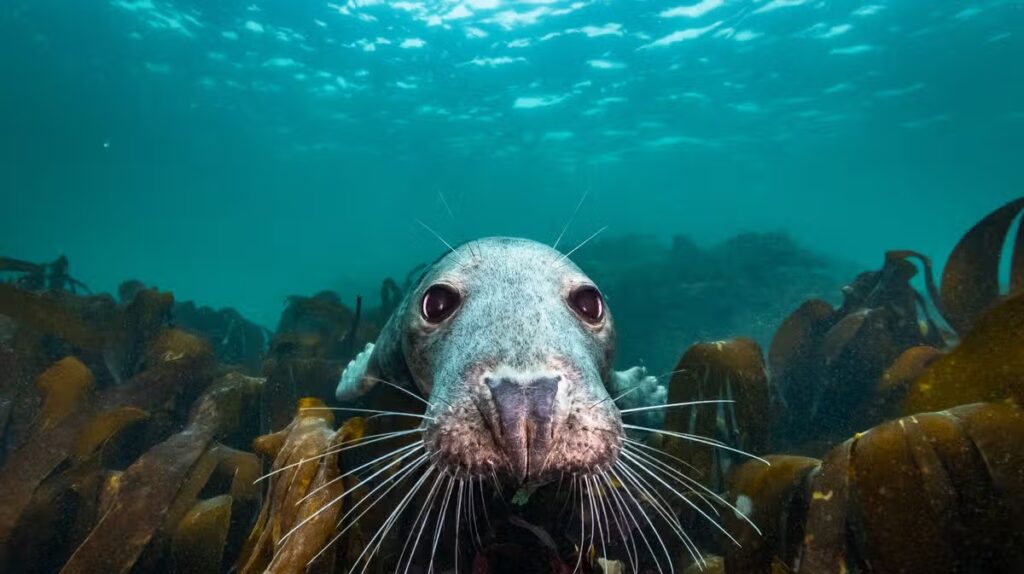
We meet puffins, brittle stars, bioluminescent plankton, sharks, and seals. The film also confronts overfishing, the noise of windfarm construction and the damage done to the seabed by trawling.
Mark trained at the London International Film School and has spent more than 40 years in documentary, starting out with Australian broadcaster ABC in 1980.
Across six feature documentaries he has directed, Mark says nothing has come close to the difficulty of working in the North Sea, explaining: “Nature is always difficult, because you can’t control things, but filming underwater in the North Sea is by far the most difficult. Out of five dives planned, four of them would be cancelled. Weather or currents, conditions just making it impossible.”
Peter learned to dive on the Great Barrier Reef and spent years in tropical water before turning his attention to the sea on his own doorstep.
He narrates the film himself, and opens it by tracing the whole thing back to a childhood spent watching Jacques Cousteau. He says: “Every time I drive here, I see myself as a kid again. Cycling, dreaming about Jacques Cousteau,” he says in the film. “The underwater world became my passion.”
The film’s largest animal is the basking shark, which grows up to 33ft long and is the second largest fish in the world after the whale shark. Despite their size they eat nothing but plankton, straining it from the water as they cruise near the surface.
The crew never expected to film one. “It was never in the script, that was the funny part,” Peter says. “We knew they were out there, but the chance of seeing them was rare. We were called by our friends in Scotland. They were looking at the North Sea in this bay around the Moray Firth, and there was this special event happening, they’d never seen it before.”
“It was really spectacular, just being alongside these prehistoric animals, huge, incredibly big. They were just doing their thing, and allowing us to film them. It was incredible.”
At the other end of the scale is the moon jellyfish. “It’s still hard for people to understand how small it is, it’s tinier than the tip of a needle, just hanging there, growing out of these tiny polyps, then swimming off and growing,” says Peter.
“When the conditions are right, especially with the spawning in the water column, it’s thousands and millions of eggs being fertilised, and you get this abundance of life in special places.”
The North Sea covers 220,000 square miles between the British Isles and north-west Europe, bordered by Great Britain, Orkney and Shetland, Norway, Denmark, Germany, the Netherlands, Belgium and France.
Few parts of it are deeper than 90 metres. In the south it drops below 35 metres, and off northern England the Dogger Bank sits under as little as 15 metres of water, making it one of the finest fishing grounds in the sea.
“The big idea behind the story was to try to give a portrait of the whole working system of the North Sea, not focus on any sort of charismatic animal,” says Mark. Individual species only survive in relation with all the others.”
Nowhere is that clearer than with the puffin, which spends most of its year at sea and comes ashore on the Scottish coast only to breed. Peter says: “For them, the sea is home base, and land is just an awkward thing they have to do because they need to breed.
“They lay one or two eggs a year and they are monogamous, they stay together, fly out and come back next year to meet up at the same burrow.”
Puffin chicks are raised almost entirely on sand eels, small shoaling fish that grow to around 30cm and are the main prey of many seabird species during the breeding season. “The sand eels are a keystone species in the North Sea, and they’re fed on by many other creatures, including the puffins,” Peter says.
“Until about four or five years ago it was legal to fish sand eels, that’s what the Danish mainly did. That caused a whole collapse of the puffin colony.”
Meanwhile, Mark says the pressures the film documents – on wildlife, the wind farms, the shipping, the decades of oil and gas, are not unique to this stretch of water. Mark says: “Although this is a film about the North Sea, you can extrapolate a lot of the pressures going on there to seas all around the world.”
And both men are optimistic that with the right management, the North Sea can remain a haven for millions of species that rely on it. The signs of recovery are already there. Sand eel fishing was closed in the English North Sea and all Scottish waters after decades of campaigning by the RSPB and others.
Peter says: “Once the UK put a ban on sand eel fishing, that had a positive effect right away. The next year, and the year after, the numbers of puffins grew again, and quite rapidly. That’s the resilience of the sea and the life around it.”
Peter said his time on boats with fishermen convinced him that the argument over the North Sea is not the shouting match it is usually presented as. “Even if you go out with fishermen, if you’re together on the boat for a couple of days, you really start to understand them.
“You don’t always agree, but you understand them,” Peter said. “The whole discussion about the usage of the area, what to do or not to do, is much more complicated than black and white.”
Mark adds: “It’s been gratifying to see that the film changes the nature of the discussion, people look at things in a different way.”
The whole ecosystem, Peter says, is capable of far more than most people give it credit for. And he is confident that with the right help it will repair itself.
“If we start to use our brains a bit more and keep a bit more space and quiet for some areas, it will bounce back, I think more explosively than we could ever imagine. I hope I plant the seeds with people, like Cousteau did with me all those years ago.
“I’m also convinced that you can only motivate people to act with hope, with some optimism. Because in the end, people only protect what they love.”
*North Sea, Nature Untamed will be released in cinemas UK wide on 25 September by Dartmouth Films