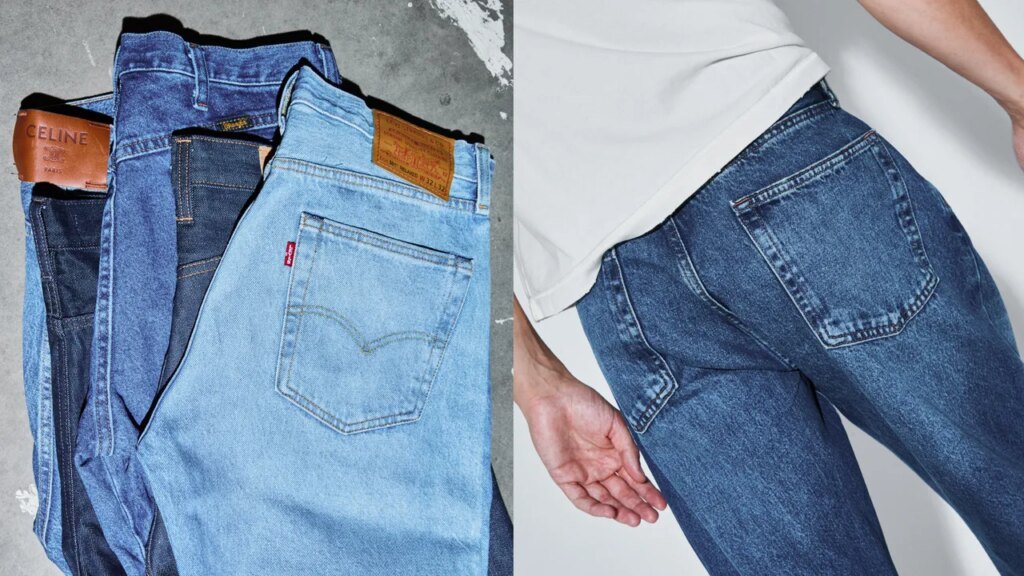

2. Consider the construction. Janine Chilton-Faust, Vice President of Men’s Design says that every detail matters, but there are a couple standouts. “Fit and Fabric are at the top of my list,” she says, “followed by trim qualities such as size of the zipper to the metal shanks as well as thread quality and construction details. All these components are essential for a great pair of jeans that will stand the test of time.” Jeans’ long-term quality mostly comes down to their fabric, stitching, and hardware. Jeans from the big names tend to be made from mid-weight denim (generally “12 oz.” denim, calculated as weight-per-yard of fabric).
Speciality denim retailers usually start there and carry heavier artisanal selvedge denim, probably woven in Japan, the last bastion of high-end raw denim manufacturing. Heavier denim is meant to last longer (or so the theory goes), but isn’t necessarily better. Lighter denim (9 to 11 oz.) is nice in the summer, but also more delicate. Chen reminds us to pay attention to details that are often glossed over. “For construction, look at pocketbag material, look at whether the finishing is clean.” While denim is the main focus, it’s the finer details like these that are often a better indicator of a jean’s quality.
You might have heard of Japanese denim. There’s a great deal of reverence for the stuff and for good reason. Chilton-Faust says it’s one of the highest quality denims you can get, since they’re made on shuttle looms with ring-spun cotton yarns.”These yarns are softer, stronger and more durable, giving the fabric an authentic look with natural slubs. This denim molds to your body, and the less you wash the better it becomes.
3. Explore your fits. Jeans, like snowflakes and Haribo candy, come in a mind-melting array of seemingly-minute variations: high-rise vs. low-rise; flares vs. straight vs. taper; and so many more. So take a deep breath. Ultimately, it comes down to two things for Chilton-Faust. “The right fit in a pair of jeans can enhance comfort and confidence.” Remember that big-box brands like J.Crew and Uniqlo—and the affordable OGs like Levi’s, Lee, and Wrangler—usually offer a much wider range of sizes than their indie counterparts. (We’ll spare you a lesson on the economies of scale.) Those brands also tend to have plenty of brick-and-mortar outposts to try on different styles IRL if you’re wondering about the recent relaxed-fit revolution or find yourself high-rise-curious.
On the flip side, smaller companies experiment more, and aren’t afraid to roll out new silhouettes. “Buy them from a brand or a retailer that can give you good feedback on how they will break in, how much they will stretch, how much they might shrink on their first wash,” Chen says. He also mentions that the amount of details a brand’s website dishes out or how knowledgeable a sales associate is are good indicators.
One thing to keep in mind? Jeans should get better with age…if they’re any good. Chen keeps it simple: “The good stuff looks better the more you wear it and the bad stuff looks worse.”
How We Test and Review Products
Style is subjective, we know—that’s the fun of it. But we’re serious about helping our audience get dressed. Whether it’s the best white sneakers, the flyest affordable suits, or the need-to-know menswear drops of the week, GQ Recommends’ perspective is built on years of hands-on experience, an insider awareness of what’s in and what’s next, and a mission to find the best version of everything out there, at every price point.