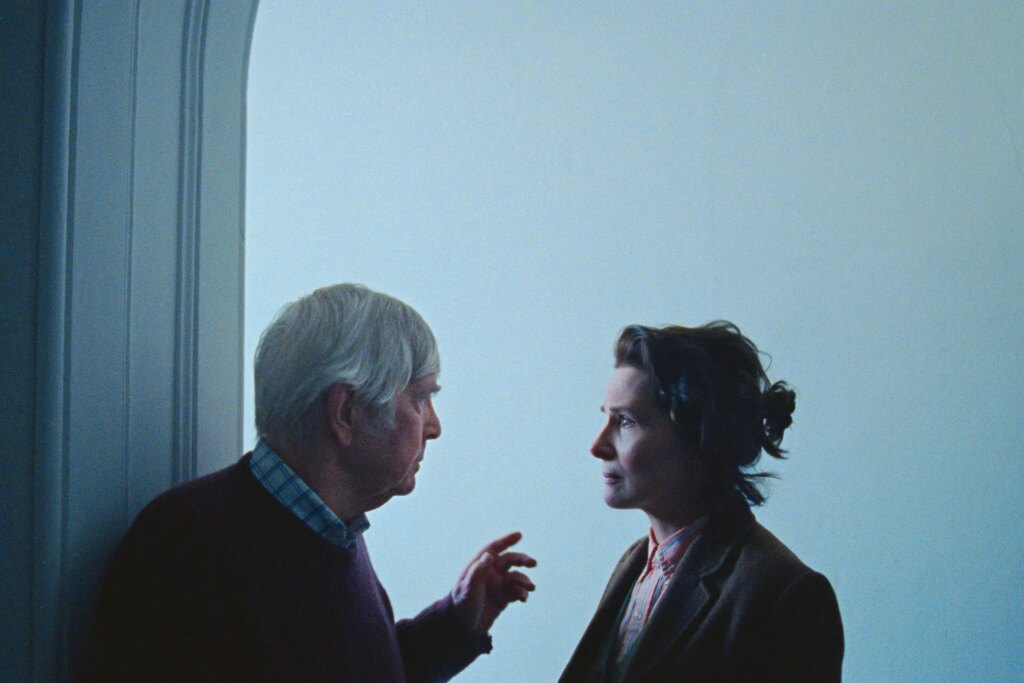

Arriving almost two decades after his debut, Ballast, won him the Best Director award at the Sundance Film Festival; writer-director Lance Hammer returns with his latest feature, Queen At Sea.
The film follows Amanda (Juliette Binoche), who, after walking in on her elderly parents in the throes of what appears to be a consensual sexual encounter, instinctively calls the police, believing her mother, Leslie (Anna Calder-Marshall), who is suffering from dementia, is incapable of giving consent to her husband, Martin (Tom Courtenay). The film is as complex and disturbing as it sounds, but the uniformly strong performances and Hammer’s sensitive direction and script underline Queen at Sea’s welcome honesty and practicality.
After months on the festival circuit, and racking up accolades along the way – including the Berlin Film Festival’s Jury Prize, as well as the Best Supporting Performance prizes for Calder-Marshall and Courtenay – Queen At Sea is finally set to hit cinemas.
Ahead of the release FILMHOUNDS sat down with Hammer, discussing what an outsider brings to shooting in the U.K., the research process for such a heavy story, and what it’s like to work with a dream cast.
Firstly, why did you wait so long to make your second film after Ballast?
I was just living my life! It’s pretty difficult to make an actual living making films in the United States, so I was doing other things. I’m an architect by training, so I did a little architecture, but mostly I was just doing investment. At the same time, I was writing things. I had a lot of things I’d been writing, and with this one, I decided I want to make a film again. I wasn’t trying to do it to have a profession that made my salary.
The film centers on a family dealing with dementia. Do you have anybody in your life that has such an illness?
There’s nobody in my family with dementia, but my father is 88 now, and he has a lot of friends around that age, so I’ve been seeing it for a while through his peer group. I’ve been hearing some of those stories from Dad’s circle of friends, and I was also reading some things that came up in the New York Times or wherever. To me, there seemed to be a lot of energy around this idea.
It was on my mind because the moral dilemma was something that I had encountered through some secondary stories. It really struck me that I really don’t know what I feel about this. I’m very ambivalent, and that’s a really interesting place to make a story from, where I never have any certainty what I feel ethically or morally.
What was your research like for the script?
I started with just some oral histories, and then I read some articles. I guess my radar was out for these stories, so I started seeing them all over the place. Then I started researching other stories online. Early on, I was putting together elements from all of those things, synthesising those little snippets and vignettes, and the thrust of an outline started to suddenly appear to me one afternoon, which never happens to me. I don’t write that way, but the basic plot appeared, and so I just followed it.
When I had some general ideas of the story, I immediately called people in the U.S. that worked at emergency rooms. I spoke to people who work in dedicated unit for sexual assault cases, and I spoke to social workers. I ended up doing a first wave of research that was pretty intensive on how the story would work in the American system, because it’s different than in the U.K. That research changed a lot of my outline and thinking, and gave me some ideas about how things could go. I also spoke to people that had their parents in care homes, and what I learned from those stories was a very important part of the script.
It’s a clichéd experience, but the story started kind of writing itself, and so that’s why I continued to write it when I didn’t actually want to make this particular film. It’s such a difficult story, and it’s hard to sell a story about the elderly and dementia. There are so many sentimental versions of that out there. I felt that if I’m going to tell this story, I need to be completely honest about what I have experienced in the families that are dealing with it. It’s not easy, and there’s no redemption. There can be meaning in it, but it’s hard-earned and painful. If anybody’s going to tell this story, they need to tell it with honesty about the real experiences that people are having.
You spoke about researching the U.S. health care system. How did you end up filming in London?
I wrote the original script with the idea that I could shoot it in any major city in the world, for financing flexibility. When I had to choose a setting, originally I chose New York. Because I’m an American, I was basically assuming I’d shoot it in the U.S.
I ended up casting Juliette first. She was on the project for a long time, and we were still thinking about shooting it in New York. But we needed an American actor to make that work with her being French. I decided that Tom was the best person to play Martin, but I realised if it’s Tom, it makes no sense to shoot it in the U.S. Tom said yes, and I said, “Well, then we’re gonna have to shoot it in London.” Then, we cast all the rest of the film.
My Director-of-Photography on Ballast was Lol Crawley, and he recommended Tristan [Goligher] as producer because they did 45 Years together. Tristan was amazing; he made the film happen in London. It became real with Juliette and Tom and Tristan.
As an American coming to the U.K., did you know London well, or did you decide to dive in and capture it as you found it?
I’ve been here many times, but I’ve never lived here, and I didn’t know it well. I knew I needed to rely on all of the key crew responsible for all the decisions for the way the locations look. I told everybody I’d probably have an outsider lens on this, and that I need the most quotidian look. Every time I’d say I like something, they’d tell me why it’s wrong or why it looks like a tourist’s choice, right down to the choice of Leslie and Martin’s house. We were going to have a different house around Notting Hill. It was bigger, and it was of a classic kind of wealth. I loved it, but I kept asking Tristan and the location and production departments, “Is it too much?” We all agreed it should be more modest. Late in the game, we went looking for something smaller and found the house we used. It’s about trusting my local crew for their opinions and actively seeking it out.
Do you think an outsider can capture a place better than the locals?
There’s something about an outsider. As a general concept, I believe in an outsider’s view of a place. Wim Wenders shot America a lot, and a lot of filmmakers like him that shot in America capture it better than an American can, because they have a detachment from it. They’re not so inured to the place that they forget to look at it. Also, our DoP Adolfo Velosar (Academy Award nominee for Train Dreams) is from Brazil, and he had an outsider’s view too. Maybe we can see things slightly differently and more objectively than somebody locally. I think the combination of an outsider’s gaze, but relying on true locals for the specificity of locations and accents and things like that, that combination can work.
What does it feel like when Juliette Binoche says ‘yes’ to your script?
Oh, it feels very good! She’s my favourite actress, and she read it and got back to me really quickly, and agreed right away. It was the best day of my life! But even better is learning what kind of a person she is. It was just the two of us on the project for a long time, and she’s just a fierce producer. She’s very kinetic and action-based; if she is determined to get something made, she’s committed to it. Her first real role was as a development producer with me, and the project had gone through many ups and downs of getting financing and then falling apart, and she just kept rolling up her sleeves and starting over. What I assumed about Juliette, and then subsequently it was confirmed, was her creative drive. She’s an art beast! She’s absolutely committed to artistic integrity and the creative process, and she thrives on it. That’s why she’s doing this; she can’t get enough. She’s just fearless, and I’m that way too, but in a different way than her. We really had an affinity there, and it’s the most rewarding experience when you’re working with somebody that’s so committed to the art.
How did you go about casting the other roles?
When I decided that it didn’t matter if we shot it in the U.S. or in England, I finally decided to go with Tom because I love him. It was another incredible moment for me because he read the script and said ‘yes’ immediately. That was exciting because he and Tristan came on board about the same time, and it confirmed we’re going to shoot it in the U.K. Working with Tom has been extraordinary. Like Juliette, but in his own way, he’s absolutely committed to the best art that he can make, and he brings 100% of his soul to the character. What you’re seeing is his own soul and spirit, but communicated through a fictional character. He cares so deeply about the psychology and the emotions of the character.
Anna was actually Tom’s suggestion, and he was absolutely right. In real life, they have a deep platonic love for each other, and it shows. Like Tom and Juliette, Anna’s fearlessly committed to this idea of being as truthful as possible. She went in knowing full well that people were going to see her in this vulnerable way, but she’s absolutely the opposite. She’s so sharp, very articulate and wonderful. She, Tom, Juliette and I workshopped together for a month before shooting, and we became very close. Tom and Anna knew each other for many decades, but by a stroke of luck, everybody just resonated with each other as friends. Anna and Tom had the combination of their friendship in real life and their tremendous craft as actors. Their ability to improvise is not something every actor can do. These things just started coming out of them, and it was beautiful.
Did much change in the script as a result of the workshopping?
The story was already there, and what I’m trying to do is work with actors to bring realism to the scenario and language, and change as necessary. The workshop is a time and place to say, “Here’s the script as a starting point.” Everything’s open to change if the actors want, and in the end, we have to make it all work. We’ll try everything. We take enough time where we can try things. What I really want is their own language whenever they can give it. I prefer to have them bring their own words to the table because they feel more comfortable in their mouths. Especially with Tom, who has many different phrasings in a particularly English way. I wrote dialogue, but I was nervous because it has to be spoken by Brits. I really want them to use their own expressions and idioms, and so that’s exactly what happened. There were a lot of scenes that were not written that came out of the improvisation or little moments.
Many of the medical professionals in the film are played by non-actors who work in those roles. How did that come about?
[Workshop producer] Gabrielle De Cevins and I did several months of extensive research with medical professionals. She found a lot of professionals in SARC units in the U.K., and they are the people that we eventually cast in the film. I knew I wanted to try to cast them because I wanted the real people to be consultants, and to go through the script with us. They’d tell us exactly how these scenarios would happen, and if the script was wrong, what wouldn’t happen.
Because the response to such cases is so different in the U.K., there was a point when I was here in London with everybody cast, and the money and everything, and the script didn’t work. I was trying to shove a square peg in a round hole, to keep the script as it was and make it work in the U.K., but it just wasn’t working. I had to go back again with Gabrielle and our consultants to figure out the problems. It meant changing the way scenes worked, and it made the film a lot better. Something happens when truth comes into the picture; it suddenly just rings. There are a lot of scenes of frustrating bureaucracy, but it is what it is.
Where did the storyline for Florence Hunt’s character Sara come from? Did you feel a need to offer a contrast to the main story?
There’s a lack of awareness of what’s happening in Sara, because when you’re that young, you think the world is revolving around you. At 16 years old, your frontal lobes aren’t developed enough to have empathy, but it’s just normal. That’s what I was trying to do with her character. Sara was the first character that came into my mind before I decided to bring it into dialogue with the dementia story. It’s kind of from another story, and it feels that way, and it’s shot in a very different way. Its purpose was to show that it’s not all death, the ending, and the deceleration into the next plane. There’s ascension too, and it’s always happening. Life is like that; life goes on.
Queen at Sea is in cinemas from 18 September.