
Meghna Gulzar’s Daayra delves into the uncomfortable territory between public anger, police power and the rule of law, drawing inspiration from the 2019 Hyderabad rape-murder case and the subsequent police encounter.

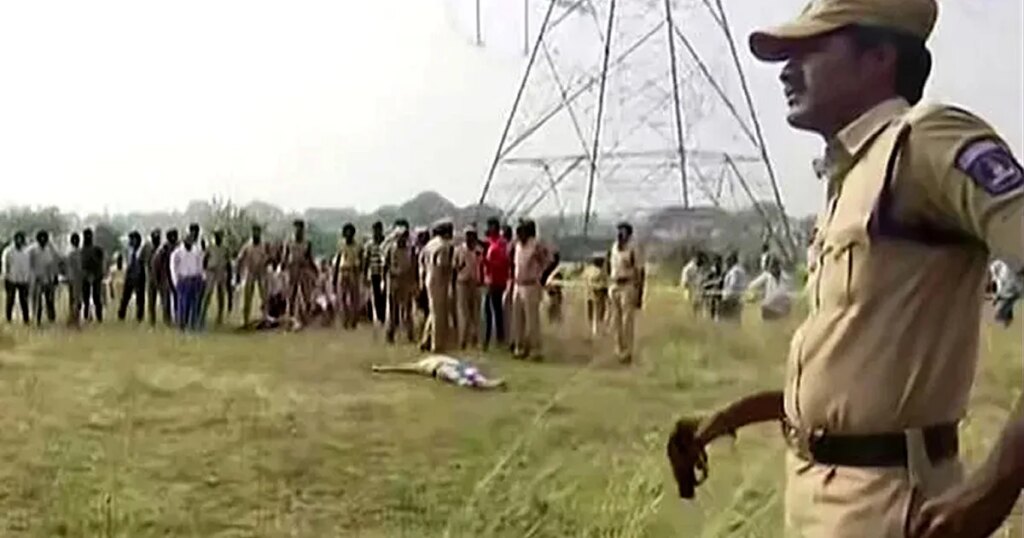
IMAGE: Police personnel at the spot where the four men accused of the rape and murder of a veterinary doctor in 2019 were killed in an encounter in Hyderabad. Photograph: ANI Photo
Key Points
- Meghna Gulzar’s Daayra is inspired by the 2019 Hyderabad rape-murder case and the subsequent police encounter, exploring the complex interplay of public anger, police power, and the rule of law.
- The film features DCP Ajooni Kohli (Kareena Kapoor Khan) and DCP Raman Kumar (Prithviraj Sukumaran) representing contrasting views on justice and the State’s role.
- The 2019 Hyderabad case involved the rape and murder of a veterinary doctor, followed by the police shooting of four accused men, which sparked widespread public debate.
There was a moment in in December 2019, when the country seemed to arrive at a conclusion before a courtroom could.
Four men accused of raping and murdering a young veterinary doctor were killed in Hyderabad.
They had been shot by the police while being taken to the place where, according to investigators, the rape crime had occurred.
For a country furious over the brutality of the crime, the encounter was, for many, the ending they had been waiting for.
Justice, it appeared, had arrived in the form of four bullets.
Then came the uncomfortable question: What if it wasn’t justice?
That question reportedly lies at the heart of Meghna Gulzar’s Daayra, the upcoming thriller starring Kareena Kapoor Khan and Prithviraj Sukumaran.
The film is not officially a retelling of the Hyderabad case but it is described as being inspired by true events.
Its central conflict — between two police officers with radically different ideas about justice, punishment and the law — inevitably takes the audience back to the debate that followed the 2019 police encounter.
Exploring Competing Ideas of Justice

IMAGE: Kareena Kapoor in Daayra.
In Daayra, Kareena plays DCP Ajooni Kohli and Prithviraj plays DCP Raman Kumar.
They are not simply two cops investigating the same crime.
They represent two competing answers to a question that is far more difficult than identifying a criminal: What is the State entitled to do in the name of justice?
That is where the film becomes more interesting than a conventional crime thriller.
The Crime That Sparked a National Debate
On November 27, 2019, a 26-year-old veterinary doctor was abducted, sexually assaulted and murdered on the outskirts of Hyderabad. Her body was found near Chatanpally, in Shadnagar.
The crime produced an extraordinary public reaction. There was grief, anger and a demand for swift punishment.
The case acquired a name — ‘Disha’ — in the public domain to protect the victim’s identity.
Four men were arrested. Nine days after the crime, all four were dead.
On December 6, the accused were taken to Chatanpally to reconstruct the events surrounding the murder.
The police said the men attacked the officers, attempted to escape and opened fire after taking weapons from the police.
The officers, the police maintained, fired in self-defence.
The encounter was immediately hailed in some quarters as an example of decisive policing.
But the speed with which the episode was accepted as a form of justice was what made the subsequent investigation so important.
Because an encounter is not a courtroom. And a police officer is not a judge.
The Supreme Court’s Inquiry and Its Findings
The Supreme Court appointed a three-member inquiry commission, headed by retired Supreme Court judge Justice V S Sirpurkar to examine how the four men died.
The commission’s findings fundamentally challenged the police account.
It concluded that the four accused had been deliberately killed and rejected the explanation that they had died in the circumstances described by the police.
The panel recommended prosecution of 10 police officers, including action under Section 302 of the IPC.
The significance of the report went beyond the four dead men.
The original crime had been a question of what the accused had allegedly done to the victim.
The encounter transformed it into another question: What had the State done to the accused?
That reversal is the real drama behind Daayra.
The Police Officer as a Moral Question

IMAGE: Kareena Kapoor and Prithviraj Sukumaran at the Daayra trailer launch. Photograph: Afsar Dayatar/Rediff
Raman Kumar and Ajooni Kohli are not merely opposing personalities. Their disagreement is about the source of police legitimacy.
If Raman’s position is understood as the belief that a system that repeatedly fails victims cannot demand patience from a grieving society, Ajooni’s position represents the equally difficult proposition that the State cannot suspend the law simply because the public believes the accused deserve no mercy.
Both positions begin with the same thing: A horrific crime.
They diverge over what comes next.
That makes the film’s conflict more interesting than a simple ‘good cop versus bad cop’ narrative.
The real battle is between justice as an emotion and justice as a process.
The first wants an answer immediately. The second insists that the method matters as much as the outcome.
The Uncomfortable Legacy of Police Encounters
The Telangana high court in 2024 stayed the the Sirpurkar Commission report and restrained coercive action against police officials on the basis of the report while petitions challenging the findings were being heard.
The police officials challenged those findings.
The courts have been called upon to examine the competing claims.
The distinction matters because the Hyderabad case is not simply a story in which one side was angry and another side was right.
It is a story about what happens when the demand for justice collides with the rules designed to deliver it.
Photographs curated by Manisha Kotian/Rediff