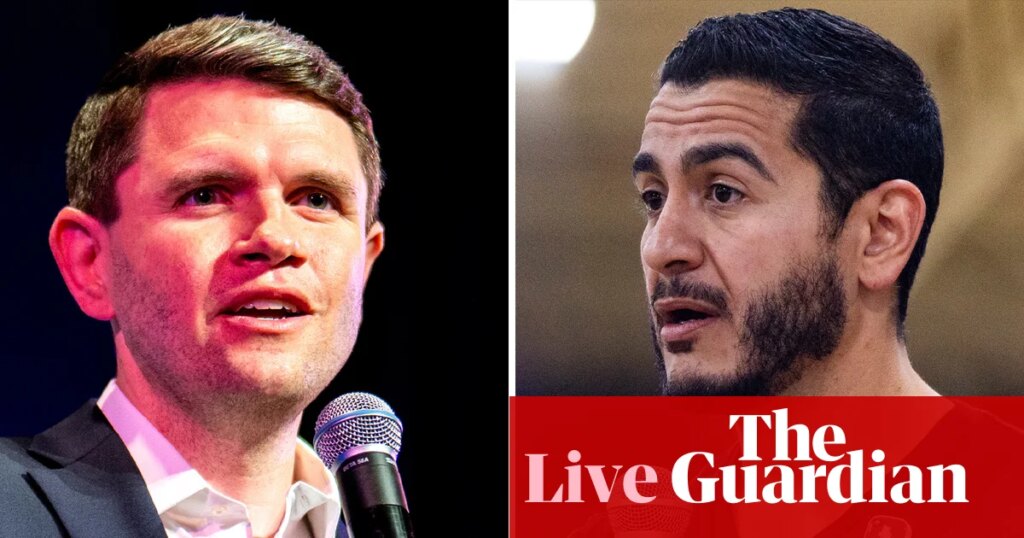

New poll shows Talarico, El-Sayed hold narrow edge in Texas, Michigan Senate races
New polling shows that margins in Texas and Michigan’s key Senate races remain razor-thin, with Democrats just narrowly in the lead.
The new poll from Emerson College and The Hill puts James Talarico, the Democratic challenger in Texas, up by just one percent against Republican nominee Ken Paxton.
The prospect of flipping a Senate seat in deep-red Texas has long seemed a Democrat pipe dream. The last meaningfully competitive Senate race in the state was 6 years ago, when former Texas congressman Beto O’Rourke came within three percentage points of ousting Republican senator Ted Cruz.

But it’s seemed closer to becoming a reality ever since Paxton, the scandal-plagued Texas attorney general, unseated incumbent John Cornyn in a primary race with President Trump’s backing.
In Michigan, the poll found that progressive firebrand Abdul El-Sayed is faring slightly better against Republican Mike Rogers, a former congressman, with El-Sayed winning 48 percent of respondents’ support compared to Rogers’ 46 percent. Rogers, the poll found, wins out with non-college educated voters and older Michiganders, while El-Sayed is ahead with independents.
The Texas poll found that Democrats haven’t won over as many voters in the state’s race for governor, with challenger Gina Hinojosa lagging sitting governor Greg Abbott by 3 percent.
Key events
Trump spoke with Mexican President Claudia Sheinbaum on Wednesday as the two countries eye an end to long-simmering trade disputes, Politico reported on Thursday. A US official who spoke to the outlet described the call as “constructive.”
The US and Mexico have been trying to hammer out disputes surrounding the U.S.-Mexico-Canada Agreement, the North American trade pact Trump spearheaded in his first term but that he has since tried to revise.
Judge orders Kennedy Center to give 30-day notice before any major renovations… or demolition
Not long after President Trump threatened to tear down the Kennedy Center unless his administration is allowed to slap his name on it, a federal judge on Thursday ordered him to hit the brakes.
The order from U.S. District Judge Christopher Cooper mandated that the Kennedy Center tip off the public at least 30 days before making any significant changes to the structure – such as demolishing it.
The center is currently closed due to what its Trump-backed leadership calls safety issues caused by age and structural deficiencies.
But opponents fear that closing the center is a pretext for its demolition, or retaliation for Trump not being allowed to follow through on a plan for renovations that would see his name added to former President John F. Kennedy’s on the building’s facade.
Trump has done a lot to stoke those anxieties recently. In addition to his recent remarks, the president was photographed on Air Force One reviewing what appeared to be plans for the center’s demolition.
Facing backlash, the White House withdraws Trump’s pick to lead ICE
The White House on Thursday announced that it had withdrawn its nomination for Lance Schroyer, who President Trump had picked months earlier to serve as the new head of Immigration and Customs Enforcement.
A former Oklahoma state trooper, Schroyer faced criticism for his apparent lack of formal experience working in ICE. His greatest connection to the agency appeared to be his previous stint on the security detail of Markwayne Mullin, the homeland security secretary Trump chose to replace the ousted Kristi Noem.
A White House statement announcing the withdrawal of Schroyer’s nomination gave no reason for the move.
Robert F. Kennedy Jr., Trump’s Health and Human Services Secretary and a longtime champion of the anti-vaccine movement, on Thursday addressed Children’s Health Defense, the anti-vaccine advocacy organization he ran for years.
On stage at the organization’s event in Washington D.C., Kennedy touted his efforts to bring his agency’s force to bear on vaccines and processed food.
“For many years, you’ve asked questions from outside the government, as I did,” Kennedy said in a meandering hour-and-a-half-long speech. “And now I have the privilege and the responsibility of leading the department that can put the full weight of the federal government behind answering those questions.”
He continued: “That’s what this department has done for the past 19 months, under my leadership, and under the leadership of President Trump.”
Kennedy reassured the audience that he would continue to represent their interests, and that they “have a strong and steadfast friend at the White House.”
Jon Kyl, a longtime Republican congressman from Arizona, died on Thursday, his family said in a statement.
Over three decades in Congress – first as a member of the House of Representatives, and later of the Senate – Kyl established himself as a quiet titan of Arizona politics. His family attributed his cause of death to complications from a neurological disease.
Kyl announced in a statement late last year that he would be withdrawing from public life after being “diagnosed with a neurological disease manifesting as dementia.”
“We know that Jon belonged to all of Arizona, a state he loved and explored with vigor, curiosity, and wonder,” Kyl’s family said in the statement. “Serving his state and nation in Congress was a privilege and responsibility he honored and respected. We are grateful for his full and meaningful public life.”
Kyl first joined the House of Representatives in 1987, an office he held before winning election to the Senate in 1995. He held his Senate seat until his retirement 2013, briefly returning by appointment in 2018 after the death of fellow Arizona senator John McCain.
Melody Schreiber
Representative Thomas Massie opened with a joke about his colleague’s return to Congress: “Senator [Mitch] McConnell has inspired my latest bill. It’s a term limit bill called Three Strokes and You’re Out,” he said.
“Some people try to say that I’m not effective enough up here. I’m so effective they had to take two and a half weeks off of the calendar to stop me,” Massie said. He said he’s calling the unexpected House recess “the Hegseth Holiday” because he’s unable to introduce articles of impeachment against the US defense secretary until after the midterms.
Massie says he called a newly elected Trump to ask him for the agriculture secretary position. Referring to RFK Jr, Trump asked, “Are you friends with Bobby? Is he too much for HHS? Don’t you think we need some vaccines?” Massie recounted.
House Republican releases campaign ad critical of Trump’s immigration policies

Chris Stein
A Republican congresswoman has released a campaign ad criticizing Donald Trump’s approach to immigration enforcement, in the latest sign that a key plank of the president’s 2024 re-election campaign has become a liability for his congressional allies ahead of November’s midterm elections.
“Mr President, some of your immigration enforcement efforts have gone too far,” Florida’s María Elvira Salazar says in a 30-second ad. “In July, 50% of the 50,000 people that were detained had no criminal record. Be careful what your advisers are telling you about immigration policy.”
Salazar represents a competitive Miami-area district that is nearly three-quarters Hispanic, and where Trump won by a 15-point margin two years ago after a campaign in which he promised to carry out “mass deportations”. While his administration has implied that those targeted would be undocumented immigrants who committed crimes in the United States, in reality, a substantial portion of the people arrested since Trump returned to the White House in January 2025 have no criminal record.
Salazar won re-election by a 20-point margin in 2024, but this year is facing a significant challenge from Eliott Rodriguez, the Democratic nominee and a former television news anchor. A poll conducted for his campaign late last month found him tied with Salazar.
“The same Hispanics who helped you get to the White House in 2024 feel betrayed today,” Salazar said in the ad. “You can be for immigration what Lincoln was for slavery and Reagan was for communism. I’m not talking about giving them amnesty. I’m talking about giving them a dignified life in this promised land.”
Salazar’s ad is the latest instance of Republican lawmakers seeking to put distance between themselves and Trump before the 3 November elections, in which Democrats are vying to take back both the House and Senate. With gas prices high due to the war with Iran and Trump’s public approval low – including on key issues like handling of immigration – Democrats increasingly believe their candidates are competitive even in heavily Republican seats.
Kennedy Center says building closed temporarily due to ‘acute risks to public safety’
A top official at the Kennedy Center said that he closed the institution temporarily due to “acute risks to public safety resulting from continued structural deterioration” of the aging building.
Matt Floca, the Kennedy Center’s executive director and chief operating officer, said in a federal court filing seen by the Associated Press that the building will be closed for at least seven days to “assess existing safety risks in those portions of the main building exhibiting severe structural deterioration”.
The temporary closure, which occurred without notice yesterday, is separate from a vote on Tuesday by the Kennedy Center’s Trump-picked board to close the performing arts center indefinitely for repairs.
It was based on an inspection of the roof terrace canopy and a partial ceiling collapse earlier this month, Floca said. The closure may be extended after evaluation next week, he said.
The announcement of the closure came in response to a court case filed by Democratic congresswoman, Joyce Beatty, who is a trustee and sought an emergency court hearing to prevent what she called the building’s “unlawful closing’.
Beatty, an Ohio Democrat and an ex-officio member of the Kennedy Center board, has led efforts to block Donald Trump’s name from being added to the facade of the building. Beatty told MSNOW she had a verbal confrontation with the president on Tuesday during a virtual board meeting.
The Trump-aligned board, chaired by the president, voted to close the center after a federal judge blocked the institution from returning Trump’s name to the building.
Trump, who was named the Kennedy Center’s chairman last year by loyalists on the board, said yesterday that his efforts to restore the aging building deserve recognition, “because frankly, if we don’t do that, it’s going to close. It’ll end up being ripped down. It’s in very, very bad shape, very dangerous shape.”
Congress has allocated $257m to cover the repairs, but Trump said they only would happen if the board was permitted to move forward with plans to add his name to the building.
Anti-vaccine advocates take victory lap ahead of address from RFK Jr. in D.C.
Melody Schreiber
As the death toll from the worst measles outbreak in decades mounts, Robert F. Kennedy Jr. is headlining the Washington, D.C., conference of the anti-vaccine organization Children’s Health Defense, which he led for nearly two decades.
Longtime anti-vaccine activists celebrated their unprecedented role in the national conversation, at times expressing astonishment over the ways anti-vaccine sentiment has been elevated to the highest levels of the US government.
Kennedy, now serving as secretary of the US Department of Health and Human Services (HHS), brings unusual attention to the conference, said Mary Holland, current CEO of Children’s Health Defense (CHD). “We have an opportunity today to speak to our colleagues and our friends in mainstream media,” she said at the event on Thursday.
The organization laid out its policy agenda, including plans to challenge state-level immunization requirements for school attendance, to recruit younger people to the aging organization, and to combat the installation of cell phone towers for fears of 5G and 6G.
“Never, never surrender,” said Andrew Wakefield, a former gastroenterologist whose medical license was revoked after he was found to have fabricated research indicating a link between vaccines and autism.
Recent polling suggests that one-quarter of Americans now have doubts about the measles, mumps, and rubella (MMR) vaccines following a years-long campaign against immunizations by once-fringe actors. But the majority of Americans also disapprove of the Trump administration’s handling of the widening measles outbreak, which killed three people in Texas and Arizona last year and four people in Pennsylvania recently.
Being called the “largest anti-vaccine conference, probably in the world” is “a red badge of courage,” said Sen. Ron Johnson, a Republican from Wisconsin. Johnson and Sen. Rand Paul, a Republican from Kentucky, rehashed grievances over the Covid pandemic and the immunizations that were rapidly deployed to stem the tide of illness and death.
Paul repeated incorrect statements that only elderly people died from Covid, but he also suggested that deaths among those who were “thin and healthy” may have been attributed to genetic factors, proposing genetic testing to determine vulnerabilities. “There probably is in all likelihood some genotype that predisposes you to this,” Paul theorized. “If you could go in and figure out a genetic test — those are the things we should be looking for.”
Anti-vaccine activists became nervous earlier this year after the White House reportedly put the kibosh on speaking about vaccines before the US midterm elections. “February, March, April, May, vaccine reform got a little quiet, a little scary. You know, behind the scenes, we’re like, “Yeah, what happened?” said Michael Kane, CHD’s director of advocacy. He praised Rand Paul for bringing the anti-vaccine conversation back to the national stage.
Kane urged attendees to comment on the proposed HHS changes to the way it recommends vaccines, which experts say could sow confusion and chaos. “As we’re turning the corner and looking at the midterm elections, and this is now top priority — I mean, sometimes I gotta pinch myself,” Kane said. “Just a few years ago, we were the, you know, hated stepchild in the corner… Now we are a national movement that isn’t going anywhere.”
A Senate panel on Thursday voted in favor of President Trump’s pick to head the Consumer Financial Protection Bureau, advancing him to face a vote by the full chamber, Reuters reported.
If his nomination clears the Senate, Brian Johnson – an executive for the banking giant Capital One – would become the head of an agency charged with protecting American consumers from abuses in the financial sector.