
Last summer, X user @Gravantus made a pointed observation:
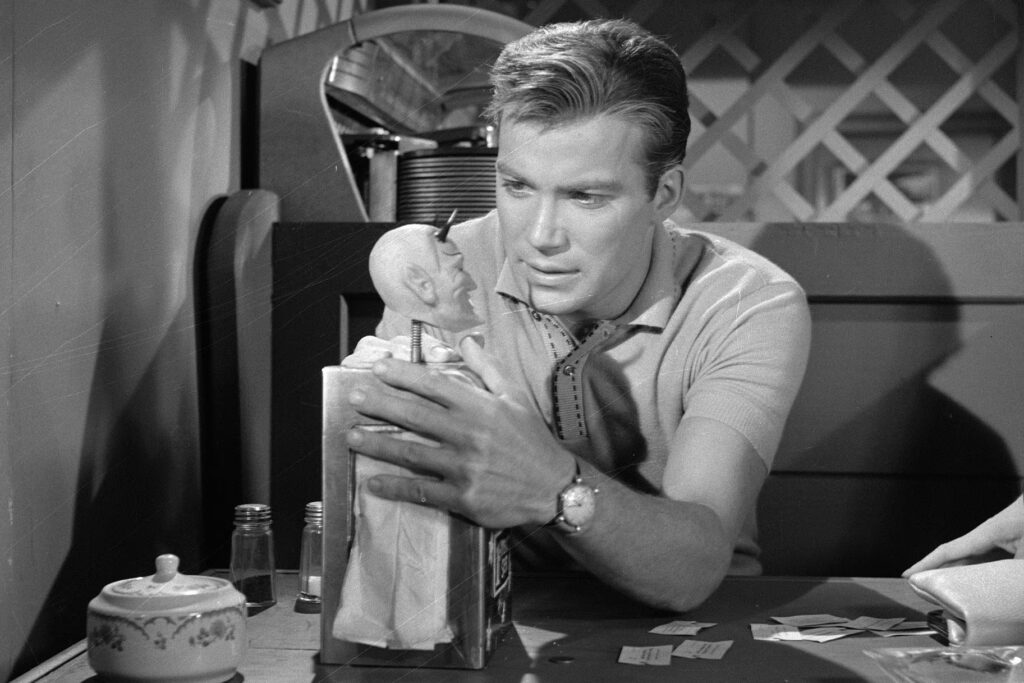
“Watching an old Twilight Zone episode where a man becomes obsessed with a devil machine coin fortune teller. The machine gives generic answers but he becomes paralyzed, unable to make a decision without consulting it. Anyway, some of these episodes are a bit farfetched.”
The post included a picture of the devil-headed fortune teller from season two’s “Nick of Time”—starring William Shatner—alongside the ChatGPT logo on a cellphone screen. While clearly meant as satire, the tweet effectively underscores the prescience and timelessness of Rod Serling‘s trailblazing anthology series.
At its best, The Twilight Zone delivered hard-hitting morality plays capable of relevance in any time period.
William Shatner On The Twilight Zone‘s “Nick of Time” Being Allegory For AI
And more than 65 years after “Nick of Time” first aired, its warning about becoming overly dependent on something else to provide answers feels particularly timely in the age of AI.
Shatner sees the parallel too. As he recently told SYFY Wire while promoting his new book William Shatner… And You, “Absolutely.”
“His mind was in that area long before most people’s were,” Shatner said of Serling. “Reading your fate and being so conflicted, that it resulted in no motion at all, which is what a lot of people do. ‘I think I could do that’ results in absolute stillness and not taking that step. Which is much easier to do, to be conflicted and confused the rest of your life, against having the courage to say, ‘Well, I’m going to step off that cliff and see what happens.'”
As an occasional question-asker of AI himself, Shatner has fed his personal chatbot with a mixture of queries related to everyday life and philosophy. The latter topic led to an interesting revelation for the Star Trek icon.
“What I didn’t realize, until this took place this past year, is that the machine is remembering my questions and refers to my past questions as though it’s a friend,” he explained. “‘Remember we were talking about whatever?’ I think, ‘My God! It remembered what I said, and is becoming a character based on the humanitarian questions I asked it, and the answers it was required to look up.’ It’s now got the beginning of a humanity, and is that the answer to humanizing AI? By interacting with it a lot? Not just programming it, but asking it humanitarian questions?”
The episode boasted a script from regular Twilight Zone contributor Richard Matheson, who wrote other classic installments like “Third from the Sun,” “Little Girl Lost,” “The Invaders,” “Steel,” and Shatner’s second guest vehicle, “Nightmare at 20,000 Feet.”
“He was superb,” added Shatner. “He was one of the foremost American writers. Spielberg’s first movie [Duel] was a script by Richard Matheson, involving the truck that pursued [Dennis Weaver]. That script was the making of our foremost film director.”
Matheson was part of a group of top-notch genre writers based in the Los Angeles area known as “The Green Hand,” whose membership also included Serling, Charles Beamont, Ray Bradbury, William F. Nolan, George Clayton Johnson, Robert Bloch, Jerry Sohl, Ray Russell and Harlan Ellison.
Classic episodes of The Twilight Zone air regularly on SYFY. Click here for complete scheduling info!