
Comedy films are under-rated. Industry big-shots tend to look down their noses at the humour genre, especially when it comes to awards, critical prestige and financing. The general feeling is that drama and tragedy are worthier of praise, and have more artistic depth; although Shakespeare and Dickens might have disagreed. It’s easy to make someone cry. Life is full of sadness – death, illness, pain and heartache are always with us. But to make someone laugh is a rare skill. British film-makers, scriptwriters and comedy actors have been bringing us sunshine for over a century.
Londoner Charlie Chaplin was one of the greatest stars of Hollywood’s silent movies era; his finest, timeless work includes The Gold Rush (1925) and 1930s movies City Lights and Modern Times – all American made. Ulverston-born Stan Laurel was another immortal. He and Oliver Hardy made their first talkie in 1929, peaking with 1933’s superb Sons Of The Desert. Back home the British film industry produced comedy hits like 1937’s Oh, Mr Porter!, starring Will Hay, and George Formby had audiences rolling in the aisles with flicks such as the 1940 classic Let George Do It. But what were the funniest-ever British films? It’s a tough question, but I attempt to answer it with my Top 11 list. Feel free to disagree in the comments section.
11. Clockwise, 1986

John Cleese plays stuffy comprehensive school headmaster Brian Stimpson in this sparkling comedy written by playwright Michael Frayn. Everything runs like clockwork in Stimpson’s compulsively-ordered domain. We see him first in his office barking orders at idle schoolboys in-between working on the “historic” speech he’ll deliver while chairing a headmasters’ convention for the first time at Norwich University. His journey starts badly when he mistakenly boards the Plymouth train due to his habit of saying “Right” when he means yes.
“On the left, then.” “Right.” “Right?” “Right.” Panicking, he leaves the text of his speech on the wrong train and misses the correct one. Unable to find his wife Gwenda (Alison Steadman), Stimpson spots Laura (Sharon Maiden), his young neighbour and truanting sixth former, and commandeers her car. Complications quicky arise – her parents report the vehicle as stolen, and Gwenda spots the pair at a petrol station and assumes Brian is having an affair. (Laura is sleeping with a different teacher, though, Mr Jolly).
Frayn’s script builds masterfully into a glorious farce as misunderstanding mount and their car is followed by the police, Gwenda with geriatric hospital patients (Joan Hickson on top form), Laura’s parents and Mr Jolly (Stephen Moore). Penelope Wilton plays Pat, Brian’s old flame, who summons the police to arrest him for vandalism before she recognises him. More chaos ensues as they leave Pat’s car stranded in a field of mud, clean up in a monastery and steal another car, while their pursuers reach the conference ahead of them.
It ends with Stimpson, our punctilious anti-hero, delivering the speech from memory and admonishing the assembled head teachers and his pursuers as if they were his students. Although he forgets colleague Ted’s Angela-Rayner-style advice to “tell all those upper-class we’re gonna hang ’em from the lamp posts, by their old school ties.” Inevitably, it ends with multiple arrests. Directed by Christopher Morahan, Clockwise won the 1987 Peter Sellers Award For Comedy, grossed £5m in the UK and gave us the memorable, oft-misquoted line: “It’s not the despair, I can stand the despair; it’s the hope.”
(Image: Daily Record)
10. The Man in the White Suit, 1951

Alexander Mackendrick’s early Ealing comedy classic slyly illustrates how both capitalists and trade unions can undermine progress. Alec Guinness plays Sidney Stratton, a charming, idealistic research chemist who secretly invents a superstrong artificial fibre, that never wears out and is impervious to stains, while he’s working in Birnley Mills, a northern English textile mill. Instead of generating grateful acclaim, his suit, made of dirt-repellent white synthetic polymer, earns Stratton hostility from mill owners and the unions who realise the miracle material would make the entire textile industry redundant and put them out of work. These modern-day Luddites conspire with the bosses to keep the invention off the market. Ageing mill owner Sir John Kierlaw (Ernest Thesiger) grumbles, “Some fool has invented an indestructible cloth. Where is he? How much does he want?” Even Sidney’s landlady, Mrs Watson turns against him, asking, “Why can’t you scientists leave things alone? What about my bit of washing when there’s no washing to do?”
Guinness is on fine form as the stubborn dreamer, with Joan Greenwood as mill-owner’s daughter Daphne Birnley, who is deployed to double cross Sidney but ends up on his side, describing him as a knight in shining armour… “Millions of people all over the world, living lives of drudgery, fighting an endless losing battle against shabbiness and dirt. You’ve won that battle for them. You’ve set them free. The whole world’s going to bless you.” The story ends with a slapstick chase as Stratton is pursued through the streets at night in his luminous suit by a mob of industrialists and workers. When they finally surround him, the suit begins to fall apart, disintegrating before his detractors’ eyes. They then strip away the remains, leaving Sidney in his underwear. The next morning, he is sacked from the mill but as he gathers his possessions, he takes a look at his lab notes and declares, “I see!” Inspiration has struck again; his ambition is undented.
(Image: -)
9. Shaun Of The Dead, 2004.

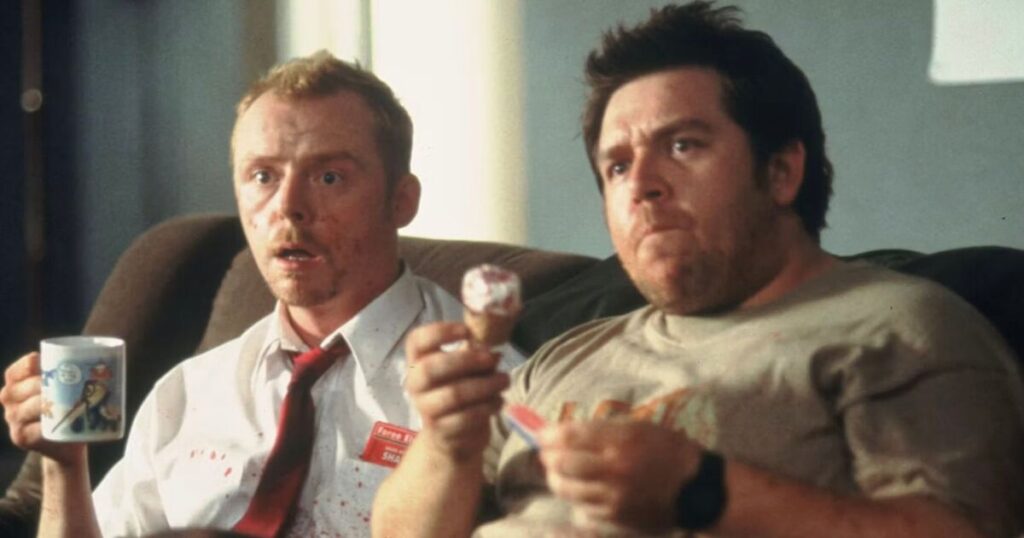
A clever blend of horror, gore and satire, Edgar Wright’s often hilarious film treats a zombie apocalypse like an irritating interruption to everyday life. In Crouch End, electronics salesman Shaun Riley (Simon Pegg) is drinking with his best pal Ed in their local, The Winchester, to drown his many sorrows – he’s disrespected at work, his girlfriend Liz has dumped him over his lack of ambition, and he hates his stepfather. He is essentially staggering through his aimless life like a brainless zombie himself. Shaun and lay-about Ed (Nick Frost) are so refreshed, and then so hung-over, that they don’t realise the flesh-devouring living dead are taking over north London – even though zombies are working on checkout tills. As they stagger out of the pub singing Grandmaster Melle Mel’s White Lines (with synchronised undead background groans), they’re too mangled to spot that a kissing couple are actually a female zombie and a human male victim whose head falls off. The penny finally drops when they have to fight off two of them in their backyard. Shaun decides to turn his life around, by rescuing his mum, saving Liz and her friends, and hiding out at The Winchester. To do so, they have to fight their way through zombie-ridden Haringey. Not everyone survives un-bitten.
Rib-tickling moments include the survivors beating a zombie barman with pool cues inside the Winchester pub om time to the rhythm of Queen’s Don’t Stop Me Now; and our two slackers debating which of their rare vinyl LPs are worth tossing at a pair of zombies in their living room. The film stalls a little with awkward serious scenes but takes off again when they reach The Winchester. In a classic moment, with mobs of the undead hammering at the doors, Ed tries to cheer up Shaun by telling him “It’s not the end of the world.”
Written by Edgar Wright and Simon Pegg, the film took nearly £30 million at the box office. As a nice touch, the firm Shaun works for Foree Electric, was named in honour of Ken Foree who played the lead role of Peter Washington in George Romero’s original 1978 zombie thriller Dawn of the Dead.
(Image: -)
8. Passport To Pimlico, 1949.

Like the good people of Piddington, in this Ealing film the citizens of Pimlico vote for independence from the UK. Unlike the Piddington folk, their vote is legally valid. The tall tale begins when children playing on a bomb site setting off an unexploded war-time bomb.
The explosion unearths an underground treasure trove including a 15th Century royal charter proving that the area in central London legally belongs to the medieval Duchy of Burgundy. Which means the residents are exempt from post-war rationing and petty red-tape restrictions. Margaret Rutherford puts in a marvellous turn as the eccentric history professor Hatton-Jones who authenticates the ancient documents and sparks the neighbourhood’s declaration of independence. The duke’s descendent Sébastien de Charolais arrives and forms a council which includes Spiller, the local policeman, the bank manager, and Stanley Holloway’s shopkeeper Arthur Pemberton who is appointed as Burgundy’s prime minister. But the moral of the film is be careful what you wish for. Liberated from rationing and bureaucracy, Little Burgundy becomes a trading paradise. If doesn’t take long for independence to turn sour, though. Black marketeers overrun the area and then the British government sets up passport controls and surrounds the area with barbed wire.
The Burgundians retaliate by stopping a tube train and asking to see passengers’ passports of all passengers, turning away anyone without documents. When the British government respond by breaking off negotiations and cutting off power, water and food supplies the locals look beaten. They are saved in the end by sympathetic Londoners who throw food parcels over the barrier. Milk is pumped from a helicopter and pigs are parachuted in. Realising public opinion is against them, the government negotiates a deal. The Burgundians agree to loan the treasure to Britain; all restrictions are cancelled and Burgundy reunites with the UK. The Pimlico residents celebrate with an outdoor banquet that is ruined by torrential rain and cold weather. Welcome back to Blighty… Written by Tibby Clarke, Passport To Pimlico was wonderfully cast and a joy to watch. Its only weakness was Henry Cornelius’s direction. The fun film offered relief to cinema audiences living through the dark days of late 40s austerity. It captured the spirit of wartime unity while delivering a very London V-sign to petty officialdom. Frequently repeated, it became part of popular culture encapsulating English decency and individuality.
(Image: -)