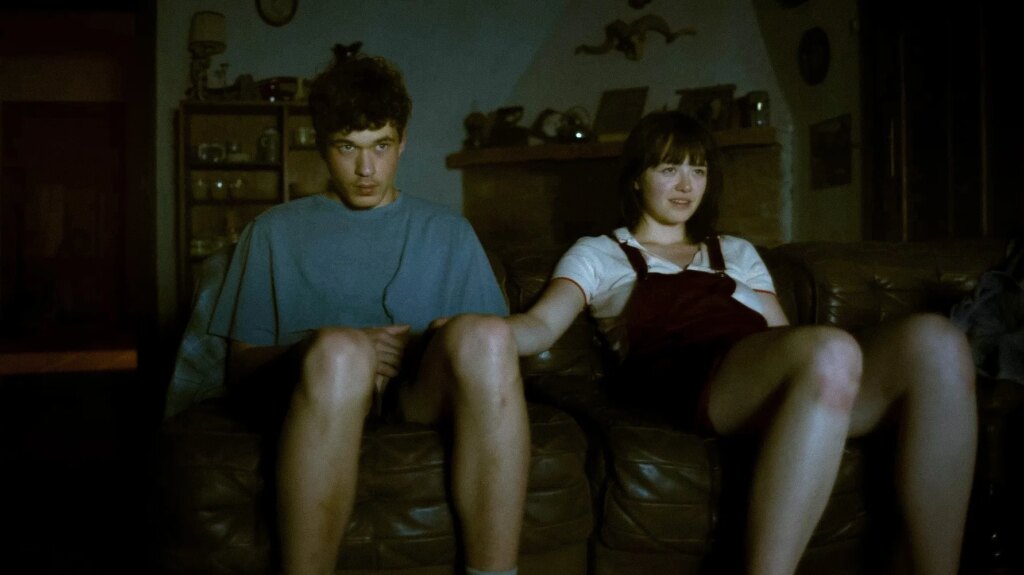

In Sick, teenage siblings Maks and Emma are sent to the countryside to care for their ailing grandmother, and they experience personal changes and changes to their relationship as time passes.
Ahead of its world premiere at Fantastic Fest, FILMHOUNDS sat down with Agata Trzebuchowska to discuss her feature directorial debut.
Agata, thank you so much for talking with me today. How are you feeling about the world premiere at Fantastic Fest?
I’m very excited about it, a bit nervous, I have to admit. It’s going to be the first screening, and I’m very curious about people’s reactions. So I’m super excited and a bit nervous.
Sick is an incredibly unique film. What was the origin of your idea for it?
Well, there were two places. One was more thematic, one was more pragmatic. The story came out of frustration, in a way, because I had been working on a different project for quite a long time and we struggled a bit with gathering funds. So, I had this very strong urge to make a movie quickly so I could prove myself as a director. That’s how Sick came about.
As for the subject, I was drawn to this very specific and disorienting moment of life when you are on the verge of becoming grown-up, and you feel like a stranger to yourself with all the hormones and changes in your body. I was very curious about this particular moment of life, and what can happen when you are experiencing it in very isolated circumstances, and how far you can drift from yourself when you are totally cut off from the outside world.
Were there any films that inspired Sick?
Not really, no, but sometime before coming up with the idea, I read this book by Ian McEwan called The Cement Garden. It also tells the story of adolescence about siblings that are left without any adults, and they are trying to create their own world instead. It’s a very unsettling vision, but also very realistic in terms of portraying that very specific moment of life.
What was the experience like directing your first feature versus the short films you have previously directed?
First of all, it’s definitely a greater responsibility. It was very exciting, I have to say, because I had been really waiting for it and looking forward to it. I was very happy having the space and time to work with actors and the crew, seeing how this idea evolved throughout the whole process from scratch to the very end. I enjoyed the process very much.
Sick has a few intimate scenes. How did you approach directing those?
We, of course, had intimacy coordinators on set. We rehearsed all the intimate scenes. And we talked about them a lot. It was very important for the intimate scenes not to feel isolated, I wanted to build them into more complex and larger choreography of the last scene. And I believe that, by doing so, I will take some emotional weight off the actors, because it won’t feel isolated and loaded, in a way. I tried to make it as technical as possible while, at the same time, not avoiding conversations around it.
I won’t spoil it for our readers, but I have to know – was the ending always going to be what it was, or did that change over time?
I knew from the beginning that it had to finish that way. Even though the process of writing was very free and uninhibited, and I didn’t always know what was going to happen in the next scene, I knew the ending from the very beginning.
There’s a lot of fluids and other bodily-based gross outs on screen. How did those special effects come together?
I wanted this film to feel very physical because it touches on very physical experiences, so it was important for me to work with practical effects rather than CGI. It was very exciting to have things happening in front of the camera, rather than creating it entirely digitally. We were also a very small production, so we decided to benefit from the limitations.
Sick will have its world premiere at Fantastic Fest 2026 on Friday, September 18