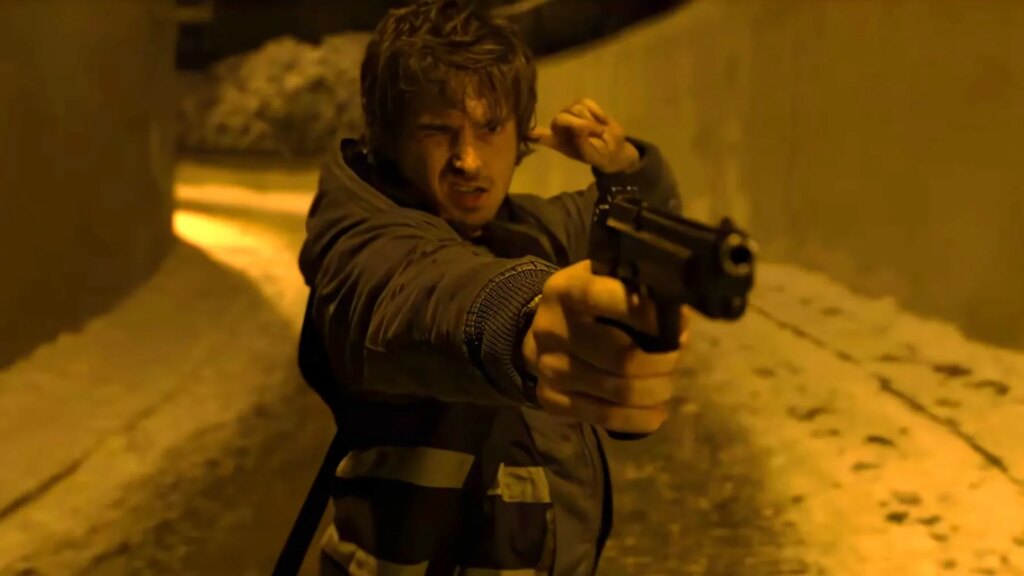

To be perfectly honest, as a fan of horror cinema, this ending is the weakest element of the film for me. I can enjoy a mean-spirited, or even bleakly humorous horror movie finale. Sam Raimi made a cottage industry out of them with the conclusion of nearly every Evil Dead movie (and go back and watch the original ending of Army of Darkness to make the hat trick complete). Raimi can also pursue a bleak ending with a sense of bitter, even tragic irony (see: Drag Me to Hell).
On a purely cinematic level, however, Bryan’s fate plays colder because it seems cruel purely for cruelty’s sake. The film ostensibly wants you to pity him because the whole journey is about Bryan realizing he wants to be a father–-an epiphany that could’ve saved his life if he was home with his girlfriend instead of looking for excuses to stay on the road. There is even irony in this because he initially thinks he is doing a good deed by taking this job since he’ll be saving some kid’s life. In the end, though, it was because he tried to save a sweet, angelic child that he got infected in the first place. Thematically it kind of works, but by juxtaposing him leaving a tragic audio message of contrition to his girlfriend and then comically turning into a monster that slaughters a bunch of comic relief red shirts fails to tonally blend. It’s more flippant than fitting.
Nonetheless, I would argue that the ending, like pretty much the rest of the far more satisfying and gleeful movie, should leave video game fans euphoric because of how snugly it fits into the canon.
To be sure, there’s been plenty of vitriol from self-styled guardians of the Resident Evil lore and mythology, who in recent months have denounced this movie, sight unseen, because it doesn’t star Leon S. Kennedy, Jill Valentine, or one of the Redfield siblings, nor does it take place in the 1990s and feature the Nemesis, a Licker, Mr. X, or the like. It even seems to play fast and loose with the biological symptoms that differentiate the T-virus, G-virus, and later games’ dreaded Las Plagas parasite.
And yet, the movie gets the aesthetic, style, and vibe of the games intrinsically, so much so that the ending gracefully inserts itself into a version of the mythology. Whatever criticisms I can sling, this conclusion is very much apiece with the world that Jill, Leon, Chris, and Claire traverse through, one quivering flashlight movement at a time.
Those games are famous in a lot of fans’ minds for their heroes, but back in the ‘90s, the original Raccoon City trilogy was more famous for its ruined world and atmosphere. Everywhere you went, be it the old Spencer Mansion, Raccoon City Police Department, or a popular Clock Tower, there were signs of lives shattered and stories abruptly ended. There were the annihilated cops who had a surprise welcome party for Leon still hanging from the walls by the time the rookie gets there to find their undying remains; a journalist hiding from William Birkin inside the jail cell beneath; and even a little girl who lost her parents in a shameless lift from James Cameron’s Aliens.