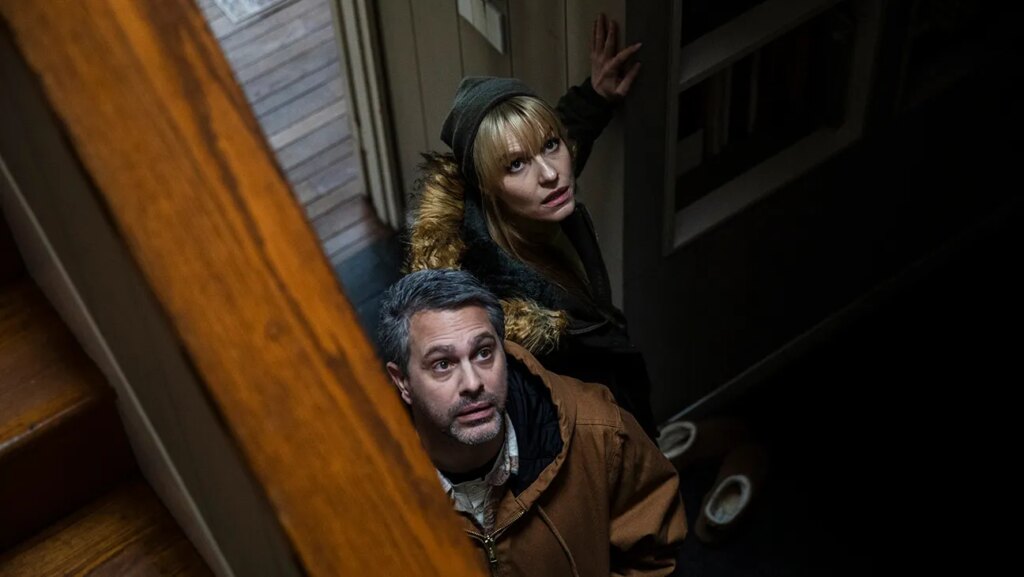

Best-selling novels like Jean Hanff Korelitz’s The Plot and stage thrillers like Ira Levin’s Deathtrap, among many other works, have demonstrated that stealing another writer’s work can have fateful if not deadly consequences. Neil LaBute (In the Company of Men, Nurse Betty) delivers another variation on the familiar theme with his latest effort, receiving its world premiere at the Oldenburg Film Festival.
Taking place in a single location and featuring but three lead performers, Murderous carries a strong whiff of such LaBute-cited influences as Joseph L. Mankiewicz’s Sleuth and Hitchcock’s Rope. Unfortunately, it doesn’t live up to those predecessors, feeling like an undernourished stage thriller whose plot machinations are far too obvious.
Murderous
The Bottom Line
Stagy and contrived.
Venue: Oldenburg International Film Festival
Cast: Gia Crovatin, Thomas Sadoski, Jordan Baker
Director-screenwriter: Neil LaBute
1 hour 47 minutes
The story, beginning with a first chapter titled “Him,” revolves around Marian (frequent LaBute collaborator Gia Crovatin), a filmmaker who made a splash with her debut effort, a femme-oriented horror film entitled “Murderous.” With her financial success signified by her gorgeously rustic home, a former mill, and the vintage red Porsche in her driveway, she’s surprised one day by the unexpected arrival of Norman (Thomas Sadoski), who announces that he wants to have a talk. And that he’s driven all the way from Iowa to do it.
Clearly made uncomfortable by the intrusion, she eventually agrees to invite him in. It turns out that they were both students at the same time — he was a teacher’s assistant, he reminds her — and had a brief romantic relationship. He compliments her expensive new home, commenting that she seems to have no personal items or photographs. What she does have are valuable knick-knacks previously owned by such famed writers as Truman Capote and Willa Cather. Not to mention Shirley Jackson’s letter opener. It’s a wonder she doesn’t have Chekhov’s gun on display.
After brief small talk in which Norman’s sorry lot in life is made clear — he has no job and no girlfriend, he admits — he finally gets to the point.
“Did you think I wasn’t going to see it?” he asks about her film that won awards and put her on the map. It turns out that he had originally devised the film’s premise and the two had worked on the idea together and even collaborated on flipbooks of individual sequences, which he claims to still have “somewhere” in his possession. Needless to say, he thinks they need to come to some sort of agreement on compensation.
Despite the tension, things, as they tend to do in LaBute’s works, turn sexual. When he reminds her that she cheated on him during their relationship, she takes it as a cue.
“Is that what you want to make up for things? A blow job?” she asks. Norman thinks carefully for a moment before replying, “I wouldn’t hate it.”
To reveal more about what happens next during the charged encounter would be too much of a spoiler. Suffice it to say that things end … abruptly.
Another unexpected visitor, this time an older woman, arrives in the second chapter, “Her.” She’s Lila (Jordan Baker), who declares herself to be a big fan and simply wants some DVDs autographed, including one for her son. Again, Marian reluctantly invites the stranger in, and the two engage in a lengthy discussion about Marian’s film and the film business in general. It provides the opportunity for Marian to launch into a diatribe about the frustrations of working with clueless movie distributors and marketers, which, coming from LaBute, feels like the most personal and honest part of the film.
The film drops hints about Lila’s true identity, or at least Marian’s perception of it, with the subtlety of a sledgehammer. Onstage, these plot machinations might have worked with a live audience eager to be manipulated. But they come across as forced and artificial here, and despite the best efforts of the performers Murderous feels more like an actors’ exercise than an organically plotted thriller. It never transcends its air of narrative claustrophobia and, considering its thin premise, would have benefited from a sharp cutting of its overlong 107-minute running time.