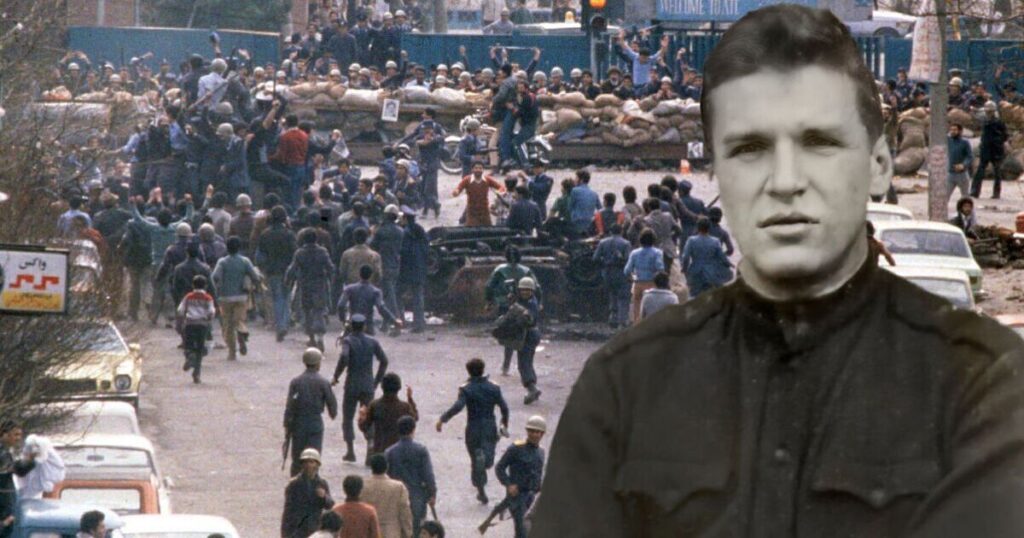


Vladimir Kuzichkin, alias Redwood, helped bring down communists in Iran… with unseen repercussions (Image: Courtesy Elena Alexandrovna / Getty)
Had Viagra been invented two decades earlier, one of the most extraordinary feats of espionage of the entire Cold War quite conceivably might never have happened. Indeed, the entire course of history could have been irrevocably altered. But it wasn’t until 1998 that the little blue pills were first prescribed for erectile dysfunction. And by then, it was too late to make a difference – possibly for the best given that difference could have spelled the end of the world.
When KGB agent Vladimir Kuzichkin arrived unannounced at the British embassy in Tehran on October 1, 1981, offering important information, he wasn’t driven by ideology or money – but by love for his wife, Galina. The 6ft 4in intelligence officer, codenamed Redwood by MI6, was suffering a problem 50% of men are said to experience at some point. He believed Western scientists could cure his sexual impotence.
In return, he would spill the beans on an audacious KGB plot to topple Iran’s hardline Islamic regime in a communist coup, establishing a puppet government and welcoming Russian tanks over the border from neighbouring Soviet states. “It was one of those hinge moments in history,” explains author and historian Ben Macintyre, 62, who reveals the jaw-dropping plot in his thrilling new book, Redwood.

Vladimir Kuzichkin and his wife Galina pictured in the early Seventies (Image: Courtesy Galina Kokosova Archives)
“I’m hesitant to say that if Kuzichkin had been able to get it up, as it were, we might all be living in a different world, but in a way that’s true.”
The idea of Moscow controlling the oilfields and warm water ports of the Persian Gulf was anathema in Washington and London. “You can’t exaggerate how much Britain and America were terrified of a Soviet takeover of Iran,” Macintyre continues. “It was absolutely their worst possible nightmare. We might have lost the Cold War, there could even have been a nuclear war.
“I have to be careful, because what-if history is dangerous, but everybody was genuinely terrified a coup could change the Cold War. America had nuclear options, and it was looking at them. And if they’d used nuclear weapons, the Russians would have responded…”
It was a story Macintyre first heard ten years ago but discounted, he admits, because it didn’t seem remotely credible. A few years later, he heard it again. But it wasn’t until a chance meeting with former MI6 agent Ian McCredie, Redwood’s handler, that he realised it was all true. The bestselling SAS Rogue Heroes and Operation Mincemeat author’s nose for a story now reveals an astonishing tale of plots, betrayal and bedroom unhappiness that echoes to this day.
A trawl through MI6 files and databases in London after his first approach produced no trace of Kuzichkin. He had never been ‘flagged’ as a potential informant by MI6, the CIA or other Western agencies. But could he be too good to be true?
“There had been walk-ins before but I doubt anyone had had such a short distance to go. He literally walked across the road because the embassies were opposite each other,” says Macintyre. “He was big, highly recognisable. It was a massive gamble. But it was a reflection of just how desperate he was. The initial reaction in MI6 was terror – it looked like a classic ‘set-up’. That they’d got wind of McCredie and were trying to smoke him out.”
Such operations, known as “dangles” could have lethal consequences.
“Quite apart from the cost to McCredie personally had he been exposed – he’d have wound up in Evin Prison and whether he’d ever get out is anyone’s guess – but the entire embassy would have been taken hostage.”

MI6 officer Ian McCredie would become Agent Redwood’s handler (Image: Courtesy Ian McCredie)
Eventually London gave permission to McCredie – new to Tehran and working full time as First Secretary, Commercial, with “intelligence activity in my spare time” – to meet Kuzichkin.
During their first clandestine rendezvous, at the Chattanooga restaurant, once the most fashionable hangout in Tehran before the Islamic revolution of 1979, the Russian explained in a mixture of Persian and English that he could no longer work for the KGB.
He was prepared to spy for Britain but only for a limited time, before being resettled in the UK. Crucially, he convinced McCredie he was legitimate. A second meeting took place at McCredie’s home in the British embassy compound. “I did not know if I was going to be ambushed or caught in a roadblock by Iranians or Russians,” he told Macintyre. For Kuzichkin, the stakes were even higher.
If his betrayal was discovered, he would be seized, sedated and shipped back to Moscow on a stretcher swathed in bandages to hide his identity. In the bowels of the dreaded Lubyanka prison in Moscow, he would be interrogated, tortured and finally executed. Indeed, in the 1960s a previous double agent had been cremated alive as a warning to potential traitors.
Sitting drinking vodka in a small bathroom, McCredie having turned on a radio and ran the taps to confound audio surveillance, the pair of professional spies thrashed out a deal.
“I have no power in bedroom. I cannot make love to my wife,” Kuzichkin revealed. “There is something wrong with me, need your help. Western medicine is superior. A cure…”
Kuzichkin was convinced MI6 could help save his marriage. For her part, his wife Galina had no inkling of her husband’s betrayal. But in the time it took to run a bath, Kuzichkin had agreed to become a double agent.
“He’s almost the un-James Bond – he’s this huge, handsome, brave intelligence officer, but actually he suffered from a human frailty 50% of men experience at some point in their life,” says Macintyre.
Among the trove of intelligence the KGB man revealed were plans by the Soviet-backed Iranian communist party, the Tudeh, to replace the Ayatollah with a pro-Russian government. As McCredie scribbled away, Kuzichkin described weapons caches, training, an underground military network and money funnelled to party leaders. It was pure dynamite. The decision was taken at the highest levels to hand over the information to the Iranian secret services and a meeting was held in Pakistan in September 1982.

Kuzichkin and McCredie after the former was brought to UK for a fresh start (Image: Courtesy Ian McCredie)
Thousands of Iranian communists and their families were subsequently rounded up and slaughtered. The fallout, explains Macintyre, is one reason Redwood is still studied at MI6’s field training base, Fort Monckton in Gosport, Hants.
“They knew those communists were not going to be dealt with gently,” he says. “Within MI6, when the decision was taken, there was a vigorous internal debate. It has a kind of moral issue at its heart. ‘Did we do the right thing?’
“But bear in mind the context. Their job was to stop the Soviets and Ian McCredie is bullish about this. He says, ‘In the circumstances what else could we have done? Ignore it? Allow the possibility of a Soviet takeover of Iran?’ Frankly, what’s the point of getting golden intelligence if you don’t use it?”
In the event, the Iranians moved fast and ruthlessly. The communists were wiped out and the Islamic regime was set in concrete. But any sense of gratitude Britain and the US might have expected for was wholly absent. “It’s a Cold War triumph and in some ways a disaster because it sets up a new enemy,” Macintyre admits.
Indeed, with US strikes ongoing against Iran, the ramifications of Redwood continue to reverberate. “It’s a dreadful, brutal, dictatorial, theocratic regime. And yet what nobody knows is that MI6 and the CIA had a hand in creating it,” says Macintyre.
Ironically, today Russia is bankrolling Iranian drones and providing technology. “Once again, Russia is trying to get leverage,” adds Macintyre. “So the Great Game is still going on.”
As for Kuzichkin, MI6 exfiltrated him to the UK where he was given a new identity, as Alexander Larkin, and retrained as an acupuncturist. In a curious twist, one of his patients was actor Alec Guinness who was suffering from a bad back.
Guinness, who played fictional spy George Smiley, never realised that the huge man with the foreign accent sticking needles into him in a sleepy seaside resort was a real spy.

Author Ben Macintyre has a remarkable ability for sniffing out unique espionage stories (Image: Courtesy Ben Macintyre)
Macintyre chuckles: “If you were writing a fiction and said, ‘My character’s going to end up as the most successful acupuncturist in Weston-super-Mare and one of his clients is Alec Guinness at the time he’s making Smiley,’ people would think it preposterous.”
Although his impotence was eventually cured, Kuzichkin ended up drinking himself to death. But as Macintyre adds: “They stuck with him and, when he died, they all turned out at his funeral. That duty of care in the end is why MI6 will probably be okay with this book – it demonstrates that they do look after their agents.”
Away from Redwood, Macintyre is awaiting season three of his smash hit SAS Rogue Heroes, adapted by Peaky Blinders creator Steven Knight who’s currently writing the hugely anticipated next 007 film.
“It’s in occupied France and the war is becoming much more personal now. It’s about civilians. It’s about collaborators, it’s about resistance fighters. And it’s just extraordinary what they’ve done,” says Macintyre.
“Steven has this incredible understanding for male characters. He’s absolutely brilliant at a certain sort of angry, male violence. He did it in Peaky Blinders, he’s done it in this and I think he’ll probably do it in Bond, too.”
A six-part adaptation of his last book about the SAS Iranian embassy siege is coming in early 2027 via Slow Horses show runner Will Smith with an ensemble cast, including Danny Dyer as PC Trevor Lock, the embassy cop and one of the heroes of The Siege.
“The SAS are the drumbeat that runs through it, and a lot of people will come to this thinking, ‘They’re going to kick the doors in straight off’,” says Macintyre.

Redwood by Ben Macintyre is out now (Image: Viking)
“It does get really kinetic but, until that point, you get drawn into this kind of incredibly tense theatre of what’s going on inside the embassy. When the gunmen are introduced, you think, ‘Oh, these are the baddies’. But actually, by the end of episode two, you’re thinking, ‘F***, don’t do this! Get out, boys’. It’s so cleverly written.”
As for Macintyre, as well as promoting Redwood in a world tour, he’ll no doubt be doing what he always does – thinking of his next incredible tale. “These stories throw up the strangest combinations of personalities,” he adds. “And Redwood is such an odd one because at its very core is one man’s private, intimate problem – and yet its world impact is just astonishing.”
Redwood: The Untold Story of the Cold War’s Most Extraordinary Spy, by Ben Macintyre (Viking, £25) is out now

![Sammy Hagar Says Alex Van Halen Is 'Doing A Lot Of Stuff Wrong For Van Halen's Legacy,' Challenges Alex Van Halen To 'Come Clean' With Reasons For Recent Insults [News]](https://biger.shop/wp-content/uploads/2026/09/188573_0_wide_ver1789797721.jpg@1200-150x150.jpeg)