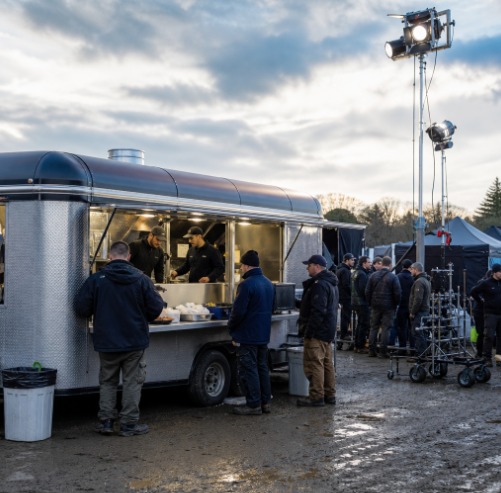

Feeding a large crew in a remote location is one of the most underestimated logistical challenges in production management. Whether you are running a film shoot in the middle of a desert, managing a construction project miles from the nearest town, or coordinating a large-scale outdoor event, the ability to deliver hot, consistent, high-quality meals directly on-site can make or break crew morale and productivity. The solution that production managers, catering companies, and event coordinators have increasingly turned to is the self-contained mobile kitchen — a purpose-built unit that brings the full functionality of a commercial kitchen wherever it is needed most.
The Unique Demands of On-Location Catering
On-location catering is fundamentally different from restaurant or banquet-style food service. There is no fixed infrastructure to rely on. Power may be limited or entirely off-grid. Water supply must be self-managed. Storage must account for temperature-sensitive ingredients across long service windows. And the kitchen must be capable of moving from one location to the next without losing a single piece of equipment or compromising food safety standards.
These demands have pushed the catering and production industries toward a new standard: fully equipped, road-ready kitchen trailers that function as independent culinary operations. These units are not glorified food trucks. They are engineered commercial kitchens mounted on trailer chassis, capable of serving hundreds of meals per service period with the same output quality expected in a fixed facility.
What a Self-Contained Kitchen Actually Includes
Commercial-Grade Cooking Equipment
A properly outfitted mobile kitchen trailer is equipped with commercial ranges, convection ovens, flat-top grills, deep fryers, and steam tables — the same equipment found in high-volume restaurant kitchens. The difference is that every component is secured for transport, connected to onboard fuel systems, and designed to operate without a permanent utility hookup. Propane or natural gas systems power the cooking equipment, while onboard generators or shore power connections handle electrical loads for refrigeration, lighting, and ventilation.
Refrigeration and Cold Storage
Cold chain integrity is non-negotiable in any food service operation, and mobile kitchens address this with integrated refrigeration units, reach-in coolers, and sometimes walk-in cold storage compartments built directly into the trailer structure. This allows catering teams to store multiple days’ worth of perishable inventory without relying on external refrigeration or daily resupply runs — a critical advantage on remote shoots or multi-day events.
Water Systems and Sanitation
Fresh water tanks, wastewater holding tanks, and on-demand water heaters give mobile kitchens complete independence from municipal water connections. Three-compartment sinks, handwashing stations, and NSF-compliant surfaces ensure that health code requirements are met regardless of location. This level of sanitation infrastructure is what separates a professional mobile kitchen from improvised field catering setups.
Why the Film and Production Industry Relies on Mobile Kitchens
Film and television productions operate on tight schedules where every hour of downtime has a direct financial cost. Crew members who are not fed on time or who receive poor-quality meals become less productive, and in union productions, meal penalty clauses can add significant costs to a production budget. The craft services and catering departments on any major production are therefore treated as essential infrastructure, not an afterthought.
Mobile kitchen trailers allow production caterers to set up a fully operational food service station within hours of arriving on location. They can be positioned adjacent to base camp, connected to a generator, and begin service without waiting for local restaurant deliveries or temporary facility construction. For productions shooting in rural areas, national parks, or international locations, this self-sufficiency is not just convenient — it is the only viable option.
The same principle applies to large-scale construction projects, disaster relief operations, military field deployments, and corporate events held in non-traditional venues. Any situation where a large group of people needs consistent, nutritious meals in a location without fixed kitchen infrastructure is a situation where a mobile kitchen trailer delivers measurable value.
Fabrication Quality Determines Field Performance
The performance of a mobile kitchen in the field is directly tied to the quality of its fabrication. Units that are poorly welded, use substandard materials, or lack proper insulation will fail under the stress of repeated transport and continuous high-volume cooking. This is why the fabrication standards applied to mobile kitchen trailers matter as much as the equipment installed inside them. Just as custom sheet metal fabrication bridges critical gaps in hardware development, precision metalwork in trailer construction determines whether a mobile kitchen holds up through hundreds of service days or begins to deteriorate after the first season.
Structural integrity, corrosion resistance, thermal performance, and the precision fit of all installed systems depend on the skill and experience of the fabrication team. Buyers evaluating mobile kitchen trailers should look closely at weld quality, material specifications, and the manufacturer’s track record with commercial-grade builds before making a purchasing decision.
Craftsmen Industries: Purpose-Built for Commercial Food Service
When it comes to sourcing a mobile kitchen that meets the demands of professional catering operations, the manufacturer’s expertise in commercial fabrication is the most important variable. Craftsmen Industries has built a reputation for producing heavy-duty, custom-configured mobile kitchen solutions that are engineered for real-world performance. Their mobile kitchen trailers are designed with commercial operators in mind — built to accommodate full cooking lines, integrated cold storage, and complete utility systems within a road-legal trailer format that can be deployed anywhere a production or event requires.
What distinguishes Craftsmen Industries from general trailer manufacturers is their deep experience in industrial fabrication. Every unit is built to client specifications, allowing catering companies, production studios, and event operators to configure their kitchen layout, equipment package, and utility systems to match their exact operational requirements. The result is a mobile kitchen that functions as a true extension of a professional catering operation rather than a compromise solution.
Industry Trends Shaping Mobile Kitchen Design
The mobile kitchen sector is evolving alongside broader trends in commercial fabrication and food service technology. Energy efficiency, sustainability, and digital monitoring systems are becoming standard considerations in new builds. Operators are increasingly requesting solar-assisted power systems, low-emission cooking equipment, and smart inventory management tools that integrate with catering software platforms.
For those tracking where the fabrication and mobile equipment industries are heading, the state of the industry insights from FABTECH Canada offer a valuable perspective on the manufacturing innovations that are shaping the next generation of mobile commercial equipment. As fabrication technology advances, mobile kitchens will continue to become more capable, more efficient, and more adaptable to the diverse environments in which they are deployed.
Conclusion: The Mobile Kitchen as Essential Infrastructure
Feeding a crew on location is not a secondary concern — it is a core operational requirement that directly affects productivity, safety, and the overall success of any large-scale project. A well-designed, professionally fabricated mobile kitchen trailer transforms one of the most challenging aspects of remote operations into a manageable, repeatable process. For production companies, catering contractors, and event operators who need reliable food service anywhere in the world, investing in a purpose-built mobile kitchen is not an expense — it is infrastructure that pays for itself in every service it delivers.