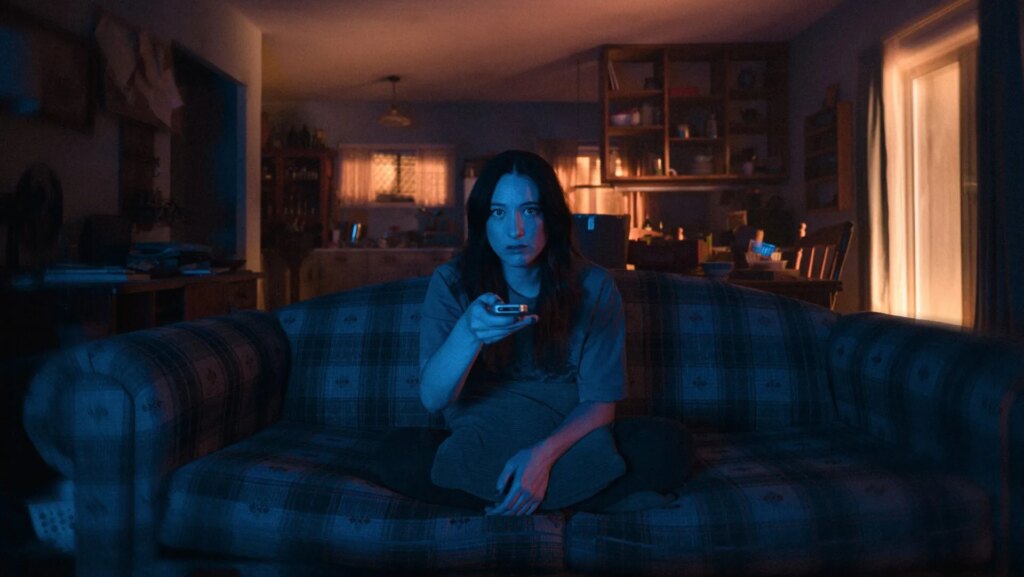

In Josh Tanner’s feature directorial debut, Posthumous, Zoe (Sophie Lowe) returns to her family home for her 30th birthday to a less-than-warm welcome from her father (David Roberts).
Her childhood home is messy and neglected, with a “for sale” sign out front. Zoe plans to crash on the couch for a couple of days while she and her boyfriend cool off from a fight. Poking around her old bedroom, she finds photographs of her deceased mother, who she never got to meet, since she died right after childbirth. The photographs show Zoe’s parents with their next door neighbors, whom Zoe thought they weren’t friends with. Those photos, combined with VHS birthday messages recorded by her mother, send Zoe on a mission, determined to learn all she can about the woman who didn’t get to raise her. She uncovers secrets that her father wished were left in the past.
Posthumous is all about family, especially parent and child relationships, but also the love in a marriage. Zoe and her father have a distant relationship, but clearly love each other, and Zoe wants to learn where the cavern between them came from. She sees her mother as an angel, a ghostly figure she never got to meet, who only represents love and light. Flashbacks in the film, which show Zoe’s parents as if on a VHS tape, reveal a beautiful relationship between the parents, who had such love for one another, and their unborn daughter. As Zoe learns more about her past, she realizes how much each of her parents sacrificed for her, but especially her mother. The characters are easy to love and cheer for, and viewers will want Zoe and her dad to mend their relationship. Even Zoe’s somewhat-bland boyfriend proves his usefulness, and helps the family meet their goal.
The tapes in the film serve a purpose greater than simply teaching Zoe about her past, though they do that as well. Tapes are an essential part of the horror of the film, bridging the past and present, and bringing together death and life. Sometimes the tapes blur reality, and the strange images on them are hard to follow, in an unsettling way that brings to mind Ring (1998). The setting ramps up the horror of the film, especially as Zoe enters her strange neighbour’s house. Odd symbols and relics give the sense that they are in a magical place, but who’s to say if it’s good or bad magic?
While Posthumous wears its heart on its sleeve, it also uses subtlety to its advantage. Character traits come through the performances and story without any exposition dumps. For example, as the film progresses, it’s clear that both Zoe and her father drink too much, and maybe that’s what her mother was referring to when she wanted Zoe in one of her tapes not to pick up his “bad habits.” It’s always refreshing to see a film that trusts its audience to catch subtle story beats.
Posthumous is a thrilling and frightening film about familial love, and how much you might be willing to sacrifice for it. Fans of supernatural mysteries and stories about haunted tapes will find much to love in this film.
Posthumous had its world premiere at Fantastic Fest 2026 on Saturday, September 19