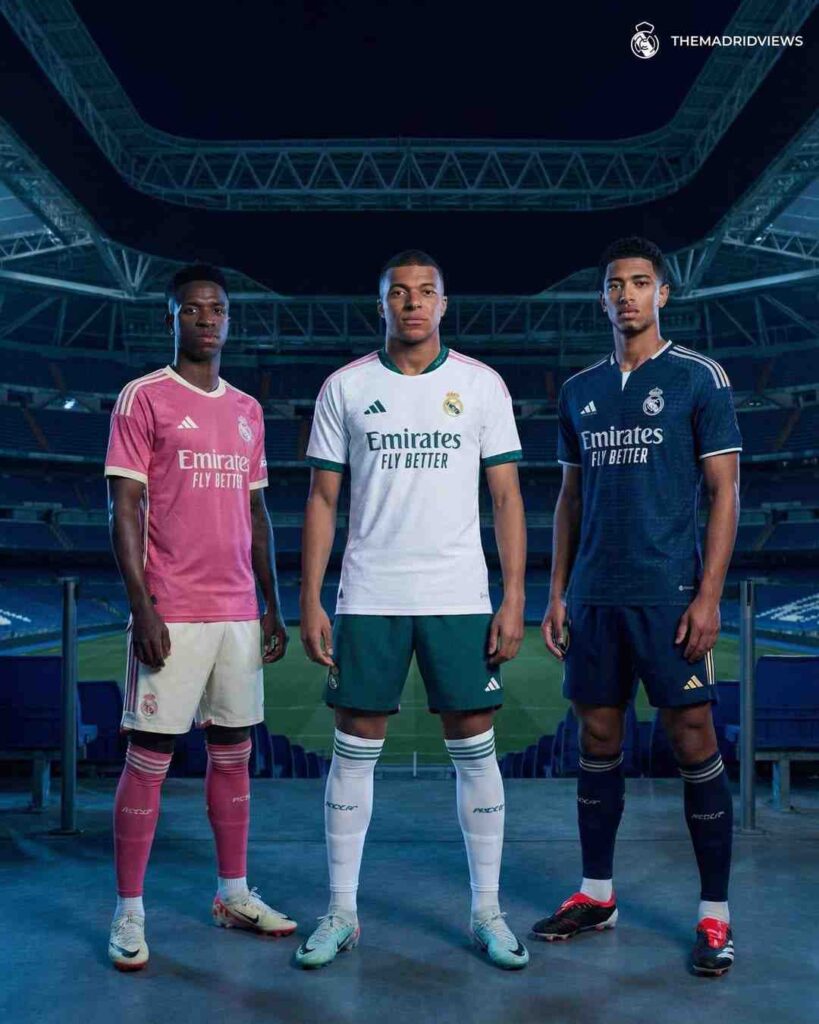

Real Madrid’s latest Adidas home kit has split supporters across timelines, group chats, and comment sections. The 2026/27 white base, dark green collar, and pink shoulder stripes have fans arguing whether the club has pushed too far from its sober identity or simply updated it for a new audience. The Real Madrid jersey now functions as both product and provocation.
Leaked images set the tone
Photos surfaced in late 2025 through kit accounts like Footy Headlines and Opaleak. They showed the white shirt with bolder stripes and the unexpected pink-green pairing. Early reactions ranged from curiosity to outright rejection, and the Real Madrid jersey became the main character in dozens of threads before any official statement.
By the time Adidas and Real Madrid confirmed the design in June 2026, the conversation had already hardened. Fans who liked the risk pointed to past experiments, such as the 2012/13 green accents or 2014/15 pink details. Detractors called the new look an aberration that ignored the club’s preference for clean white.
Within hours of the leaks, edited versions circulated with purple or navy accents instead. Several of those unofficial tweaks received more positive engagement than the official images, showing how quickly the Real Madrid jersey had become a template for fan redesigns.
Official reveal widens the split
Adidas framed the kit around “excellence, craftsmanship, and a winning mentality.” Marketing shots featured Mbappé, Bellingham, and Vinícius, positioning the shirt as both heritage piece and performance tool. The language did little to calm viewers who already disliked the color accents.
Marca reported that the design “ignited the debate between those who applaud its sobriety and those who ask for more audacity.” The Real Madrid jersey therefore arrived with two simultaneous narratives: one of measured evolution, the other of unwelcome departure.
Trustpilot reviews of the official store added another layer. Some buyers noted sizing inconsistencies and questioned whether the premium price matched the fabric quality. Practical complaints about fit began to mix with aesthetic ones, extending the argument from social media into real-world purchases.
Tradition versus commercial pressure
Real Madrid’s crest and history have long favored a restrained white look. The 2026/27 kit’s green collar and pink stripes therefore read to some supporters as a concession to trend cycles rather than a nod to the club’s past. Critics argued the changes prioritized shelf appeal over identity.
Defenders countered that Adidas must balance heritage with sales targets. They noted that bolder accents often drive replica numbers, especially among newer or international fans who discover the club through stars like Mbappé. The Real Madrid jersey, in this view, functions as both symbol and revenue stream.
Previous seasons had already tested the same tension. The 2025/26 home kit introduced yellow trim and Bernabéu renovation textures that drew mixed reviews, while the third kit’s retro stripes were largely welcomed. The pattern suggests each release now arrives with an expectation of debate rather than consensus.
Social media accelerates the argument
X and Reddit threads filled with side-by-side comparisons within minutes of the official images. Some users posted the new Real Madrid jersey next to vintage kits from the 1990s or early 2000s, arguing that earlier Adidas versions managed boldness without clashing tones.
Others highlighted the marketing imagery. Photos of Mbappé and Vinícius wearing the shirt on the pitch were praised for making the colors appear more integrated than they looked in product shots. The gap between static images and on-field movement became another talking point.
Memes quickly followed. One widely shared edit replaced the pink stripes with the club’s traditional purple, earning more likes than the official announcement post. The speed of these responses showed how the Real Madrid jersey now circulates as editable content as much as wearable merchandise.
Fit questions move beyond aesthetics
Customer feedback on the official store raised concerns about sizing and durability. Some fans reported that fan versions run small, while authentic replicas feel stiff after initial washes. These practical issues fed into the broader conversation about whether the Real Madrid jersey delivers value.
Retro and lifestyle releases, such as 1990s-inspired EQT drops, continue to receive warmer reception. Their success suggests that fans remain open to bold designs when they feel anchored in club history rather than seasonal trend cycles.
The price difference between fan and authentic versions also factors into the discussion. At roughly €100–110 for the supporter edition, buyers expect a certain level of comfort and longevity. When those expectations are not met, aesthetic complaints gain additional weight.
Player marketing shapes perception
Images of Mbappé, Bellingham, and Vinícius wearing the kit were released alongside the launch. The choice of stars with large global followings aimed to soften resistance by linking the shirt to current success rather than past tradition.
Some supporters argued that the players’ presence made the colors appear more intentional. Others felt the marketing could not override the design itself. Either way, the Real Madrid jersey became inseparable from the squad’s image in the weeks after the reveal.
MLS ties and U.S. retail availability further extended the conversation. American fans following the club through streaming or international players encountered the same images and debates, often discovering the kit through Adidas stores rather than Spanish-language coverage.
Color choices drive the loudest reactions
The dark green collar and cuffs were described by some as a respectful nod to the club crest’s jewel details. Others saw them as an unnecessary addition that broke the white field’s simplicity.
The pink Adidas stripes on the shoulders proved the most divisive element. Supporters of the choice pointed to previous pink accents in club history, while critics called the combination visually jarring. The Real Madrid jersey thus became a referendum on how much deviation the club’s identity can absorb.
Marca noted that any minimal change to the shirt is examined under a microscope because the garment carries near-sacred status. That scrutiny explains why small details, such as stripe width or accent color, can dominate weeks of coverage.
Future kits may follow the same pattern
Adidas and Real Madrid have not indicated whether the 2026/27 design signals a longer shift toward bolder accents. The club’s next releases will likely face the same immediate social media response, with leaks and edits shaping opinion before official images appear.
Commercial considerations remain central. Replica sales drive revenue, and international audiences often respond to visible color changes. The tension between those incentives and the preference for a sober white identity shows no sign of easing.
Fan edits and unofficial redesigns will probably continue to outperform official images in engagement. The Real Madrid jersey now exists as much in digital conversation as on the pitch, with each release serving as a prompt for collective redesign.
Design debate reflects larger club questions
The argument over the Real Madrid jersey mirrors broader discussions about how the club presents itself in a global market. Supporters who value continuity see each new accent as a potential erosion, while those focused on growth view the same changes as necessary adaptation.
Neither side appears likely to convert the other. The 2026/27 kit has simply confirmed that the shirt functions as a live site of negotiation between heritage and commerce, with social media providing the arena where that negotiation plays out in real time.