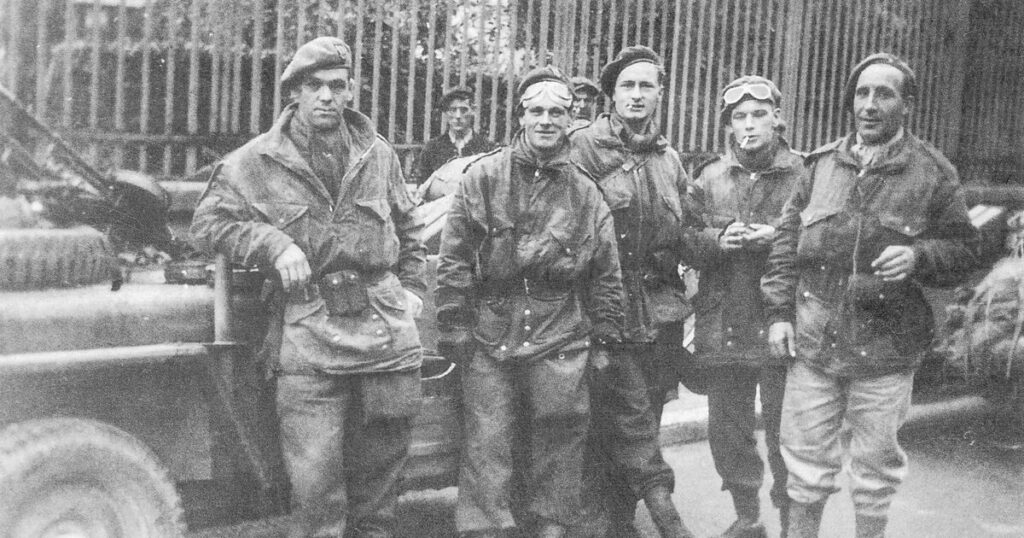


Members of 2 SAS on Operation Wallace, the precursor to Operation Loyton (Image: Courtesy SAS Regimental Association)
On June 30, 1984, SAS creator David Stirling was invited to open the then-new SAS barracks in Hereford named Stirling Lines in his honour. He gave an address crediting Brian Franks as one of the founding fathers of the modern SAS. Also included in the list were David’s brother Bill, Paddy Mayne and Jock Lewes.
Yet despite being one of the many unsung heroes of World War 2, and helping to save the SAS as a fighting force post-war, Franks remains largely unknown outside the tight-knit special forces world. Educated at Eton, he chose not to go into the Army like his father, a professional soldier – killed leading his regiment in a cavalry charge six weeks before the end of the First World War when Brian was just eight.
Unusually for an Old Etonian he joined the hotel business, starting as a “pan diver” at the Dorchester in 1932. His skills, style and ambition were soon noticed. By 1936 he had been promoted to manager of the Mayfair Hotel and subsequently headhunted to run the Hyde Park Hotel in its exclusive and stylish heyday in the 1930s.

Brian used the Hyde Park Hotel in London as an unofficial headquarters for the Intelligence Service (Image: Getty Images)
In 1939, on the advent of war, he was commissioned into the Middlesex Yeomanry. Soon he gravitated to the world of moreesoteric military operations, which suited his unconventional temperament, moving first to the GHQ Reconnaissance Regiment or “Phantom”, then to the Commandos.
He became the Brigade Major of the Special Service Brigade in 1943 and took part in the invasion of Sicily, and the operation at Termoli in Italy where he won the MC. He was posted to 2 SAS in early 1944 and, taking over from Bill Stirling in June 1944, he commanded the Regimenton operations in France, Italy, Germany and Norway. During Operation Loyton in the Vosges mountains in September 1944 he parachuted in to lead operations behind enemy lines.
The operation had begun to get into difficulties – General Patton’s army, who were supposed to make a rapid link up with the SAS, had stalled through lack of fuel. Simultaneously, the Germans unleashed a 2,000 man SS anti-Partisan unit, whosemission was to hunt down and kill the SAS and French Resistance.
Most of the Resistance were killed but Brian and his men fought back killinghundreds of Germans and tying down 2,000 SS men.
In the end, Brian had to give the order to exfiltrate from behind enemy lines. During the exfiltration, Brian was wounded in the leg and 31 of his soldiers were captured, tortured and executed by the Germans.
Brian’s decision to join the operation did a lot to calm the situation and dispel the aspect of doom that was beginning to settle on Loyton. His striking presence, tall and imposing, combined with his natural cheerfulness, instinctive and immediate understanding of the difficulties in which Loyton was operating, all had a massive morale-boosting effect on his men.
For Operation Loyton he was awarded the DSO, Croix de Guerre and Legion d’Honneur. After the war he returned to the Hyde Park Hotel where he remained general manager throughout the 1950s and 60s.
The Hyde Park became a favourite of the Royal Family and was the hub of the London social scene.

Brian pictured in Palestine (Image: Courtesy Franks Family Archive)
The war had taken its toll however and it was shabby, threadbare and dilapidated. With the same energy and leadership he’d shown in the SAS, Brian took matters in hand,starting a massive refurbishment plan. However, Brian also kept a foot on the secret world – working for SIS in their War Planning Directorate, making preparations just in case the Cold War turned hot, and enlisting the help of Sir Stewart Menzies – as “C”, the Head of SIS – in his campaign to bring back the SAS.
In 1945, the decision had been taken to disband the SAS and SOE, something Brian and many others thought very short-sighted. Brian had left the Army with two driving ambitions. First to track down and bring to justice the war criminals who had murdered his soldiers, and their Resistance helpers during Operation Loyton. Secondly, to have the SAS restored.
To prosecute the former, Brian contrived to set up an “off the books” SAS war crimes investigation team that operated for the next three years – successfully bringing to justice many of the war criminals who had murdered SAS soldiers in France. But it was in the corridors of power that Brian fought a different sort of battle – one that required more than his skills as a fighting soldier.
He was adept at political manoeuvring and had some very high level contacts, including Winston Churchill and many of the more effective senior commanders of the Second World War, and he was supported by David Stirling and Paddy Mayne.

Lieutenant Colonel Tim Spicer OBE has written a biography of Brian Franks (Image: Courtesy Tim Spicer)
On April 17, 1947, his hard work and intensive lobbying paid off when authority was given for the “formation of the following unit wef 1 May 1947 21st Special Air Service Regiment (Artists Rifles) (Territorial Army)”.
The SAS was back and open for business. In the words of David Stirling: “Had it not been for Brian Franks, we would have been consigned to oblivion.”
In 1987, former SOE agent Dare Newall wrote: “In retrospect it is a miracle thatthe post-war SAS survived, let alone flourished as it does today. Several times it was touch and go. Our salvation depended on a few, very few dedicated visionaries andpersistent champions in the right place at the right time.”
Brian became the first commanding officer of 21 SAS. He also used the Hyde Park Hotel as an unofficial headquarters and welcomed its operational use by the Intelligence Services. He became involved with running another “off the books” venture in the 1960s – Britain’s secret war in Yemen, together with David Stirling and Julian Amery. In 1977, he became the Colonel Commandant of the SAS, and helped manage their image and profile, quite often against the wishes of the MoD, defending them in public against malicious propaganda from the IRA.
In this he was very forthright and robust. He died on May 6, 1982, six weeks after the Argentinians invaded the Falkland Islands and sadly was unable to welcome the SAS home after a very successful war.
In his private life, he was a dashing bon viveur, gastronome and a terrific sportsman – cricket, shooting, racing, stalking and fishing. He was great company, loved by all, from the Royal Family, to the most junior soldier. He was close friends with a wide range of characters. David Niven, Ian Fleming, Evelyn Waugh, and Winston Churchill as well as his military comrades.

An Axe and Four Balloons: The Biography of Brian Franks (Barbreck Publishers, £25) is out now (Image: Barbreck Publishers)
Other than bringing to justice those who had murdered his soldiers in the Vosges mountains, Brian Franks’ greatest achievement was his determination to reinstate the SAS into the British Army. Today the SAS face a more insidious threat, as do many veterans of the Northern Ireland campaign. They face ideologically driven political hatred from the government who asked them to put their lives on the line in the first place. It is akin to the veterans of the Western Desert in 1941 and Operation Loyton in 1944 being hounded by unscrupulous lawyers to their graves.
In 1947, it was easy to rebuild the SAS. Highly experienced, brave and professional soldiers clamoured to rejoin, so many that Brian was obliged to ask many of the officers to rejoin as private soldiers. He had noshortages of takers. It would be a different story today. If the SAS was done away with, the country would be in serious trouble. Our enemies would be delighted. It would take many years to recreate a successor special force capability given the skills, experience, characteristics and mental agility required of these extraordinary soldiers.
An Axe and Four Balloons: The Biography of Brian Franks DSO, MC, the man who saved the SAS (Barbreck Publishers, £25) is out now