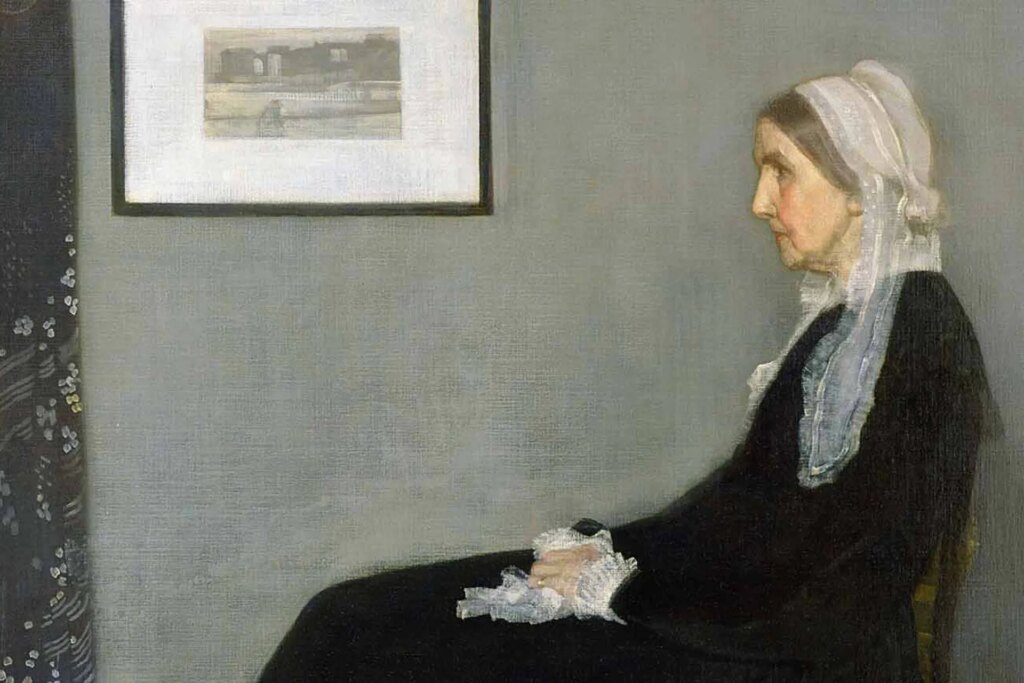

Four years in the making, Tate Britain’s blockbuster summer exhibition on the American painter and printmaker James McNeill Whistler is the starting point for a globe-trotting and idiosyncratic entry in the Exhibition on Screen series, just like its subject.
The film, which takes its name from the exhibition, is set to be followed in the first half of 2027 with two films on major Impressionists, so it seems the perfect time to look at Whistler. But it’s quickly established that he was, in many ways, ahead of the movement; he wasn’t at the forefront of either the French or British scenes, but forged an avant-garde path of his own.
Whistler makes an impressive subject and host. A stage-bound prologue theatrically introduces his voice, with plenty of subsequent excerpts taken from his writing sliding between expert talking heads. This was an artist who rarely doubted his ability—his letters frequently praise his work (“charming head”). It’s no wonder Oscar Wilde observed he ‘spells Art with a capital I’. But as he’s described as where the ‘culture of personality’ starts, Whistler had a brand and a legend to build.
That curated mythology poses the film’s first challenge, as it must navigate a wilfully obscured biography. Despite claiming a heritage in the southern United States, he hailed from Massachusetts and, after some early time in England and three doomed years at West Point Military Academy (where he at least learned invaluable etching skills), arrived in Paris full of knowledge and drive.
Tate’s exhibition, the artist’s first major retrospective in 30 years, deliberately covers the scope of Whistler’s career, but that doesn’t mean the film can plant sticks in London. It also visits the French capital, Venice and the National Museum of Asian Art in Washington D.C. In the last third, it heads behind gallery walls to explore the Tate-led study into the artist’s technique and method, amusingly called Whistler’s Finish.
It’s here that the sharpest revelations into this “complicated showman” hit home:
Whistler’s absolute approach to his art and the groundbreaking style that developed from it. In Paris, he developed the realism of Gustave Courbet into a briefer, lighter technique. It became more of an… Impression. But when one finished work was dismissed as a sketch, he picked up his brushes in pique and headed across the Channel (“It is England mon chere that welcomes artists with both hands,” he wrote in one letter).
Not that Whistler didn’t dwell on his paintings. A later story recalls a subject who threatened to walk out after 90 sittings, earning the brilliant response from the artist, “Look at me a minute longer, and you will look forever.” That poetry was there in his life, on the page and on the canvas. Director David Bickerstaff’s film delicately works through that innovation on the canvas as much as the larger-than-life personality behind it. From the early influence of Japanese art to later on, when the film studies ‘Arrangement in Black and Brown: The Fur Jacket’ a sumptuous and startling portrait where the top half dissolves to primed canvas.
In the company of curators, historians and critics, the film excels at drawing out Whistler’s approach, as it examines his “brevity that intensified the beauty” in portraits, or in his extraordinary etches and studies of cities, particularly the River Thames, an ongoing dialogue with Baudelaire’s observation on “the profound and complicated poetry of a vast metropolis.”
His “colourful and acerbic” writing includes the brilliantly named tome ‘The Gentle Art of Making Enemies’, which outlines one of his most notorious feuds over one dazzling Japanese-inspired interior design, now relocated from London to America. But beyond that, his fondness for naming his paintings after musical terms, “arrangements and harmonies,” spins out the fascinating character. Described early on as “Elegant, beautiful, dangerous,” and shown to be all three, it’s Whistler’s absorption in the technique and poetry of his work that shines through.
Helped by its extraordinary subject, James McNeill Whistler may be a peak for the series, enthrallingly combining art, geography, history, and biography in its winning format.
Exhibition on Screen: James McNeill Whistler is in cinemas now.