
‘The FFI jury said Gondhal is the best film in terms of overall quality — the sound, background music and cinematography.’
‘In every aspect, I don’t think this film can be compared to other Indian films. This may sound like overconfidence, but we know what we have done.’

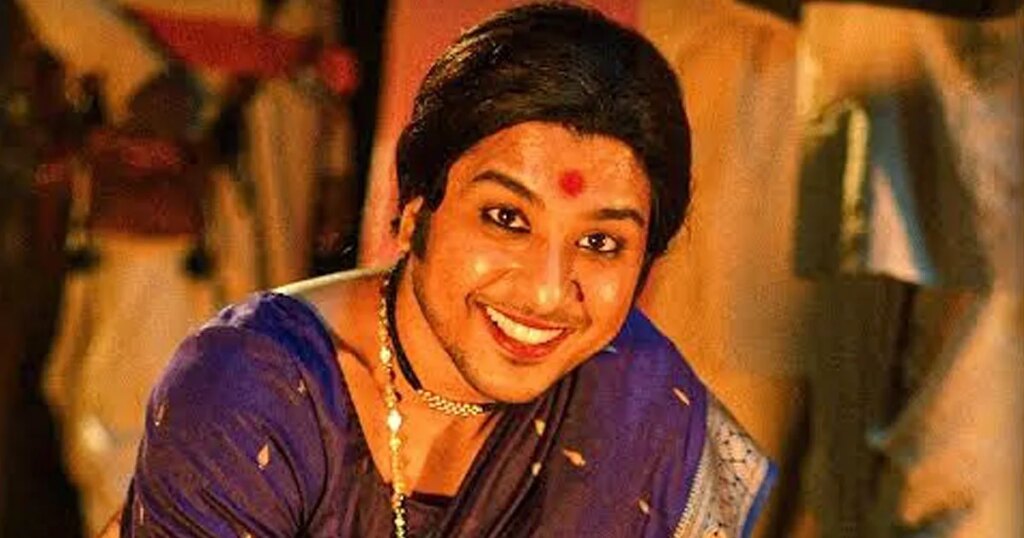
IMAGE: Anuj Prabhu in Gondhal.
Key Points
- ‘As India’s official Oscar entry, we have a huge responsibility. It is a huge blessing from the Indian government and the FFI jury members. There is a kind of nervousness, but my team is ready for this.’
- ‘When I had gone to Cannes, I noticed that the perception of Indian films there was often about poor people or the caste system. These are important issues, of course, but I felt that I had to change the perception of Indian films.’
- ‘I am proud of our rich heritage and culture, and I wanted to represent that through cinematic language at an international level.’
Ever since the Oscar news for the Marathi film Gondhal broke on September 18, its director Santosh Davakhar‘s phone hasn’t stopped ringing with congratulatory calls and messages.
As we sit down for the interview, his two cell phones, neatly placed on the table in front of him, buzz every few minutes. At one point, he pauses the interview to take a call, before cheekily saying, “I don’t want them to feel I have gone arrogant after the big news!”
We get back to the conversation and Davakhar takes us through the journey of his debut feature, a film made largely with fresh faces, which went past big titles like Dhurandhar, Hanuman Ansh, Dorothy, Bison: Kaalamadan, Haq, Ikkis, andMain Vaapas Aaunga to become India’s entry for the 99th Academy Awards.
Davakhar says he had planned to take Gondhal the independent route to the Oscars, but the jury’s decision has added to his confidence and excitement.
Written, produced and directed by Davakhar, Gondhal is a tribute to his native town in Maharashtra, where the traditional folk art form of gondhal is deeply rooted in the local culture and traditions.
A native of Sinnar in Nashik district, Davakhar is an IIM alumnus but his journey didn’t start there. At 14, he worked as a daily wager in 12-hour shifts for a meagre Rs 45.
“The situation at home was weak, so that money was very important. I did whatever work I could find. I even distributed pamphlets outside my college in front of my friends. Because, at that time, even Rs 50 was very important,” the filmmaker tells Mayur Sanap/Rediff in the first of a two-part interview.
Who broke the Oscar nomination news to you? What was your first reaction?
After the application, I was expecting the results on September 18-19. When I called the FFI (Film Federation Of India), they told me we could get the results on September 18, at 3 pm.
We were glued to our screens by 2:30 pm.
At 3.30 pm, we started getting calls from everyone. It was a happy shock.
But let me tell you, we were prepared for this.
Sending this film to the Oscars is my dream. For the past two years, we had planned everything strategically. We have already hired media PR team from LA. We have hired a social media team from Finland. We were getting ready for this because we had planned to go independently.
Now, as India’s official Oscar entry, we have a huge responsibility. It is a huge blessing from the Indian government and the FFI jury members. There is a kind of nervousness, but my team is ready for this.
How have you mapped out the next six months?
The lobbying process is a different beast altogether.
There are more than 10,000 voters in the Oscars, so you need to do screenings and screenings and screenings. Just show your film to as many voters.
We are going to start screenings at various places in the US from next month. We are going to travel a lot.
There is a sense of pride among the entire Gondhal team. It feels like we are going to represent India at the Olympics.
Marathi cinema has had Shwaas, Harishchandrachi Factory and Court as Oscar entries, but it has taken 11 years for another Marathi film to reach this stage. Why do you think Marathi cinema is still struggling to get it right?
When my film released last year, there was an audience perception that only one or two Marathi films are good in a year.
They have a perception that if I want to spend Rs 250 in a theatre, I will rather watch a film worth Rs 50 crores Rs 60 crores (Rs 500 million to Rs 600 million). Why would I watch a film worth Rs 2 crores, Rs 3 crores (Rs 20 million to Rs 30 million)?
They would rather watch a Marathi film on OTT.
Sometimes, there are directors who want to make good films, and come up with new ideas. But most of the time, they don’t get a producer.
Sometimes, directors don’t have funds for marketing. That’s why the Marathi audience quickly accepts Hindi films.
If you look at the South Indian audience, they support their own films more and don’t accept Hindi films easily. That’s why their films are more popular, and their stars can charge Rs 100 crore (Rs 1 billion). In Marathi films, none of our stars get even Rs 1 crore (Rs 10 million) as fees.

IMAGE: Kishor Kadam in Gondhal. Photograph: Kind courtesy Santosh Davakhar/Instagram
Except Kishor Kadam, the film has a mostly fresh cast. Was it difficult to convince established actors to come on board?
I did approach some established actors. But when I told them I wanted them to dance in a sari, they rejected the film.
But I was not disappointed.
I knew that’s how the industry looks at a new director.
I needed Kishor Kadam for that long, one-take shot in the beginning of the film. His diction was important for that scene.
Most of the time, celebrity actors don’t allow retakes but Kishor Kadam gave me 28-30 retakes for that one scene. It would take 10 to 12 minutes for just one shot. And then to set the shot again, it would take half an hour, and then the next shot. But he remained calm throughout the process. The hardcore artists are different.
The film did average business at the box office when it released in cinemas last year. How did you feel about that?
We were ready to release the film in Hindi, Malayalam, Kannada, Tamil and Telugu within seven days. But I wanted the film to release in Marathi first.
Look at how Kantara was first embraced by the Kannada audience and then reached audiences across India after two weeks of its release.
But somehow, people didn’t watch it. What can I do about that? I can’t force people to watch my film.
They will spend Rs 500 on pizza and Rs 1,000 on Dhurandhar. I want to tell the audience to come out of the OTT bubble and watch films in cinemas. Language shouldn’t decide whether a film is good or bad. We should watch all kinds of cinema.

IMAGE: A scene from Gondhal. Photograph: Kind courtesy Santosh Davakhar/Instagram
Did Gondhal not find any OTT takers after its release?
We have a contract with Amazon, but I have the rights to release it. I am not releasing it on OTT purposely, and the Marathi audience is responsible for that.
Many people come to me and tell me they saw the film and liked it a lot. When I ask them where they saw it, they say they watched it on Telegram.
There are people who wait for the pirated link. They don’t know how much effort goes into making a film. It took me two years to make this film.
The FFI jury said Gondhal is the best film in terms of overall quality — the sound, background music and cinematography.
In every aspect, I don’t think this film can be compared to other Indian films. This may sound like overconfidence, but we know what we have done.
If people are going to watch the film through a 400 MB pirated link, what should I show them on OTT?