
System Integrator Singapore Vision Rules for Medical Inspection
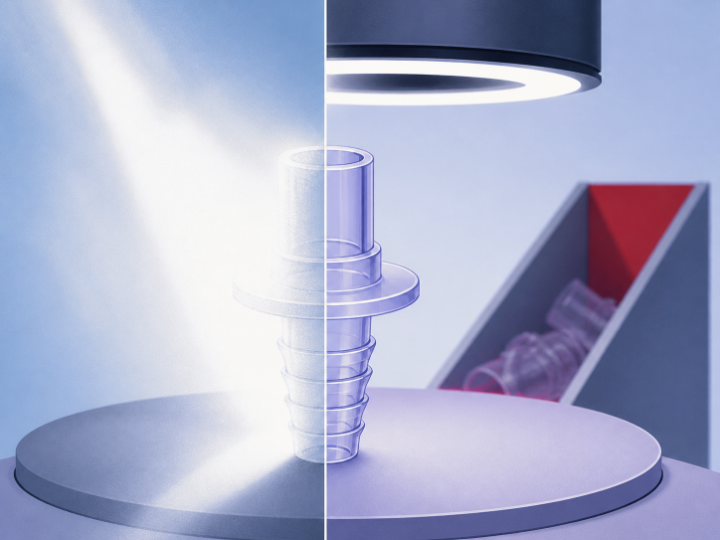
A cinematographer can change the audience’s reading of a face by moving one light. Machine vision has a less forgiving version of the same problem. A scratch, incomplete edge, cap position, or printed mark only becomes inspectable when the camera receives a stable image in which the relevant difference is visible.
That is why a medical manufacturer comparing a system integrator Singapore proposal should look beyond camera resolution. Part presentation, lighting angle, reflections, exposure, recipe control, and the physical reject path often decide whether an inspection can make a repeatable production decision.
Motionwell Automation describes medical-device systems using Keyence and Cognex vision, LED ring or dome lighting, rotary presentation, programmable recipes, position compensation, OK/NG sorting, and serial-linked inspection records. Those mechanisms support a practical rule: fix the image-forming conditions before buying more pixels.
Bigger Cameras Cannot Repair Uncontrolled Light
A higher-resolution sensor records more detail, including unstable detail. If a polished medical component reflects a ceiling lamp differently at each rotation, the resulting bright patch can resemble a defect or hide one. More pixels describe the reflection more precisely; they do not make the decision more reliable.
The inspection team should begin with the feature that matters. Is it looking for a broken contour, missing component, surface mark, fill level, printed code, dimensional edge, or assembly position? Each feature needs a different relationship among camera, lens, part, and light.
Freeze the Part Before Judging Its Surface
Part presentation is the first lighting control. A fixture, rotary platform, guide, or feeder should place the feature within a known range of position and angle. If the component rolls, tilts, or sits at different heights, illumination and focus change even when the light source remains fixed.
Some variation can be corrected in software. Motionwell Automation describes real-time position and angle compensation that sends offsets to a robot or servo. That is useful for bounded presentation variation. It should not become a substitute for a fixture that lets the part wander beyond the optical design.
Lighting Geometry Decides Which Defects Appear
Lighting should create contrast for the chosen defect while suppressing irrelevant texture. A ring light can illuminate around the lens axis, dome lighting can soften directional reflections on curved surfaces, and backlighting can make an outer contour easier to judge. The best choice depends on the material and feature, not the camera brand.
- Outer contour
- Useful image condition: Strong edge separation from background
- Common visual failure: Fixture or shadow merges with the part
- Reflective surface mark
- Useful image condition: Controlled, repeatable reflection
- Common visual failure: Glare masks the mark or mimics damage
- Printed code
- Useful image condition: Even contrast and stable focus
- Common visual failure: Hot spots erase characters
- Assembly presence
- Useful image condition: Clear feature from expected viewpoint
- Common visual failure: Occlusion hides a missing component
- Angular position
- Useful image condition: Repeatable reference features
- Common visual failure: Symmetry creates an ambiguous match
The table is a starting point for sample trials, not a universal optical recipe. Real materials, finishes, molding variation, lubricants, transparent sections, and packaging films can change the image. The project team needs known-good and known-bad parts that represent normal production, not only dramatic demonstration defects.
Challenge Glare Before Tuning the Algorithm
Move the part through its allowed rotation and height range while watching the raw image. If the defect disappears under a highlight or a good surface becomes dark enough to fail, adjust the light, optics, shielding, or presentation before adding processing complexity. Stable illumination makes thresholds and learned features easier to control.
Matte fixtures, enclosed optical spaces, and blocking stray ambient light can be as important as the chosen lamp. The objective is a scene that behaves the same across shifts, not a beautiful image under commissioning conditions.
Use multiple views only for hidden features. A rotary platform or additional camera is justified when one view cannot expose every required feature. Motionwell’s published medical inspection example includes a servo-driven rotary platform for 360-degree contour inspection. The rotation should follow a defined set of views and acceptance rules rather than collecting angles without a decision plan.
Each extra view adds timing, calibration, data, and possible failure points. Use it to answer a feature question that the first view cannot answer.
Recipes Need Physical Lighting Conditions Too
A vision recipe may store exposure, inspection regions, thresholds, feature models, and product-specific tolerances. It cannot guarantee that the correct fixture, light position, lens setting, or part orientation is present. A recipe change therefore needs a physical verification step.
The medical-device work described by Motionwell Automation includes programmable multi-recipe inspection and product-family changeover through the HMI. A buyer should ask how the delivered machine prevents a recipe from being paired with the wrong mechanical setup and how that pairing is checked after maintenance.
Store Reference Images With Approved Conditions
For each product recipe, keep reference images or challenge samples that show the approved presentation and the defects the station must distinguish. After a camera, lens, lamp, fixture, or software change, rerun the reference set before returning to production.
The comparison should use raw or consistently processed images, not screenshots resized for a report. Record the recipe version and relevant hardware condition so a later team can understand why the image changed.
Revalidation should also follow gradual physical changes. Lamps age, protective windows collect residue, fixtures wear, and a camera bracket can shift during maintenance. A scheduled reference check can reveal image drift before operators compensate by widening limits or repeatedly retraining the recipe.
Lock adjustments that change the decision. Exposure, gain, focus, inspection limits, and rejection thresholds can all change pass/fail behavior. Access should match responsibility, and consequential edits should be recorded. An operator may need a controlled way to select a recipe without receiving permission to rewrite its acceptance boundary.
Sorting Must Confirm the Camera Decision
A vision system produces a decision in software. Production quality depends on what happens to the physical part next. If a failed component remains in the good stream because of timing, air pressure, a full reject bin, or a jammed gate, perfect classification has not protected the batch.
Follow One Failed Part Into the Reject Bin
Run a known failure, observe the camera result, and track the same part through the sorting action. The cell should confirm segregation or enter a defined fault state. Reject counts and reason codes should match what physically leaves the process.
Motionwell Automation describes OK/NG auto-sorting, SCARA handling, inspection data linked to serial numbers, and automated reject handling in medical applications. Acceptance should connect those elements as one evidence path rather than approving the camera and sorter in isolation.
Review False Calls With the Original Image
When quality disputes a result, retain the inspection image, measurement, recipe, and part identity needed for review. A false reject may signal overly sensitive limits, while a false accept may expose weak contrast or an incomplete defect definition. Without the original image and setup context, teams are left arguing from memory.
Review a small set of disputed images by defect family rather than adjusting the station after every complaint. The pattern may point to one reflective batch, one fixture position, or one lighting condition. That evidence supports a targeted optical or recipe change and a defined regression test.
Fix the Light Path Before Adding Resolution
Choose one consequential defect and build the optical scene around it. Control how the part arrives, select lighting that exposes the feature, challenge the allowed variation, lock the recipe to the physical setup, and prove that a failed part leaves the good stream.
Only then ask whether additional resolution, another camera, or a more complex algorithm adds useful information. Medical inspection becomes reliable when the image and the physical decision remain stable together, not when the camera specification looks impressive on its own.