
‘I’m an ‘industry child’ and my parents were both extremely successful in the same film industry. Yet, they were helpless to ensure my success.’

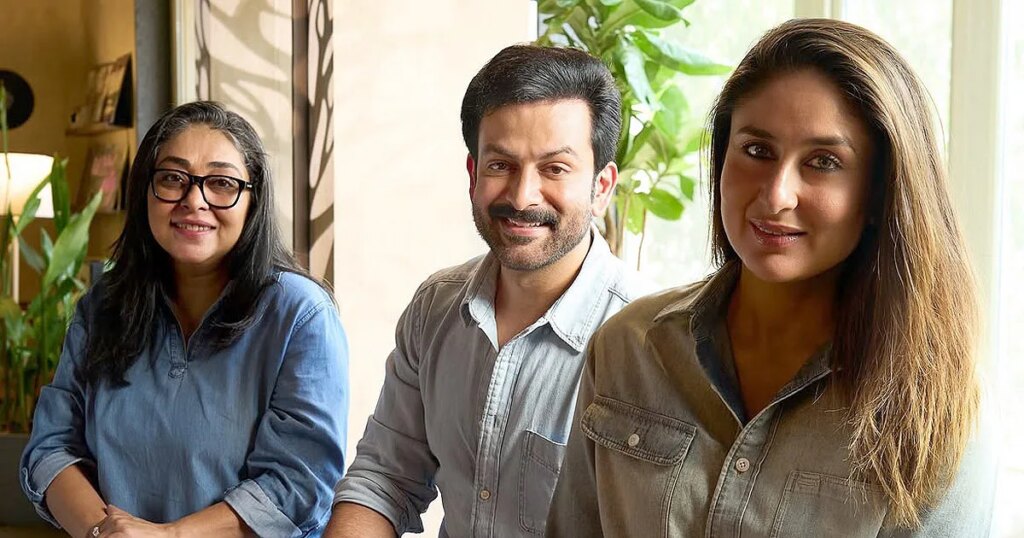
IMAGE: Meghna Gulzar with Daayra actors, Kareena Kapoor and Prithviraj Sukumaran. Photograph: Kind courtesy Meghna Gulzar/Instagram
Key Points
- ‘If your last film is not successful, it’s difficult to get the next. That’s the problem I faced.’
- ‘Irrfan sir never let me know which side Ashwin Kumar believed, I still don’t know. You can’t guess from his performance and that was his strength as an actor.’
- ‘Samay is interested in films, both behind the lens and in front of it.’
Meghna Gulzar did not have an easy journey as a filmmaker.
Despite being the daughter of two celebrated names, Gulzar and Raakhee, she spent years struggling to find her place in the film industry.
Her latest film, Daayra, may not have done well at the box office but the reviews have been encouraging.
In the second part of an interesting conversation, Meghna tells Rediff Senior Contributor Roshmila Bhattacharya, “I’m a living example that nepotism doesn’t pay. If it had, there wouldn’t have had these ‘stagnant’ years.”
Even though you debuted successfully with Filhaal, between Dus Kahaniyan and Talvar was a decade when you were stagnant as a director despite being an ‘industry child’ with parents, Gulzar and Raakhee, who were very successful in their own fields.
(Laughs) Yeah, and that was an irony really. I’m a living example that nepotism doesn’t pay.
If it had, there wouldn’t have had these ‘stagnant’ years.
Even Filhaal was actually appreciated retrospectively, when it was released in 2002, I don’t think the audience was consuming this kind of content the way they are today. And in this business, you are only as good as your last film.
If your last film is not successful, it’s difficult to get the next. That’s the problem I faced.
It was even more difficult for my parents because, as you rightly pointed out, I’m an ‘industry child’ and they were both extremely successful in the same film industry. Yet, they were helpless to ensure my success.
They knew I wouldn’t let them make any calls to set up meetings with producers and request them to make a film for me. They themselves wouldn’t have wanted to do that for me.
So, how did you negotiate this professional low early in your career?
Somewhere along the way I decided to look inwards.
Since I couldn’t change my sensibilities, telling myself that things would happen professionally when the time was right, Govind (husband) and I decided to start a family.
My son was born in 2010, three years after Dus Kahaniyan released. After that, for the next three-four years, I did not go out and do anything because I wanted to raise Samay myself.
When my son was around four-and-a-half years, Vishal sir (Bhardwaj, who scripted and co-produced the film) discussed Talvar with me.
In the course of that conversation, he actually said, ‘How long are you going to hide behind your son?’
I returned to direction with Talvar; it did well, I got to make my next film. Slowly, stories started finding me and they resonated with my audience too.
That’s why my films worked and I worked as a filmmaker.
(Laughs) It’s not as if I changed my surname.

IMAGE: Irrfan Khan in Talvar.
A memory of Irrfan Khan Talvar brings back?
More than a memory, it’s a sensation which has stayed with me.
The day Irrfan sir agreed to do the film, he asked me to take him through the entire case. Not just from the point of view of his character, Ashwin Kumar, but in its entirety
I took him through the script, point by point, milestone by milestone. I kept talking and asking counter questions.
He played the Devil’s advocate.
What if this was not how it was?
What if that’s how it happened?
I was coming from whatever was reported in the press, the the trial coverage.
It’s a myth that Talvar was based on Avirook Sen’s book Aarushi, which came out later.
Irrfan sir never let me know which side Ashwin Kumar believed, I still don’t know. You can’t guess from his performance and that was his strength as an actor.

IMAGE: Konkona Sen Sharma and Neeraj Kabi in Talvar.
Given that it deals with police procedure and an investigation while also produced by Junglee Pictures, was Daayra conceived while you were working with Talvar?
No. The story idea came to me from Junglee Pictures in 2020, during the pandemic lockdown when I was prepping for Sam Bahadur.
It was a four to five-page brief, sketching out the basic idea.
The topic resonated with me primarily because unfortunately, it’s extremely frequent in the world we live in and so very troubling for anybody with a conscience.
Being a woman and a mother, the resonance was far more from me.
So, why did it take you six years to bring Daayra to the screen?
I had told Junglee Pictures that I definitely wanted to do the film and would start collaborating with the co-writers, Sima Agarwal and Yash Keswani.
But we also knew that I would only be able to make it three years later, after the release of Sam Bahadur.
Fortunately, that did not deter anybody because we knew the topic would not get outdated which is a tragedy in itself.

IMAGE: Vicky Kaushal in Sam Bahadur.
How gratifying was it winning the National Award for Sam Bahadur?
When the country appreciates you for making one of the best films on national integration and promoting social and cultural values, there can be no bigger validation.
For the team and me, our first accomplishment was that not a single person from any of the armed forces could point to a fault with the uniforms or the medals.
The National Award was the fulcrum and culmination of all our hard work.
Behind every successful man is a woman and vice vera. When you make these challenging films and come home physically and emotionally drained, how does your husband, Govind heal you?
Fortunately for me, now there’s not one man, but two.
My son is 16 and understands that what I do is not easy. I know the child in Samay still wants his mother’s attention, to share everything he has done with me, when I return from a shoot. But he gives me time to decompress.
When I am not around to oversee, he does his own thing responsibly.
As for my husband, Govind replenishes me through my stomach. He will cook one of my favourite dishes because he knows that there are times when all I need is the comfort of a good meal and sleep.
Just to have that, along with his support, respect, emotional backing and the day-to-day small gestures makes me feel tremendously blessed.

IMAGE: Meghna’s husband Govind, son Samay, mother Raakhee and father Gulzar. Photograph: Kind courtesy Meghna Gulzar/Instagram
What are these favourite dishes Govind cooks for you?
Oh, there are many, including a really good Thai curry which I love.
He also makes a kind of mutton curry with just green chillies and sometimes the same preparation with red chillies.
When he knows I have had a tough week and I’m exhausted, he will make one of these dinners for me. After that, he will let me sleep.
Of course, we make sure the next day is a holiday.
He knows I will not have a full meal unless I have a day of rest because otherwise it pulls me down.
Is your son showing any signs of following in your footsteps?
He is interested in films, both behind the lens and in front of it.
Samay is also an avid sportsman, a really good football player.
Right now, all he hears from us is to please just complete his education, then he can do what he wants.
(Smiling) That’s what both Govind and I were told by our parents too.
Photographs curated by Satish Bodas/Rediff