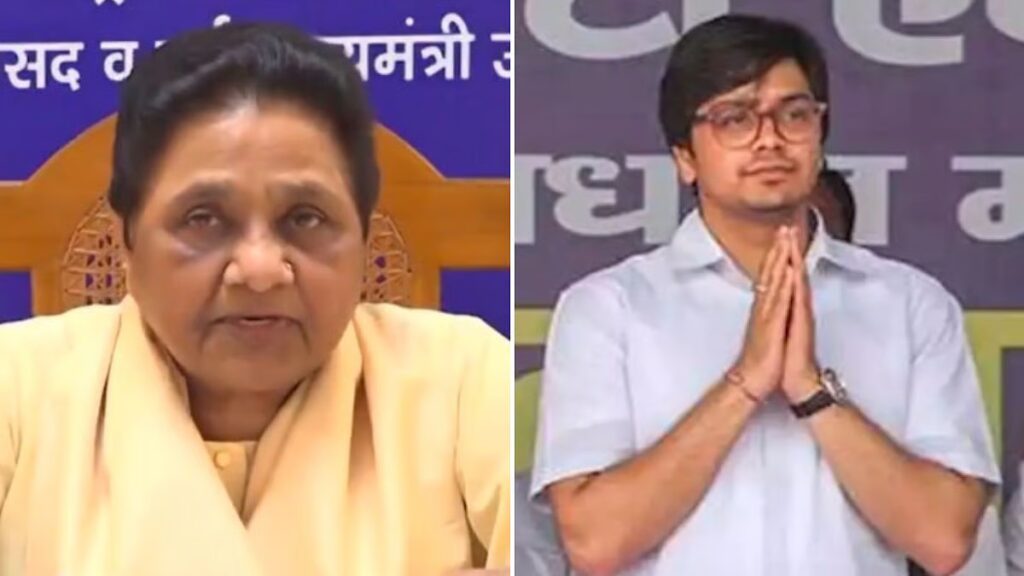

Akash Anand’s repeated removal from key BSP responsibilities has renewed focus on the party’s leadership transition ahead of the 2027 UP elections | File Pics
For Akash Anand, Mayawati’s latest decision is more than the loss of another organisational post; it raises a larger question about his political future in the Bahujan Samaj Party and whether the woman who once projected him as her successor still considers him ready to inherit the organisation she has built over decades.
Mayawati removed Anand as national coordinator at the BSP’s national executive meeting earlier this month, citing his lack of political maturity. With elections approaching, she made it clear that she did not want to give him a major responsibility when she felt he was not equipped to handle the political tactics of rival parties.
But what has gone wrong between Mayawati and the nephew she once presented as the BSP’s future?
Contrasting Political Styles
The most obvious problem is the difference in their political styles. Mayawati’s politics has always been built around tight organisational control, carefully calibrated messaging, and calculated political positioning. Anand has attempted to create a more combative image, attacking rival parties and leaders with a directness that is markedly different from his aunt’s style.
His speeches have increasingly become a source of concern. He has attacked the Congress and Samajwadi Party, spoken strongly on reservation, and targeted the RSS. His latest intervention, reportedly a sharp attack on both the BJP’s state and central governments, appears to have been the immediate trigger for the latest action.
The problem for Mayawati is not necessarily that Anand is critical of the BJP or other parties. The BSP has never been politically passive. The concern appears to be whether Anand understands when confrontation advances the party’s interests and when it merely creates another political controversy.
That distinction matters at a time when the BSP is struggling to rebuild its electoral base. Anand’s difficulties, however, are not confined to his public speeches. His growing influence also appears to have unsettled sections of the party organisation. He had begun questioning inactive office-bearers and demanding greater accountability. While that could be an effort to revive an organisation that has lost political ground, it could also alienate leaders who have operated within Mayawati’s tightly controlled system for years.
The question, therefore, is whether Anand was attempting to inject new energy into the BSP or moving too quickly to establish himself within an organisation where authority has traditionally flowed from one centre.
A Repeated Cycle Of Appointments
The chronology of his rise and fall makes the latest decision even more significant. On December 10, 2023, Mayawati announced Anand as her successor and appointed him national coordinator. Five months later, during the Lok Sabha election campaign, she removed him from all responsibilities, describing him as politically immature.
On June 23, 2024, she restored him as successor and national coordinator. The relationship broke down again in March 2025. Anand was removed from all responsibilities on March 2 and expelled from the party the next day. Mayawati later forgave him but did not restore his position as successor.
Even then, she gave him another opportunity. Anand was appointed chief national coordinator in May 2025 and was given the newly created post of national coordinator in August.
His latest removal is, therefore, difficult to view as an isolated disciplinary action. It shows that repeated attempts to settle the question of Anand’s role have failed.
Succession And Party Control
That failure points to a deeper problem. Mayawati may have wanted Anand to represent generational change without allowing him to alter the political character of the BSP. Anand, meanwhile, appears to have sought an identity of his own.
Can the BSP accommodate both? There is also a larger succession dilemma for Mayawati. She has built the party around the idea that political responsibility must come from organisational commitment rather than family entitlement. At the latest meeting, she again stressed the interests of the Bahujan movement over family considerations and recalled Kanshi Ram’s decision to devote his life to the movement.
This is more than a defence of the latest action against Anand; it appears to be an attempt to prevent the BSP from being defined as a family-controlled party.
Yet, the presence of Anand’s younger brother Ishan at the national executive meeting, alongside their father and BSP national vice-president Anand Kumar, has inevitably generated speculation. His presence by itself does not establish that Mayawati is preparing another family member for a larger role. But it demonstrates that the next generation of the family remains around the organisation even as Akash Anand’s position becomes increasingly uncertain.
The Road Ahead For Anand
Mayawati’s dilemma is clear. She needs a younger leadership capable of connecting with voters beyond the BSP’s traditional support base. At the same time, she appears to be unwilling to surrender control to a successor whose political instincts she does not fully trust.
Anand’s challenge is equally clear. He cannot build a political future merely by being Mayawati’s nephew or by occupying senior organisational posts. He has to establish that he can read the political terrain, manage the organisation, and give the BSP a sharper voice without creating liabilities for the party.
For now, Mayawati has chosen caution over succession. The latest setback may still not be the end of Anand’s political journey. Mayawati has reversed course before. But each reversal reduces the credibility of the idea that the BSP’s succession has already been settled.
The more consequential question is no longer whether Anand will receive another post; it is whether Mayawati can find a way to transfer political authority without compromising the organisational model that has kept the BSP under her control for decades.
Until that balance is found, Akash Anand’s future in the BSP will remain uncertain.
The writer is a senior journalist. Views expressed are personal. The writer can be contacted on X: @biswajeet01