
When Agnes Carberry was sitting at her desk and a bomb went off, she didn’t know what was happening until glass came crashing down on top of her and everyone was running from the building.
A deaf woman, she had been working as a seamstress in a building opposite the Europa Hotel in Belfast during the Troubles.
‘Out of the blue there was this massive explosion, I shook my head and bits of glass fell from my hair,’ says Agnes.
‘I stepped outside, saw this black cloud of really thick smoke and I felt the fear start to grow. I’ll never forget that day. I was totally on my own and felt like everybody knew what was happening but me.’
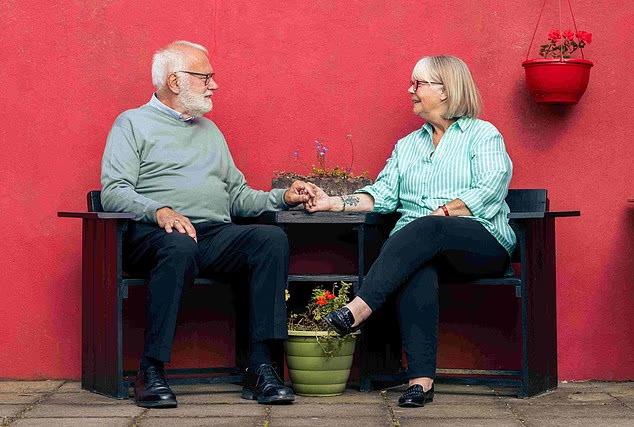
Though Agnes, 76, is Protestant and her husband John, 76, is Catholic, the pair were determined not to let that separate them in the then-divided North.
The couple have been together for around 65 years and their story is one of three told in Ireland’s first feature length documentary told through Irish Sign Language (ISL), A Quiet Love.

Though Agnes, 76, is Protestant and her husband John, 76, is Catholic, the pair were determined not to let that separate them in the then-divided North

British troops stand guard as bomb experts search through the wreckage after a terrorist bomb had wrecked the ground floor on the Luxury Belfast Europa Hotel in 1975
The documentary will have its television premiere on TG4 next Saturday night.
‘When Agnes does the sign for ‘bomb’, it’s the only sign in the whole film that’s not subtitled,’ says one of the film’s producers, Anne Heffernan.
‘The way she describes it is so powerful you’re left in no doubt about what she’s talking about.’
With no subtitles available on televisions, it was difficult for deaf people to understand what was going on during the Troubles, and they were reliant on those around them for information.
Charity calls for hearing screening for everyone over the age of 50
Chime, Ireland’s National Charity for Deaf and Hard of Hearing people, will be testing the hearing of our TDs and senators this week in a bid to raise awareness during this year’s International Week of the Deaf.
The charity will do so as part of its call for hearing screening for everyone over 50, at an event that is being held in Leinster House this Tuesday, September 22.
The group will also address representatives on the delay in publication of a long- promised Department of Health National Hearing Care Plan at 1.00pm.
The introduction of hearing screening for everyone over 50 would lessen the risk of dementia, the country’s leading Deaf and Hard of Hearing charity says.
The move, to bring Ireland in line with the World Health Organisation (WHO) guidelines, should come as part of the long-awaited National Hearing Care Plan.
The Department of Health’s delay in publishing the plan, which was originally due to be delivered in June 2025, has been criticised by Chime, which says over-50s screening would increase awareness and allow early intervention, preventing consequences of unaddressed hearing loss.
In addition to dementia these include depression, social isolation and overall physical and mental decline.
Chime says that there are approximately 300,000 adults in Ireland with significant hearing loss, but research data indicates that hearing aid take-up here is one-third less than it is in the UK.
‘They were very dark days for deaf people,’ says John.
‘Throughout the Troubles, the deaf community were like a family.
‘We would never have asked our deaf friends what their religion was, we just saw ourselves as all being part of the same family.
‘With all the bombs, shootings and violence, we were cut off from meeting each other. It was awful.’
The couple now live in Glengormley in Northern Ireland, where they have been for 54 years and they have five children and 10 grandchildren.
In 2009, John was awarded an MBE for his services to the community through deaf awareness courses and teaching hearing people to sign.
Ms Heffernan and her co-producer, Seán Herlihy, had had the idea for the documentary for years, and Agnes and John’s story was the perfect starting point.
‘They had this extraordinary love story that hadn’t been heard before in a mainstream environment,’ she says.
‘When we saw ourselves on screen it was unbelievable.
‘It was the first time we had ever exposed what we had otherwise kept hidden because it was our private lives,’ recalls John.
Agnes was diagnosed with breast cancer in March 2025 and was undergoing chemotherapy when the film first opened on the big screen.
On her eighth week of treatment, she asked her consultant if she could miss one session to go and see the film.
She says when she watched the documentary, she was moved.
‘Seeing the film was very emotional for me,‘ she recalls. ‘It was lovely to see my hair because it was longer.
‘When I went to see it, I had lost my hair because of the treatment. It took about a year and a half to complete the film and it was worth persevering through it. It was a fantastic experience.’
John says that their story was a forgotten one.
‘There are a lot of books and programs that talk about the history of the Troubles but there’s never been any mention of deaf people.
‘I think it’s very important for hearing people to see what we went through. They were hard times for us as well.’
Directed by Garry Keane, the documentary also features Kathy and Michelle, a same-sex couple navigating parenthood with deaf and hearing children, and Seán, a deaf boxer who is facing a life-changing decision with his hearing partner, Deyanna.

The documentary also features Kathy and Michelle, a same-sex couple navigating parenthood with deaf and hearing children
Ms Heffernan says: ‘Each story is so layered that there’s something in it that everyone can relate to and connect with.
‘They’re love stories at the end of the day, and who doesn’t love a good love story?’
At the start, there was some uncertainty over how the film would be received – and some people had even called the idea quite radical as it had no voiceover and only subtitles.

The documentary also features Seán, a deaf boxer who is facing a life-changing decision , and his hearing partner, Deyanna
‘Once the film was made, audiences described it as an hour and a half of meditation,’ she says.
‘You have the deaf experience as a viewer, and it allows people to really connect with the stories, because they are focused on the signs and the expressions of the people on screen.’
She adds, ‘It’s really quite a unique viewing experience. We’ve never been to a screening where there’s been a dry eye left anywhere in the house.’
When the film was shown in Derry, a 93-year-old deaf man travelled three hours to see the film.
It was his first time stepping foot inside a cinema because he had never been able to see a movie through sign, and he found it incredibly emotional to see these stories playing out on screen.
‘I think the reaction that people have had is connected to the fact that this was a deaf-led film,’ explains Ms Heffernan.
The documentary has already had a very successful run, playing in over 25 film festivals across five continents and winning many awards including the Audience Choice Award for Best Documentary at the San Diego International Film Festival and also a Global Production Award in Cannes.
Ms Heffernan’s co-producer, Seán Herlihy, is a deaf sign language user himself and there were 32 members of the deaf community involved across production.
‘We wanted to make sure that the film was authentic and accurately told and we couldn’t do that without having that level of involvement and input from the outset,’ adds Ms Heffernan.
She describes a common misconception about the deaf community, that sign language exists to assist the English spoken language.
‘It’s got its own grammar and structure, and it stands on its own two feet,’ she says.
‘It’s 30 per cent what happens on your hands and 70 per cent expressions and when you see that played out without the assistance of a voiceover, it really helps you to understand ISL’s beauty.’
She compares the intimacy of using sign language with the way that hearing people often treat verbal communication.
‘The way they look at each other and put their whole body into communicating is really lovely.
‘To just be wholly present in communication is something that we can all learn from.
‘Running around and shouting words over your shoulder is not the same as having to stop and look at somebody, and give them your full attention when you’re speaking, and there’s just a beautiful romance that comes with that.’
John says they are very much looking forward to seeing the documentary on TV next week.
‘I do hope that the film will make a lot of hearing people become more aware of what it’s like through deafness,’ he says.
‘The main thing to remember is that we are still human and we have feelings like any other person out there. The only thing we aren’t able to do is hear, but that doesn’t stop us.’
‘I think a lot of the barriers that used to exist for deaf people in the past are slowly being lowered,’ says Agnes.
‘We cannot wait to see our film on TG4. We are very proud. It’s just about showing everyone what deaf people can do.’
- An Grá Ciúin is on TG4 this Saturday at 9.30pm.